Oliveira Raphael Gonçalves de, Guedes Dartagnan Pinto
Universidade Estadual do Norte do Paraná (UENP), Centro de Ciências da Saúde. Alameda Padre Magno, 841, Nova Alcântara, Jacarezinho, PR, CEP: 86.400-000, Brazil.
Universidade Norte do Paraná (UNOPAR), Centro de Pesquisa em Ciências da Saúde. Rua Marselha, 591, Bairro Piza, CEP: 86.041-140, Londrina, PR, Brasil.
BMC Pediatr. 2018 Feb 7;18(1):33. doi: 10.1186/s12887-018-1030-1.
It is not clear which is the best anthropometric indicator to predict metabolic syndrome (MetS) in adolescents. Our objective was to identify the predictive power, with respective cut-off points, of anthropometric indicators associated with the quantity and distribution of body fat for the presence of MetS and to determine the strength of the association between the proposed cut-off points and MetS in adolescents.
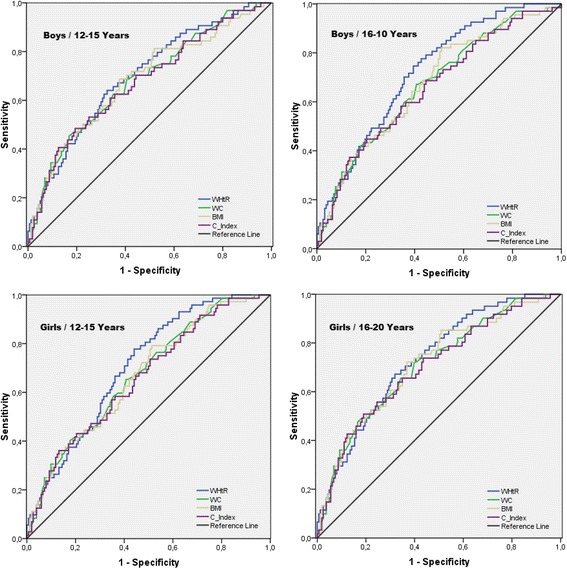
The sample consisted of 1035 adolescents (565 girls and 470 boys) aged between 12 and 20 years. Four anthropometric indicators were considered: waist circumference (WC), body mass index (BMI), waist-height ratio (WHtR), and conicity index (C-Index). MetS was defined according to the criteria of the International Diabetes Federation. Predictive performance was described through analysis of Receiver Operating Characteristic (ROC) curves with a 95% confidence interval. The most accurate cut-off points were identified through sensitivity, specificity and Area Under the Curve (AUC) values.
The four anthropometric indicators presented significant AUCs close to 0.70. At younger ages (12-15 years) the girls presented a statistically greater capacity to discriminate MetS; however, at more advanced ages (16-20 years) both sexes presented similar AUCs. Among the anthropometric indicators investigated, regardless of sex and age, the WHtR showed the highest discriminant value for MetS, while the C-Index demonstrated a significantly lower capacity to predict MetS. The AUCs equivalent to WC and BMI did not differ statistically. The proposed cut-off points for WHtR (12-15 years = 0.46, 16-20 years = 0.48) presented the highest values of sensitivity and specificity, between 60% and 70%, respectively.
Considering that the best AUC was found for WHtR, we suggest the use of this anthropometric indicator, with the cut-off points presented herein, for the prediction of MetS in adolescents with characteristics similar to the study sample.
目前尚不清楚哪种人体测量指标最适合预测青少年的代谢综合征(MetS)。我们的目标是确定与体脂数量和分布相关的人体测量指标对代谢综合征存在情况的预测能力,并确定所提出的切点与青少年代谢综合征之间关联的强度。
样本包括1035名年龄在12至20岁之间的青少年(565名女孩和470名男孩)。考虑了四个人体测量指标:腰围(WC)、体重指数(BMI)、腰高比(WHtR)和锥度指数(C指数)。代谢综合征根据国际糖尿病联盟的标准定义。通过分析具有95%置信区间的受试者工作特征(ROC)曲线来描述预测性能。通过敏感性、特异性和曲线下面积(AUC)值确定最准确的切点。
这四个人体测量指标的AUC均接近0.70,具有统计学意义。在较年轻的年龄段(12至15岁),女孩在区分代谢综合征方面具有统计学上更大的能力;然而,在较大的年龄段(16至20岁),两性的AUC相似。在所研究的人体测量指标中,无论性别和年龄,WHtR对代谢综合征的判别价值最高,而C指数预测代谢综合征的能力明显较低。与WC和BMI等效的AUC在统计学上没有差异。所提出的WHtR切点(12至15岁 = 0.46,16至20岁 = 0.48)的敏感性和特异性最高,分别在60%至70%之间。
鉴于WHtR的AUC最佳,我们建议使用该人体测量指标以及本文提出的切点,来预测具有与研究样本相似特征的青少年的代谢综合征。