Berardelli Isabella, Bloise Maria Carmela, Bologna Matteo, Conte Antonella, Pompili Maurizio, Lamis Dorian A, Pasquini Massimo, Fabbrini Giovanni
Department of Neurosciences, Mental Health and Sensory Organs, Suicide Prevention Center, Sant'Andrea Hospital, Sapienza University of Rome, Rome.
Department Human Neurosciences, Sapienza University of Rome, Rome.
Neuropsychiatr Dis Treat. 2018 Jan 26;14:399-405. doi: 10.2147/NDT.S152221. eCollection 2018.
The aim of the current study was to evaluate whether cognitive behavioral group therapy has a positive impact on psychiatric, and motor and non-motor symptoms in Parkinson's disease (PD).
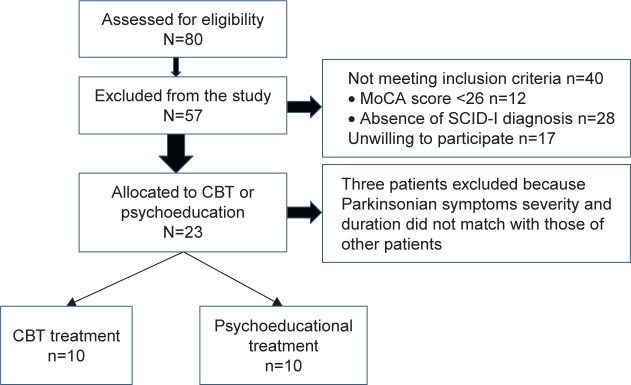
We assigned 20 PD patients with a diagnosis of psychiatric disorder to either a 12-week cognitive behavioral therapy (CBT) group or a psychoeducational protocol. For the neurological examination, we administered the Unified Parkinson's Disease Rating Scale and the non-motor symptoms scale. The severity of psychiatric symptoms was assessed by means of the Hamilton Depression Rating Scale, the Hamilton Anxiety Rating Scale, the Brief Psychiatric Rating Scale, and the Clinical Global Impressions.
Cognitive behavioral group therapy was effective in treating depression and anxiety symptoms as well as reducing the severity of non-motor symptoms in PD patients; whereas, no changes were observed in PD patients treated with the psychoeducational protocol.
CBT offered in a group format should be considered in addition to standard drug therapy in PD patients.
本研究旨在评估认知行为团体治疗对帕金森病(PD)患者的精神症状、运动症状及非运动症状是否有积极影响。
我们将20例诊断为精神障碍的PD患者分为12周认知行为治疗(CBT)组或心理教育方案组。对于神经学检查,我们采用统一帕金森病评定量表和非运动症状量表。通过汉密尔顿抑郁评定量表、汉密尔顿焦虑评定量表、简明精神病评定量表和临床总体印象来评估精神症状的严重程度。
认知行为团体治疗在治疗PD患者的抑郁和焦虑症状以及减轻非运动症状的严重程度方面有效;而接受心理教育方案治疗的PD患者未观察到变化。
除标准药物治疗外,PD患者还应考虑采用团体形式提供的CBT。