Chen Xia, Gao Jianguo, Zhao Ping, McCarthy Heather R, Zhu Liwei, Ni Guangyan, Ouyang Lei
Key Laboratory of Vegetation Restoration and Management of Degraded Ecosystems, South China Botanical Garden, Chinese Academy of Sciences, Guangzhou, China.
College of Resources and Environment, University of Chinese Academy of Sciences, Beijing, China.
Front Plant Sci. 2018 Jan 24;9:30. doi: 10.3389/fpls.2018.00030. eCollection 2018.
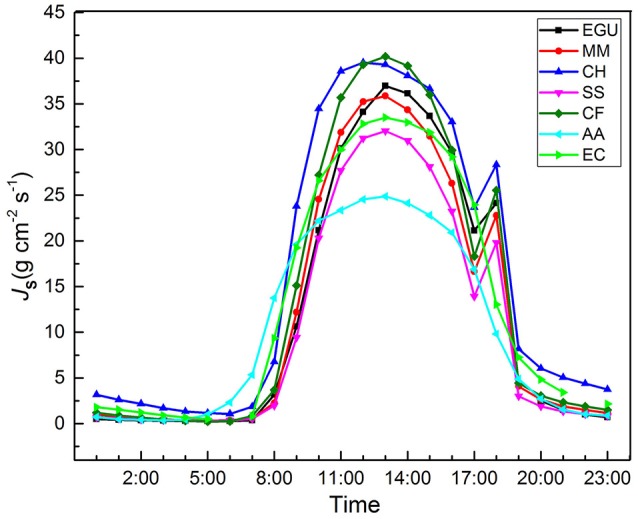
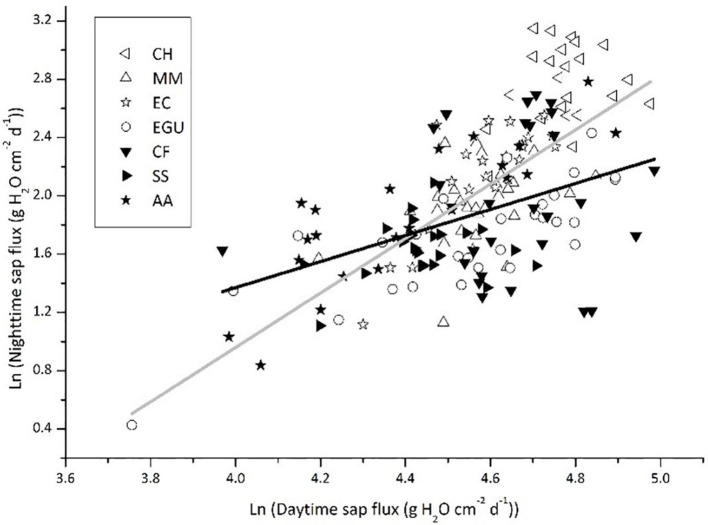
An increasing body of evidence has shown that nighttime sap flux occurs in most plants, but the physiological implications and regulatory mechanism are poorly known. The significance of corticular photosynthesis has received much attention during the last decade, however, the knowledge of the relationship between corticular photosynthesis and nocturnal stem sap flow is limited at present. In this study, we divided seven tree species into two groups according to different photosynthetic capabilities: trees of species with (, and × ) and without (, and ) photosynthetic stems, and the sap flux () and chlorophyll fluorescence parameters for these species were measured. One-way ANOVA analysis showed that the / (Maximum photochemical quantum yield of PSII) and Φ (effective photochemical quantum yield of PSII) values were lower in non-photosynthetic stem species compared to photosynthetic stem species. The linear regression analysis showed that (daytime sap flux) and (nighttime sap flux) of non-photosynthetic stem species was 87.7 and 60.9% of the stem photosynthetic species. Furthermore, for a given daytime transpiration water loss, total nighttime sap flux was higher in species with photosynthetic stems (Slope = 2.680) than in non-photosynthetic stems species (Slope = 1.943). These results mean that stem corticular photosynthesis has a possible effect on the nighttime water flow, highlighting the important eco-physiological relationship between nighttime sap flux and corticular photosynthesis.
越来越多的证据表明,大多数植物都会在夜间出现液流,但人们对其生理意义和调节机制知之甚少。在过去十年中,皮层光合作用的重要性受到了广泛关注,然而,目前关于皮层光合作用与夜间树干液流之间关系的了解仍然有限。在本研究中,我们根据不同的光合能力将七种树种分为两组:具有光合茎的树种(、和×)和不具有光合茎的树种(、和),并测量了这些树种的液流通量()和叶绿素荧光参数。单因素方差分析表明,与具有光合茎的树种相比,不具有光合茎的树种的/(PSII的最大光化学量子产率)和Φ(PSII的有效光化学量子产率)值较低。线性回归分析表明,不具有光合茎的树种的(白天液流通量)和(夜间液流通量)分别为具有茎光合的树种的87.7%和60.9%。此外,对于给定的白天蒸腾失水量,具有光合茎的树种(斜率 = 2.680)的夜间总液流通量高于不具有光合茎的树种(斜率 = 1.943)。这些结果意味着茎皮层光合作用可能对夜间水流产生影响,突出了夜间液流与皮层光合作用之间重要的生态生理关系。