1Neonatal Intensive Care Unit, Women and Children Health Institute of Futian, University of South China, Jintian South Road No. 2002, Futian district, Shen Zhen, 518045 China.
2Pediatric Intensive Care Unit, Children's Hospital of Chongqing Medical University, Ministry of Education Key Laboratory of Child Development and Disorders, Yu Zhong, Chongqing, 400014 China.
Cell Mol Biol Lett. 2018 Jan 25;23:4. doi: 10.1186/s11658-018-0071-7. eCollection 2018.
Calcitonin gene-related peptide (CGRP) can protect against hyperoxia-induced lung injury, making the upregulation of CGRP a potential therapeutic approach for this type of injury. However, the effects of CGRP on the Wnt7b/β-catenin signaling pathway are unclear. In this study, we investigated the roles of CGRP and the Wnt7b/β-catenin signaling pathway in hyperoxia-induced lung injury.
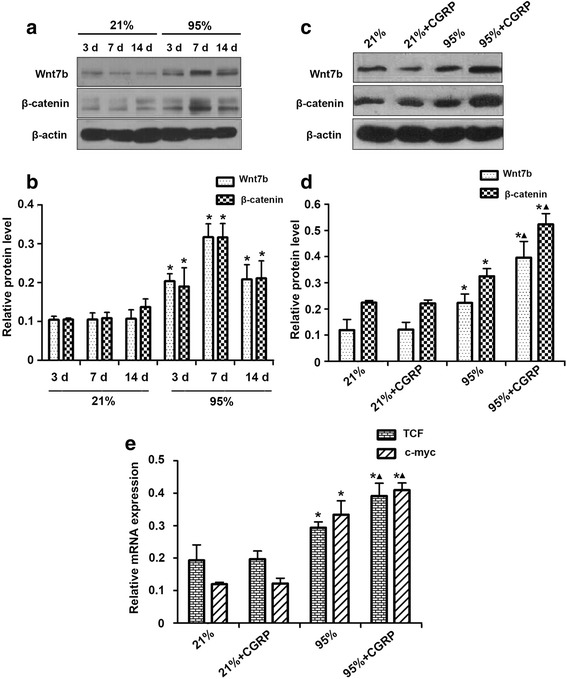
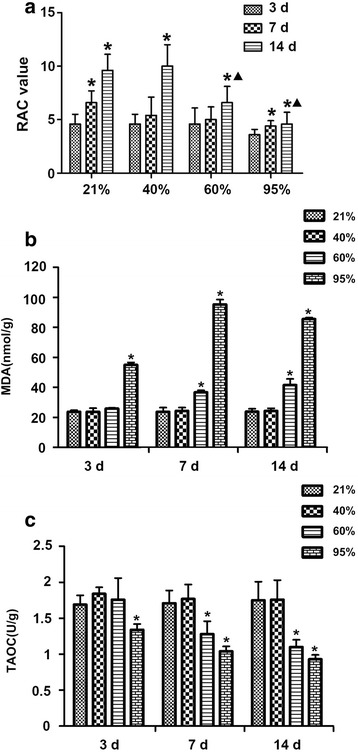
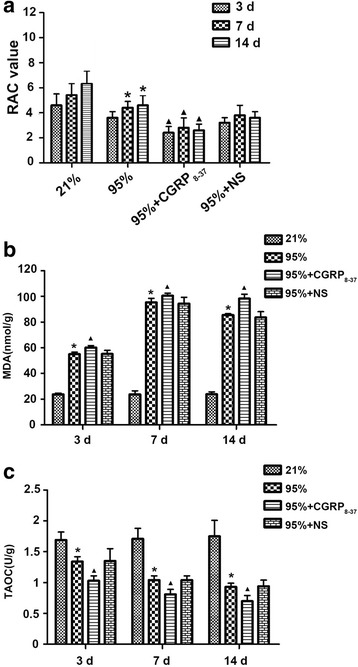
Premature Sprague Dawley (SD) rats were exposed to 21, 40, 60 and 95% oxygen for 3, 7 and 14 days. The animals' body weights, survival rates and endogenous CGRP levels were measured. Lung samples were harvested for histological analyses and measurements of malondialdehyde (MDA) concentration and total antioxidant capacity (TAOC). We also assessed the MDA concentration and TAOC in the lung tissues after administration of 200 nmol/kg CGRP (a CGRP antagonist). Finally, alveolar epithelial type II (AEC II) cells were isolated from premature rats, exposed to 21 or 95% oxygen for 3, 7 and 14 days, and treated with 10 mol/l exogenous CGRP. The protein expressions of Wnt7b and β-catenin were assessed using western blotting, and TCF and c-myc mRNA expressions were assessed using qPCR.
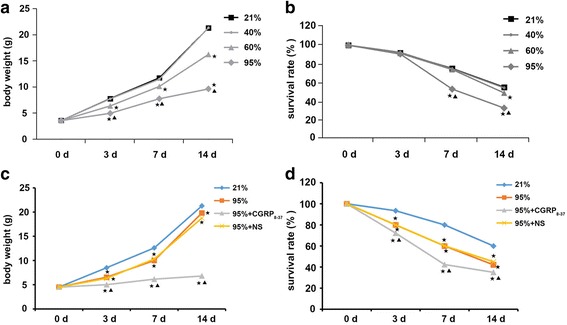
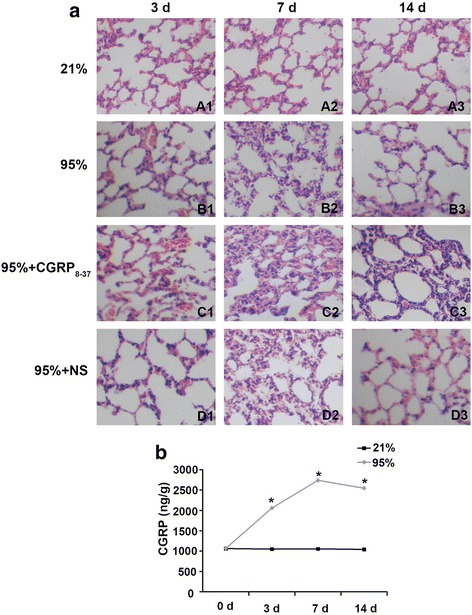
Rats exposed to 60 and 95% oxygen had significantly lower body weights and survival rates than the 21 and 40% groups, and the decrease was time dependent. Endogenous CGRP was elevated in the lung tissues of premature rats exposed to 95% oxygen. CGRP induced apparent inflammation in the lung tissue and alveolar structural remodeling. In addition, the expression levels of Wnt7b and β-catenin were markedly increased after exposure for 3 days. They peaked at 7 days, then declined at 14 days. The levels of TCF/c-myc in AEC II cells increased significantly after CGRP treatment when compared with cells that had only undergone hyperoxia.
CGRP protected against hyperoxia-induced lung injury in premature rats. This process involves the Wnt7b/β-catenin signaling pathway.
降钙素基因相关肽(CGRP)可预防高氧诱导的肺损伤,因此上调 CGRP 可能成为治疗此类损伤的一种方法。然而,CGRP 对 Wnt7b/β-catenin 信号通路的影响尚不清楚。本研究旨在探讨 CGRP 及 Wnt7b/β-catenin 信号通路在高氧诱导的肺损伤中的作用。
将早产 Sprague Dawley(SD)大鼠置于 21%、40%、60%和 95%氧气中 3、7 和 14 天。测量大鼠的体重、存活率和内源性 CGRP 水平。采集肺组织进行组织学分析,并测量丙二醛(MDA)浓度和总抗氧化能力(TAOC)。我们还评估了给予 200nmol/kg CGRP(CGRP 拮抗剂)后肺组织中的 MDA 浓度和 TAOC。最后,从早产大鼠中分离出肺泡上皮细胞 II 型(AEC II),并将其置于 21%或 95%氧气中 3、7 和 14 天,然后用 10μmol/L 外源性 CGRP 处理。使用 Western blot 检测 Wnt7b 和 β-catenin 的蛋白表达,用 qPCR 检测 TCF 和 c-myc mRNA 的表达。
与 21%和 40%氧气组相比,暴露于 60%和 95%氧气的大鼠体重和存活率明显降低,且下降呈时间依赖性。暴露于 95%氧气的早产大鼠肺组织中内源性 CGRP 升高。CGRP 导致肺组织明显炎症和肺泡结构重塑。此外,暴露 3 天后 Wnt7b 和 β-catenin 的表达水平明显升高,7 天后达到峰值,14 天后下降。与仅经历高氧的细胞相比,CGRP 处理后 AEC II 细胞中的 TCF/c-myc 水平显著增加。
CGRP 可预防早产大鼠高氧诱导的肺损伤,该过程涉及 Wnt7b/β-catenin 信号通路。