Nieder Carsten, Hintz Mandy, Bilger Angelika, Oehlke Oliver, Grosu Anca-Ligia
Department of Oncology and Palliative Medicine, Nordland Hospital, 8092 Bodo, Norway.
Institute of Clinical Medicine, Faculty of Health Sciences, University of Tromso, 9037 Tromso, Norway.
J Clin Med Res. 2018 Mar;10(3):178-181. doi: 10.14740/jocmr3248w. Epub 2018 Jan 26.
It has been suggested to replace the diagnosis-specific graded prognostic assessment (DS-GPA, based on performance status and number of brain metastases) for patients with primary malignant melanoma with the new Melanoma-molGPA. The latter is a more complex assessment, which also includes BRAF mutation status, age and extracranial metastases. To test the performance of the Melanoma-molGPA, we performed a validation study of this new survival prediction tool.
A retrospective analysis of patients treated at two different academic institutions was performed. The four-tiered Melanoma-molGPA was calculated as suggested in the original study.
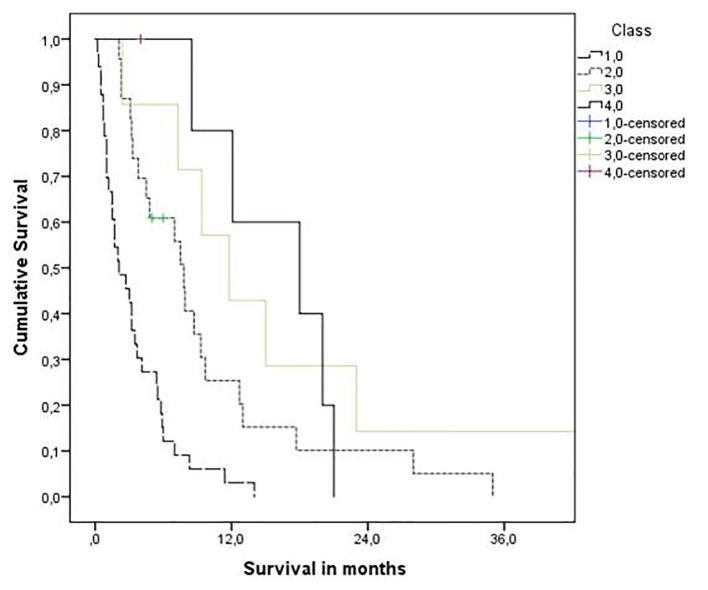
Median overall survival was 5.4 months (95% confidence interval: 3.1 - 7.7 months). Median survival in the four prognostic classes was 2.1, 7.8, 11.8, and 18.0 months, respectively. The 1-year survival rates were 3%, 25%, 43%, and 80%, respectively. The difference between the Kaplan-Meier curves was significant (P = 0.0001, log-rank test).
The present survival outcomes support the use of the Melanoma-molGPA. However, survival was better in each of the four groups in the original study. Possible reasons include lead-time bias and different treatment policies.
有人建议用新的黑色素瘤分子分级预后评估(Melanoma-molGPA)取代原发性恶性黑色素瘤患者的诊断特异性分级预后评估(DS-GPA,基于体能状态和脑转移数量)。后者是一种更复杂的评估,还包括BRAF突变状态、年龄和颅外转移。为了测试Melanoma-molGPA的性能,我们对这个新的生存预测工具进行了一项验证研究。
对在两个不同学术机构接受治疗的患者进行回顾性分析。按照原始研究中的建议计算四级Melanoma-molGPA。
中位总生存期为5.4个月(95%置信区间:3.1 - 7.7个月)。四个预后类别中的中位生存期分别为2.1、7.8、11.8和18.0个月。1年生存率分别为3%、25%、43%和80%。Kaplan-Meier曲线之间的差异具有显著性(P = 0.0001,对数秩检验)。
目前的生存结果支持使用Melanoma-molGPA。然而,原始研究中四个组中的每一组的生存期都更好。可能的原因包括提前期偏倚和不同的治疗策略。