Berger Andreas W, Schwerdel Daniel, Ettrich Thomas J, Hann Alexander, Schmidt Stefan A, Kleger Alexander, Marienfeld Ralf, Seufferlein Thomas
Department of Internal Medicine I, Ulm University, 89081 Ulm, Germany.
Department of Diagnostic and Interventional Radiology, Ulm University, 89081 Ulm, Germany.
Oncotarget. 2017 Dec 16;9(2):2076-2085. doi: 10.18632/oncotarget.23330. eCollection 2018 Jan 5.
Precision medicine in pancreatic ductal adenocarcinoma (PDAC) could be substantially supported by tools that allow to establish and monitor the molecular setup of the tumor. In particular, noninvasive approaches are desirable, but not validated. Characterization of circulating tumor DNA (ctDNA) may help to achieve this goal.
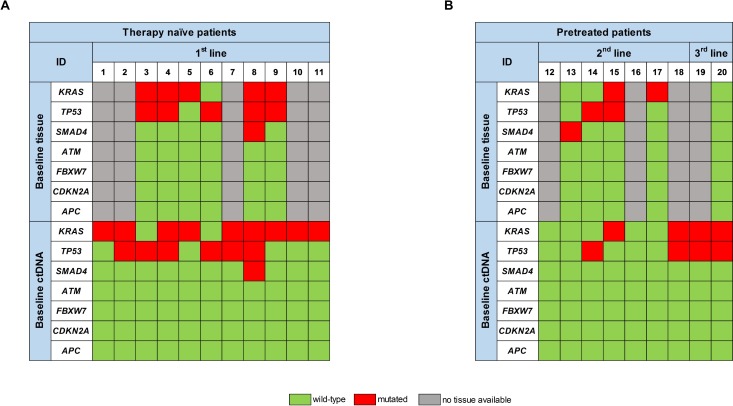
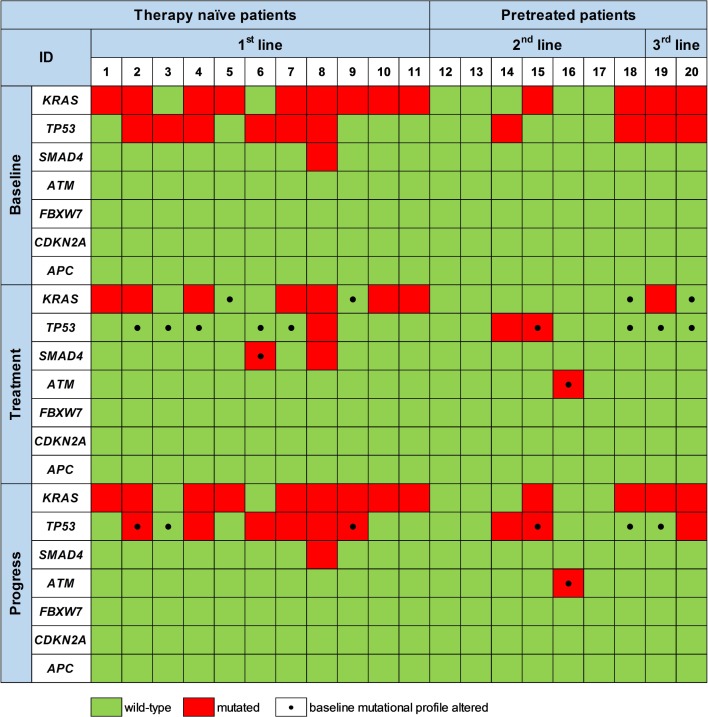
Blood samples from patients with metastatic PDAC prior to and during palliative treatment were collected. ctDNA and corresponding tumor tissue were analyzed by targeted next generation sequencing and droplet digital PCR for the 7 most frequently mutated genes in PDAC (TP53, SMAD4, CDKN2A, KRAS, APC, ATM, and FBXW7). Findings were correlated with clinical and imaging data.
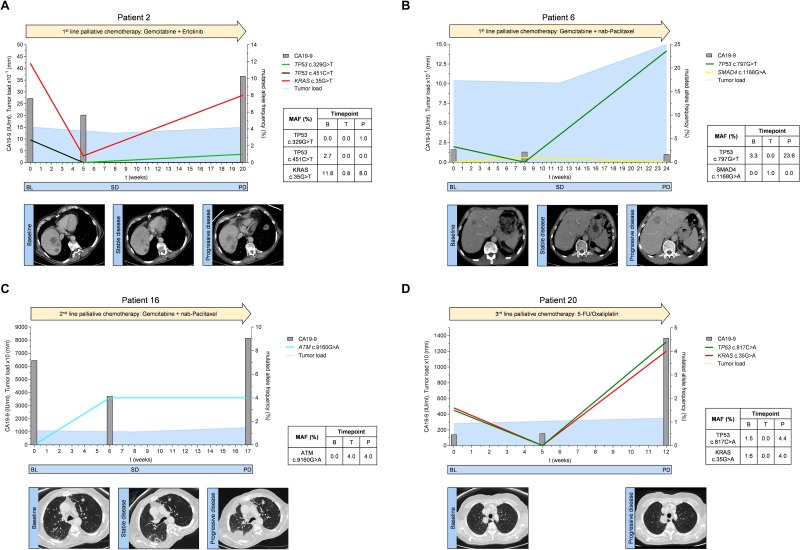
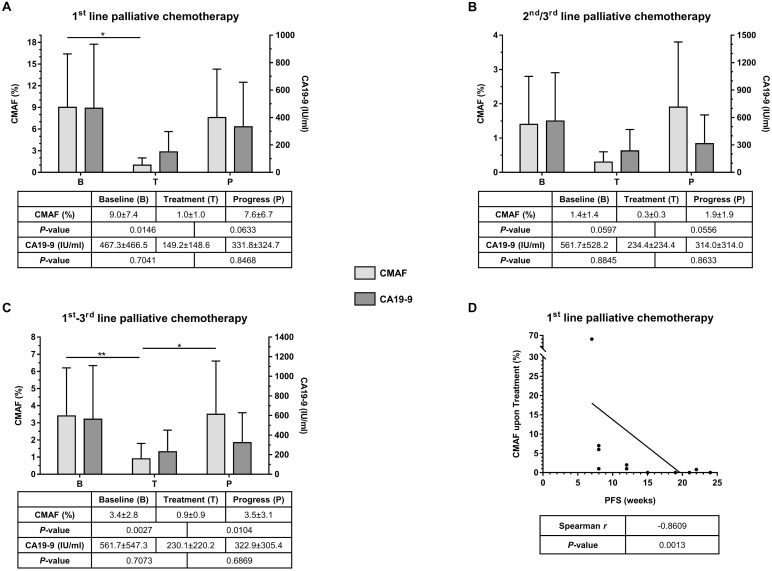
A total of 20 patients (therapy naïve = 11; pretreated = 9) were included. All therapy naïve patients ( = 11/11) presented with detectable ctDNA at baseline. In pretreated patients, 3/7 (prior to 2nd line treatment) and 2/2 (prior to 3rd line chemotherapy) had detectable ctDNA. The combined mutational allele frequency (CMAF) of KRAS and TP53 was chosen to reflect the amount of ctDNA. The median CMAF level significantly decreased during treatment ( = 0.0027) and increased at progression ( = 0.0104). CA19-9 analyses did not show significant differences. In treatment naïve patients, the CMAF levels during therapy significantly correlated with progression-free survival (Spearman, = -0.8609, = 0.0013).
Monitoring of ctDNA and its changes during treatment may enable to adapt therapeutic strategies to the specific molecular changes present at a certain time during treatment of mPDAC.
能够建立并监测肿瘤分子结构的工具可极大地支持胰腺导管腺癌(PDAC)的精准医疗。特别是,非侵入性方法是可取的,但尚未得到验证。循环肿瘤DNA(ctDNA)的特征分析可能有助于实现这一目标。
收集转移性PDAC患者在姑息治疗前及治疗期间的血样。通过靶向二代测序和液滴数字PCR分析ctDNA及相应肿瘤组织中PDAC最常发生突变的7个基因(TP53、SMAD4、CDKN2A、KRAS、APC、ATM和FBXW7)。研究结果与临床和影像数据相关联。
共纳入20例患者(初治患者 = 11例;经治患者 = 9例)。所有初治患者(11/11)在基线时均可检测到ctDNA。在经治患者中,3/7(二线治疗前)和2/2(三线化疗前)可检测到ctDNA。选择KRAS和TP53的联合突变等位基因频率(CMAF)来反映ctDNA的量。治疗期间CMAF水平中位数显著下降(P = 0.0027),疾病进展时升高(P = 0.0104)。CA19-9分析未显示出显著差异。在初治患者中,治疗期间的CMAF水平与无进展生存期显著相关(Spearman,P = -0.8609,P = 0.0013)。
监测ctDNA及其在治疗期间的变化可能有助于使治疗策略适应转移性PDAC治疗特定时间出现的特定分子变化。