Medical Center on Aging of Ruijin Hospital, MCARJH, Shanghai Jiaotong University School of Medicine, 197 Ruijin Er Road, Shanghai, 200025, China.
Department of Oncology, Ruijin Hospital, Shanghai Jiao Tong University School of Medicine, Shanghai, 200025, China.
J Transl Med. 2024 Feb 20;22(1):184. doi: 10.1186/s12967-024-04989-z.
We previously showed that the nab-paclitaxel plus S-1 (NPS) regimen had promising effects against metastatic pancreatic ducal adenocarcinoma (mPDAC), whose efficacy however could not be precisely predicted by routine biomarkers. This prospective study aimed to investigate the values of mutations in circulating tumor DNA (ctDNA) and their dynamic changes in predicting response of mPDAC to NPS chemotherapy.
Paired tumor tissue and blood samples were prospectively collected from patients with mPDAC receiving first-line NPS chemotherapy, and underwent next-generation sequencing with genomic profiling of 425 genes for ctDNA. High mutation allelic frequency (MAF) was defined as ≥ 30% and ≥ 5% in tumor tissue and blood, respectively. Kappa statistics were used to assess agreement between mutant genes in tumor and ctDNA. Associations of mutations in ctDNA and their dynamic changes with tumor response, overall survival (OS), and progression-free survival (PFS) were assessed using the Kaplan-Meier method, multivariable-adjusted Cox proportional hazards regression, and longitudinal data analysis.
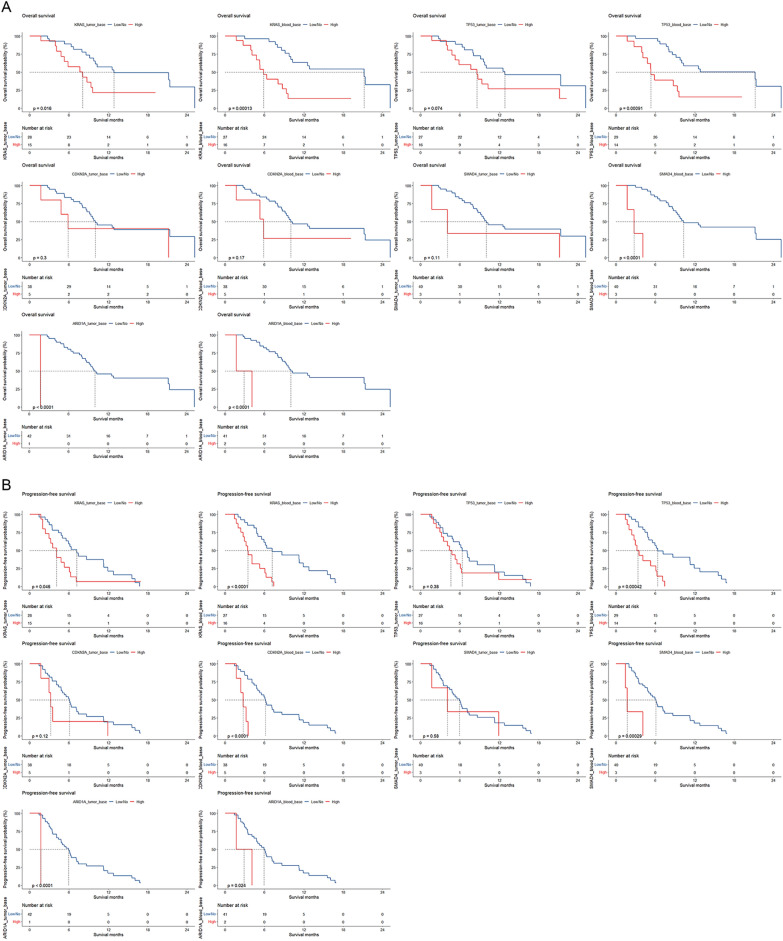
147 blood samples and 43 paired tumor specimens from 43 patients with mPDAC were sequenced. The most common driver genes with high MAF were KRAS (tumor, 35%; ctDNA, 37%) and TP53 (tumor, 37%; ctDNA, 33%). Mutation rates of KRAS and TP53 in ctDNA were significantly higher in patients with liver metastasis, with baseline CA19-9 ≥ 2000 U/mL, and/or without an early CA19-9 response. κ values for the 5 most commonly mutated genes between tumor and ctDNA ranged from 0.48 to 0.76. MAFs of the genes mostly decreased sequentially during subsequent measurements, which significantly correlated with objective response, with an increase indicating cancer progression. High mutations of KRAS and ARID1A in both tumor and ctDNA, and of TP53, CDKN2A, and SMAD4 in ctDNA but not in tumor were significantly associated with shorter survival. When predicting 6-month OS, AUCs for the 5 most commonly mutated genes in ctDNA ranged from 0.59 to 0.84, larger than for genes in tumor (0.56 to 0.71) and for clinicopathologic characteristics (0.51 to 0.68). Repeated measurements of mutations in ctDNA significantly differentiated survival and tumor response. Among the 31 patients with ≥ 2 ctDNA tests, longitudinal analysis of changes in gene MAF showed that ctDNA progression was 60 and 58 days ahead of radiologic and CA19-9 progression for 48% and 42% of the patients, respectively.
High mutations of multiple driving genes in ctDNA and their dynamic changes could effectively predict response of mPDAC to NPS chemotherapy, with promising reliable predictive performance superior to routine clinicopathologic parameters. Inspiringly, longitudinal ctDNA tracking could predict disease progression about 2 months ahead of radiologic or CA19-9 evaluations, with the potential to precisely devise individualized therapeutic strategies for mPDAC.
我们之前的研究表明,白蛋白结合型紫杉醇联合 S-1(NPS)方案对转移性胰腺导管腺癌(mPDAC)具有良好的疗效,但常规生物标志物无法准确预测其疗效。本前瞻性研究旨在探讨循环肿瘤 DNA(ctDNA)中的突变及其动态变化在预测 mPDAC 对 NPS 化疗反应中的价值。
前瞻性收集接受一线 NPS 化疗的 mPDAC 患者的配对肿瘤组织和血液样本,并对 425 个基因进行下一代测序以进行 ctDNA 的基因组分析。高突变等位基因频率(MAF)定义为肿瘤组织和血液中的分别为≥30%和≥5%。采用 Kappa 统计评估肿瘤和 ctDNA 中突变基因的一致性。采用 Kaplan-Meier 法、多变量调整 Cox 比例风险回归和纵向数据分析评估 ctDNA 中的突变及其动态变化与肿瘤反应、总生存期(OS)和无进展生存期(PFS)的相关性。
对 43 例 mPDAC 患者的 147 份血样和 43 对配对肿瘤标本进行了测序。高 MAF 的最常见驱动基因突变包括 KRAS(肿瘤,35%;ctDNA,37%)和 TP53(肿瘤,37%;ctDNA,33%)。ctDNA 中 KRAS 和 TP53 的突变率在肝转移患者中明显更高,且基线 CA19-9≥2000 U/mL,和/或 CA19-9 早期无应答。肿瘤和 ctDNA 中 5 个最常见突变基因之间的 κ 值范围为 0.48 至 0.76。在后续测量中,这些基因的 MAF 大多呈顺序下降,与客观反应显著相关,增加表明癌症进展。肿瘤和 ctDNA 中 KRAS 和 ARID1A 以及 ctDNA 中 TP53、CDKN2A 和 SMAD4 的高突变与较短的生存时间显著相关。在预测 6 个月 OS 时,ctDNA 中 5 个最常见突变基因的 AUC 范围为 0.59 至 0.84,大于肿瘤(0.56 至 0.71)和临床病理特征(0.51 至 0.68)的 AUC。ctDNA 中突变的重复测量显著区分了生存和肿瘤反应。在≥2 次 ctDNA 检测的 31 例患者中,基因 MAF 的纵向分析表明,ctDNA 进展比影像学和 CA19-9 进展分别提前 60 天和 58 天,分别为 48%和 42%的患者。
ctDNA 中多个驱动基因突变的高突变及其动态变化可有效预测 mPDAC 对 NPS 化疗的反应,具有有前途的可靠预测性能,优于常规临床病理参数。令人鼓舞的是,纵向 ctDNA 监测可在影像学或 CA19-9 评估前约 2 个月预测疾病进展,有可能为 mPDAC 精确制定个体化治疗策略。