Zepp Michael, Kovacheva Marineta, Altankhuyag Munkhtsetseg, Westphal Gabriela, Berger Irina, Gather Katharina S, Hilbig Heidegard, Neuhaus Jochen, Hänsch Gertrud M, Armbruster Franz P, Berger Martin R
Toxicology and Chemotherapy UnitGerman Cancer Research CenterHeidelbergGermany.
Institute of Pathology, Klinikum KasselKasselGermany.
J Pathol Clin Res. 2017 Dec 15;4(1):55-68. doi: 10.1002/cjp2.88. eCollection 2018 Jan.
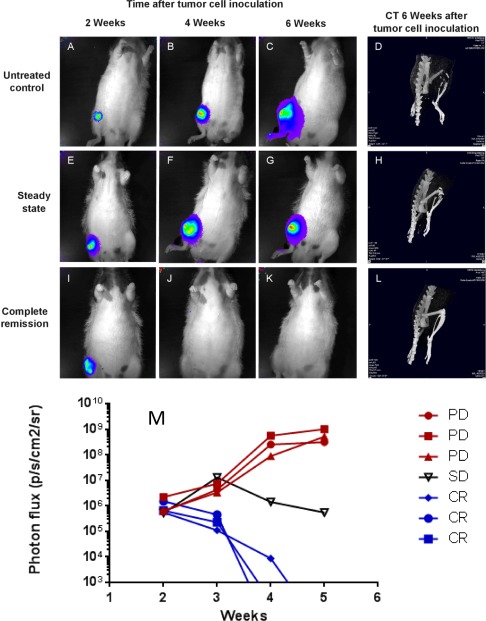
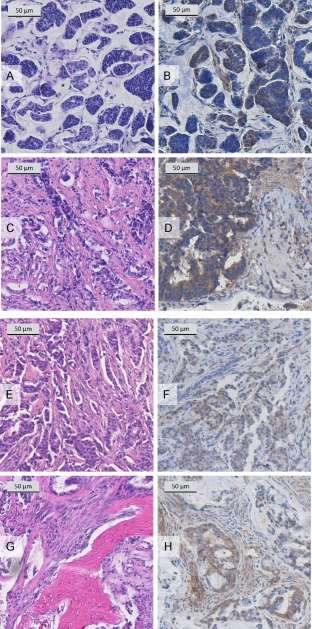
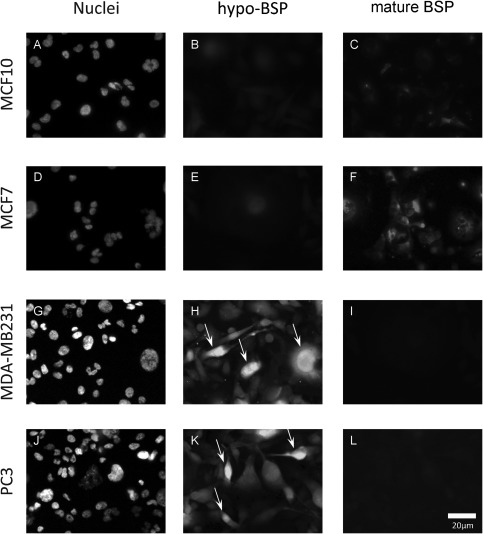
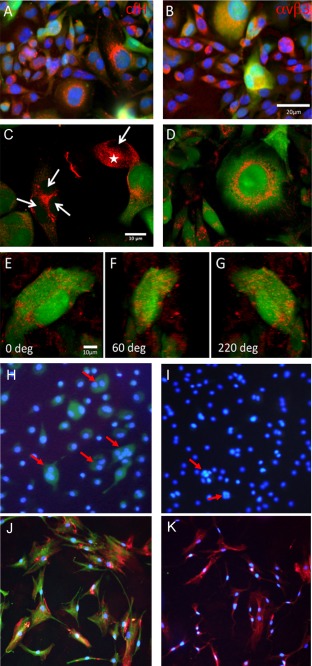
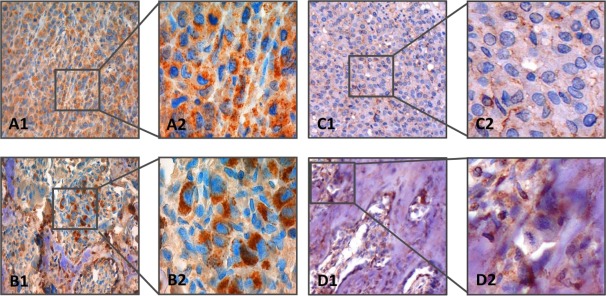
Changes in glycosylation are salient features of cancer cells. Here, we report on the diagnostic and therapeutic properties of IDK1, an antibody against tumour associated, hypoglycosylated bone sialoprotein (hypo-BSP). The affinity of the rat monoclonal antibody IDK1 for hypo-BSP, as determined by microscale thermophoresis, was three orders of magnitude higher than for mature BSP, whereas the mouse monoclonal antibody used had similar affinity for both BSP forms. IDK1 showed no activity against the proliferation or migration of normal or cancer cells growing . , however, IDK1 caused dose-dependent regression of soft tissue and skeletal lesions in nude rats harbouring human MDA-MB-231 cells. At optimal dose, 80% of the treated rats showed complete remission of all tumour lesions. Analysis of BSP expression by fluorescence-activated cell sorting (FACS) and immunocytochemistry showed basal levels of this protein, which were visible only in a fraction of these cells. Cells of the metastatic cell lines MDA-MB-231 and PC-3 were more often positive for hypo-BSP. In addition, there was co-expression of both forms in some cells, but almost no co-localization; rather, hypo-BSP was present in the nucleus, and mature BSP was detected extra-cellularly. Normal osteoblasts and osteoclasts were negative for hypo-BSP. Breast cancer tissue, however, showed strong expression of mature BSP, which was present intra-cellularly as well as in vesicles outside cells. Hypo-BSP was present mainly in lesions from skeletal sites, thus explaining the antineoplastic activity of IDK1, which was high in lesions growing in the vicinity of the skeleton but low in lesions growing subcutaneously. Finally, hypo-BSP was detected in specimens from breast cancer patients, with a significantly greater intensity in skeletal metastases as compared to the respective primary cancers. In conclusion, IDK-1 is an antibody with diagnostic and therapeutic applications in skeletal metastases of breast cancer.
糖基化变化是癌细胞的显著特征。在此,我们报告了IDK1的诊断和治疗特性,IDK1是一种针对肿瘤相关的低糖基化骨唾液酸蛋白(hypo - BSP)的抗体。通过微量热泳法测定,大鼠单克隆抗体IDK1对hypo - BSP的亲和力比对成熟BSP的亲和力高三个数量级,而所用的小鼠单克隆抗体对两种BSP形式的亲和力相似。IDK1对正常或正在生长的癌细胞的增殖或迁移没有活性。然而,IDK1使携带人MDA - MB - 231细胞的裸鼠的软组织和骨骼病变出现剂量依赖性消退。在最佳剂量下,80%的受试大鼠所有肿瘤病变完全缓解。通过荧光激活细胞分选(FACS)和免疫细胞化学分析BSP表达,显示该蛋白的基础水平,仅在这些细胞的一部分中可见。转移性细胞系MDA - MB - 231和PC - 3的细胞更常为hypo - BSP阳性。此外,在一些细胞中两种形式共表达,但几乎没有共定位;相反,hypo - BSP存在于细胞核中,而成熟BSP在细胞外被检测到。正常成骨细胞和破骨细胞对hypo - BSP呈阴性。然而,乳腺癌组织显示成熟BSP的强表达,其存在于细胞内以及细胞外的囊泡中。Hypo - BSP主要存在于骨骼部位的病变中,从而解释了IDK1的抗肿瘤活性,其在骨骼附近生长的病变中活性高,而在皮下生长的病变中活性低。最后,在乳腺癌患者的标本中检测到hypo - BSP,与相应的原发性癌症相比,骨骼转移灶中的强度明显更高。总之,IDK - 1是一种在乳腺癌骨骼转移中具有诊断和治疗应用的抗体。