Chu Wei-Min, Ho Hsin-En, Wang Jiaan-Der, Chan Wei-Cheng, Liou Yi-Sheng, Ho Wen-Chao, Hu Sung-Yuan, Tsan Yu-Tse
Institute of Medicine, Chung Shan Medical University, Taichung Department of Family Medicine, Taichung Veterans General Hospital, Chiayi Branch, Chia-Yi School of Medicine, National Yang-Ming University, Taipei Department of Family Medicine, Taichung Armed Forces General Hospital Center for Rare Disease and Hemophilia, Department of Pediatrics, Taichung Veterans General Hospital School of Medicine, China Medical University, Taichung Division of Occupational Medicine, Department of Emergency Medicine, Taichung Veterans General Hospital, Taichung City School of Public Health, National Defense Medical Center, Taipei Department of Family Medicine, Taichung Veterans General Hospital Department of Public Health, China Medical University, Taichung, Taiwan Department of Nursing, College of Health, National University of Taichung Science and Technolog School of Medicine, Chung Shan Medical University, Taichung, Taiwan.
Medicine (Baltimore). 2018 Feb;97(6):e9803. doi: 10.1097/MD.0000000000009803.
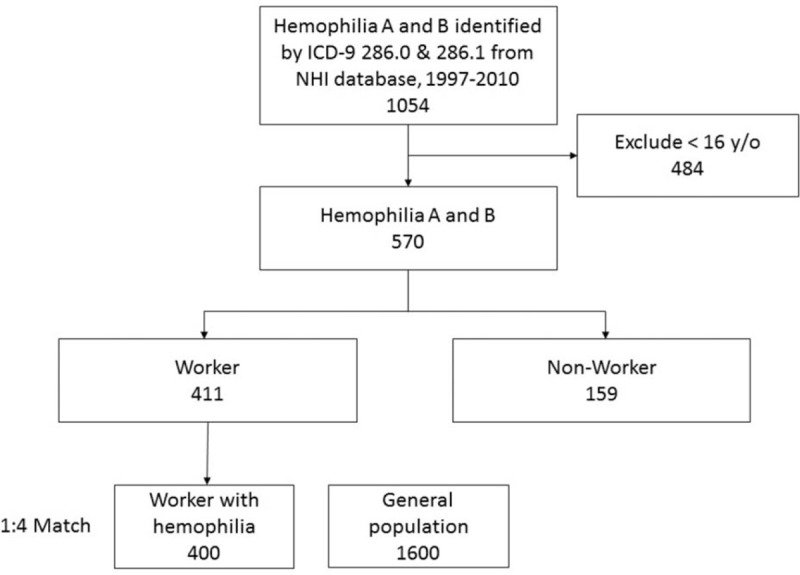
Multiple comorbidities, especially musculoskeletal dysfunction and cerebrovascular disease, remain barriers to normal social participation among persons with hemophilia (PWH). However, the relative health effects of such comorbidities on workers with hemophilia have seldom been explored. In this study, we investigated the incidence of comorbidities and their risk factors among workers with hemophilia.The study compared the incidence and risk factors of the major comorbidities of 411 workers with hemophilia enrolled in Taiwan's National Health Insurance Research Database between 1997 and 2010 with an age- and sex-matched general population.Compared with the general population, workers with hemophilia had higher risks for hemorrhagic stroke, arthritis/arthropathy, and knee/hip replacement among workers with hemophilia after multivariate adjustment, with hazard ratios (95% CI) of 4.60 (2.81-7.53), 4.03 (3.34-4.87), and 1.29 (1.10-1.41), respectively.Disorder of joints, hemophilia-related arthritis/arthropathy, hemorrhagic stroke, and knee/hip replacement remain significant comorbidities among workers with hemophilia, which will result in increased social burden. Policymakers and employers should apply appropriate interventions to help prevent productivity losses, reduced workforce participation, sick leave, and work disability among hemophilia workers.
多种合并症,尤其是肌肉骨骼功能障碍和脑血管疾病,仍然是血友病患者(PWH)正常社会参与的障碍。然而,此类合并症对血友病患者工作人群的相对健康影响鲜有研究。在本研究中,我们调查了血友病患者工作人群中合并症的发病率及其危险因素。本研究比较了1997年至2010年纳入台湾国民健康保险研究数据库的411名血友病患者工作人群与年龄和性别匹配的普通人群的主要合并症发病率及危险因素。多变量调整后,与普通人群相比,血友病患者工作人群发生出血性中风、关节炎/关节病以及膝关节/髋关节置换的风险更高,风险比(95%CI)分别为4.60(2.81 - 7.53)、4.03(3.34 - 4.87)和1.29(1.10 - 1.41)。关节疾病、血友病相关关节炎/关节病、出血性中风以及膝关节/髋关节置换仍是血友病患者工作人群中的重要合并症,这将导致社会负担加重。政策制定者和雇主应采取适当干预措施,以帮助预防血友病患者工作人群的生产力损失、劳动力参与度降低、病假和工作残疾。