Mikkelsen Mai Louise Grandsgaard, Ambrus Rikard, Rasmussen Rune, Miles James Edward, Poulsen Helle Harding, Moltke Finn Borgbjerg, Eriksen Thomas
Department of Veterinary Clinical Sciences, University of Copenhagen, 16 Dyrlægevej, 1870, Frederiksberg C, Denmark.
Department of Surgical Gastroenterology C, Rigshospitalet, University of Copenhagen, 9 Blegdamsvej, 2100, Copenhagen Ø, Denmark.
Acta Vet Scand. 2018 Feb 8;60(1):8. doi: 10.1186/s13028-018-0362-z.
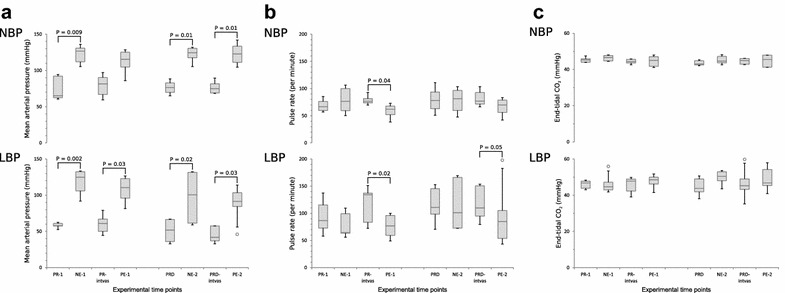
Vasopressors are frequently used to increase blood pressure in order to ensure sufficient cerebral perfusion and oxygenation (CPO) during hypotensive periods in anaesthetized patients. Efficacy depends both on the vasopressor and anaesthetic protocol used. Propofol-remifentanil total intravenous anaesthesia (TIVA) is common in human anaesthesia, and dexmedetomidine is increasingly used as adjuvant to facilitate better haemodynamic stability and analgesia. Little is known of its interaction with vasopressors and subsequent effects on CPO. This study investigates the CPO response to infusions of norepinephrine and phenylephrine in piglets during propofol-remifentanil and propofol-remifentanil-dexmedetomidine anaesthesia. Sixteen healthy female piglets (25-34 kg) were randomly allocated into a two-arm parallel group design with either normal blood pressure (NBP) or induced low blood pressure (LBP). Anaesthesia was induced with propofol without premedication and maintained with propofol-remifentanil TIVA, and finally supplemented with continuous infusion of dexmedetomidine. Norepinephrine and phenylephrine were infused in consecutive intervention periods before and after addition of dexmedetomidine. Cerebral perfusion measured by laser speckle contrast imaging was related to cerebral oxygenation as measured by an intracerebral Licox probe (partial pressure of oxygen) and transcranial near infrared spectroscopy technology (NIRS) (cerebral oxygen saturation).
During propofol-remifentanil anaesthesia, increases in blood pressure by norepinephrine and phenylephrine did not change cerebral perfusion significantly, but cerebral partial pressure of oxygen (Licox) increased following vasopressors in both groups and increases following norepinephrine were significant (NBP: P = 0.04, LBP: P = 0.02). In contrast, cerebral oxygen saturation (NIRS) fell significantly in NBP following phenylephrine (P = 0.003), and following both norepinephrine (P = 0.02) and phenylephrine (P = 0.002) in LBP. Blood pressure increase by both norepinephrine and phenylephrine during propofol-remifentanil-dexmedetomidine anaesthesia was not followed by significant changes in cerebral perfusion. Licox measures increased significantly following both vasopressors in both groups, whereas the decreases in NIRS measures were only significant in the NBP group.
Cerebral partial pressure of oxygen measured by Licox increased significantly in concert with the vasopressor induced increases in blood pressure in healthy piglets with both normal and low blood pressure. Cerebral oxygenation assessed by intracerebral Licox and transcranial NIRS showed opposing results to vasopressor infusions.
血管升压药常用于升高血压,以确保麻醉患者在低血压期间有足够的脑灌注和氧合(CPO)。疗效取决于所使用的血管升压药和麻醉方案。丙泊酚-瑞芬太尼全静脉麻醉(TIVA)在人类麻醉中很常见,右美托咪定越来越多地用作辅助药物,以促进更好的血流动力学稳定性和镇痛效果。人们对其与血管升压药的相互作用以及随后对CPO的影响知之甚少。本研究调查了在丙泊酚-瑞芬太尼和丙泊酚-瑞芬太尼-右美托咪定麻醉期间,仔猪对去甲肾上腺素和去氧肾上腺素输注的CPO反应。16只健康雌性仔猪(25-34千克)被随机分配到一个双臂平行组设计中,分为正常血压(NBP)或诱导低血压(LBP)组。麻醉诱导采用无术前用药的丙泊酚,并以丙泊酚-瑞芬太尼TIVA维持,最后补充持续输注右美托咪定。在添加右美托咪定前后的连续干预期内输注去甲肾上腺素和去氧肾上腺素。通过激光散斑对比成像测量的脑灌注与通过脑内Licox探头(氧分压)和经颅近红外光谱技术(NIRS)(脑氧饱和度)测量的脑氧合相关。
在丙泊酚-瑞芬太尼麻醉期间,去甲肾上腺素和去氧肾上腺素引起的血压升高并未显著改变脑灌注,但两组血管升压药使用后脑氧分压(Licox)均升高,去甲肾上腺素使用后的升高具有显著性(NBP组:P = 0.04,LBP组:P = 0.02)。相比之下,NBP组在使用去氧肾上腺素后脑氧饱和度(NIRS)显著下降(P = 0.003),LBP组在使用去甲肾上腺素(P = 0.02)和去氧肾上腺素(P = 0.002)后均显著下降。在丙泊酚-瑞芬太尼-右美托咪定麻醉期间,去甲肾上腺素和去氧肾上腺素引起的血压升高并未伴随脑灌注的显著变化。两组血管升压药使用后Licox测量值均显著增加,而NIRS测量值的下降仅在NBP组显著。
在正常血压和低血压的健康仔猪中,Licox测量的脑氧分压与血管升压药引起的血压升高同步显著增加。脑内Licox和经颅NIRS评估的脑氧合对血管升压药输注显示出相反的结果。