Neurodegenerative Diseases Research Group, Vall d'Hebron Research Institute-Center for Networked Biomedical Research on Neurodegenerative Diseases (CIBERNED), 08035, Barcelona, Spain.
Neurological Tissue Bank, Biobanc Hospital Clínic-IDIBAPS, 08036, Barcelona, Spain.
Acta Neuropathol Commun. 2018 Feb 8;6(1):8. doi: 10.1186/s40478-018-0509-1.
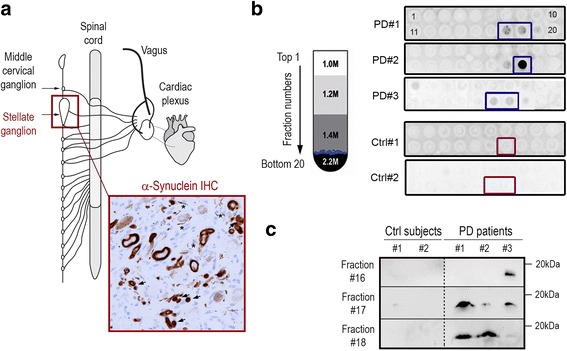
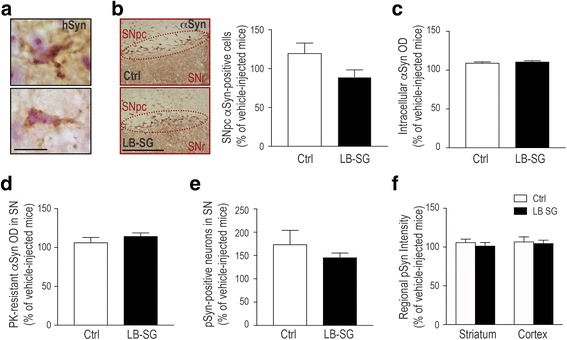
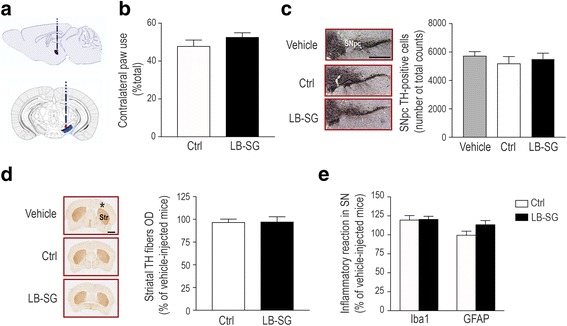
In Parkinson's disease (PD) there is widespread accumulation in the brain of abnormal α-synuclein aggregates forming intraneuronal Lewy bodies (LB). It is now well established that LB-type α-synuclein aggregates also occur in the peripheral autonomic nervous system in PD, from where it has been speculated they may progressively spread to the central nervous system through synaptically-connected brain networks and reach the substantia nigra to trigger herein dopaminergic dysfunction/degeneration and subsequent parkinsonism. Supporting a pathogenic role for α-synuclein aggregates we have previously shown that LB purified from postmortem PD brains promote α-synuclein pathology and dopaminergic neurodegeneration when intracerebrally inoculated into wild-type mice. However, the pathogenic capacity of PD-derived peripheral α-synuclein aggregates remains unknown. Here we addressed this question using purified LB-type α-synuclein aggregates from postmortem PD stellate ganglia (SG), a paravertebral sympathetic ganglion that exhibits consistent and conspicuous Lewy pathology in all PD patients. In contrast to our previous findings using nigral LB extracts, intracerebral inoculation of SG-derived LB into mice did not trigger long-term nigrostriatal neurodegeneration nor α-synuclein pathology. The differential pathogenic capacities of central- and peripheral-derived α-synuclein aggregates appear independent of the absolute amount and basic biochemical properties of α-synuclein within these aggregates and may rely instead on differences in α-synuclein conformation and/or yet unrecognized brain region-specific intrinsic factors. Our results argue against a putative pathogenic capacity of peripheral α-synuclein aggregates to promote α-synuclein pathology in the brain, propagate between neuronal networks or induce neurodegeneration.
在帕金森病 (PD) 中,大脑中广泛存在异常的 α-突触核蛋白聚集,形成神经元内的路易体 (LB)。现在已经确定,PD 患者的外周自主神经系统中也存在 LB 型 α-突触核蛋白聚集,人们推测这些聚集可能通过突触连接的脑网络从外周逐渐传播到中枢神经系统,并到达黑质,从而引发多巴胺能功能障碍/变性和随后的帕金森病。支持 α-突触核蛋白聚集的致病性作用,我们之前已经表明,从 PD 尸检大脑中纯化的 LB 可以促进 α-突触核蛋白病理学和多巴胺能神经退行性变,当将其颅内接种到野生型小鼠中时。然而,PD 衍生的外周 α-突触核蛋白聚集的致病性能力仍然未知。在这里,我们使用从 PD 星状神经节(SG)死后纯化的 LB 型 α-突触核蛋白聚集来解决这个问题,SG 是一个椎旁交感神经节,在所有 PD 患者中都表现出一致且明显的路易体病理学。与我们之前使用黑质 LB 提取物的发现相反,将 SG 衍生的 LB 颅内接种到小鼠中不会引发长期的黑质纹状体神经退行性变或 α-突触核蛋白病理学。中枢和外周衍生的 α-突触核蛋白聚集的不同致病性能力似乎独立于这些聚集物中 α-突触核蛋白的绝对数量和基本生化特性,而可能依赖于 α-突触核蛋白构象的差异和/或尚未被认识到的脑区特异性内在因素。我们的结果表明,外周 α-突触核蛋白聚集没有促进脑内 α-突触核蛋白病理学的潜在致病性,也不会在神经元网络之间传播或诱导神经退行性变。