Refardt Julie, Winzeler Bettina, Meienberg Fabian, Vogt Deborah R, Christ-Crain Mirjam
Department of Endocrinology, Diabetology and Metabolism, University Hospital Basel, Basel, Switzerland.
Clinical Trial Unit, Department Clinical Research, University of Basel and University Hospital Basel, Basel, Switzerland.
Int J Endocrinol. 2017;2017:7815690. doi: 10.1155/2017/7815690. Epub 2017 Dec 20.
Syndrome of inappropriate antidiuresis (SIADH) is the predominant cause of hyponatremia, but treatment options are unsatisfying. SGLT2 inhibitors increase urinary glucose excretion with concomitant osmotic diuresis. We therefore hypothesized SGLT2-inhibitors as a novel treatment for SIADH.
Double-blind placebo-controlled randomised crossover study in 14 healthy volunteers.
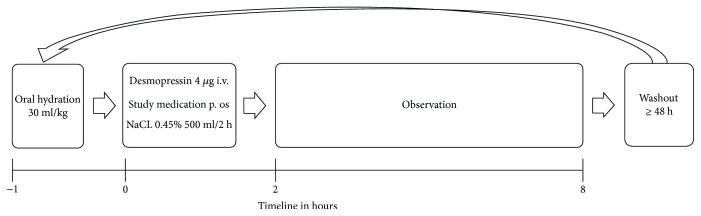
We induced an artificial SIADH model by administration of desmopressin and overhydration. Afterwards, empagliflozin 25 mg or placebo was given in random order. The main outcomes were total urinary excretion, glucosuria, and the area under the curve (AUC) of serum sodium concentration. Outcome measures were obtained 2-8 hours after administration of study drug.
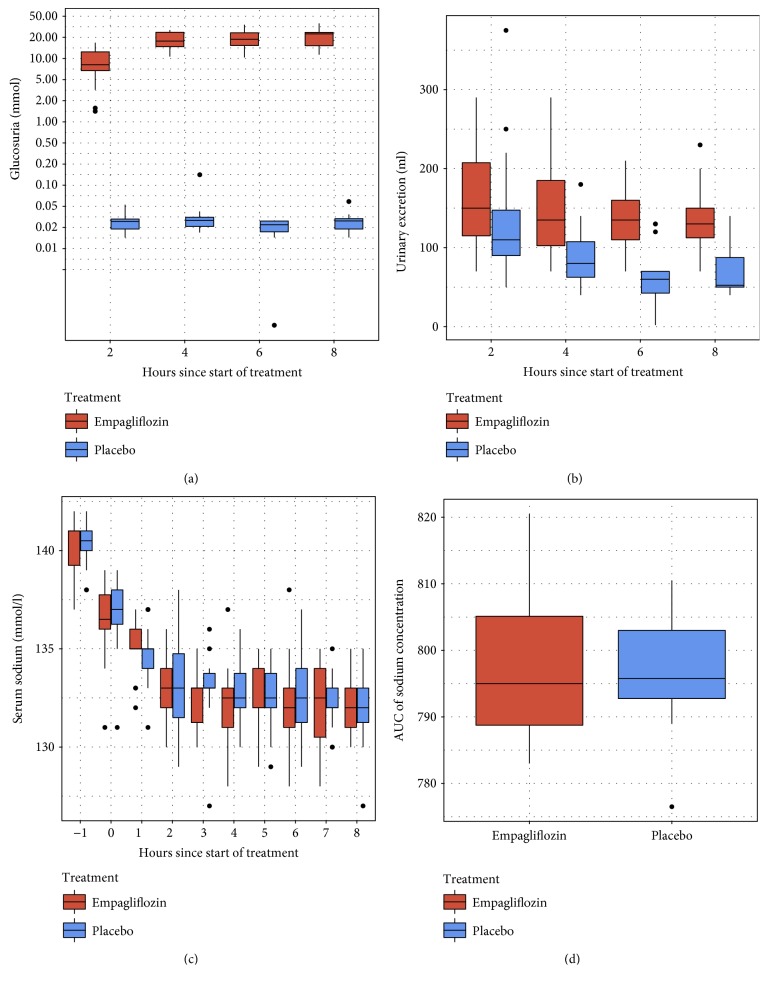
14 participants (64% males), BMI 23 kg/m (±2.4), aged 28.6 years (±9), completed the study. Empagliflozin led to significantly increased total urinary excretion (579.3 ml (±194.8) versus 367.3 ml (±158.8); treatment effect 158 ml (CI 48.29, 267.74), = 0.017) due to glucosuria (74.18 mmol (±22.3) versus 0.12 mmol (±0.04); treatment effect (log scale) 2.85 (CI 2.75, 2.96), < 0.001). There was no difference in the AUC of serum sodium concentration (treatment effect 0.2 (CI -7.38, 6.98), = 0.96).
In our SIADH model, empagliflozin increased urinary excretion due to osmotic diuresis. Due to the short treatment duration, serum sodium levels remained unchanged. Real-live studies are needed to further examine empagliflozin as a new treatment for SIADH.
抗利尿激素分泌失调综合征(SIADH)是低钠血症的主要病因,但治疗方案并不令人满意。钠-葡萄糖协同转运蛋白2(SGLT2)抑制剂可增加尿糖排泄并伴有渗透性利尿。因此,我们推测SGLT2抑制剂可作为SIADH的一种新的治疗方法。
对14名健康志愿者进行双盲安慰剂对照随机交叉研究。
通过给予去氨加压素和水负荷诱导人工SIADH模型。之后,随机给予25毫克恩格列净或安慰剂。主要观察指标为总尿排泄量、糖尿量以及血清钠浓度曲线下面积(AUC)。在给予研究药物2 - 8小时后获取观察指标。
14名参与者(64%为男性),体重指数23千克/米²(±2.4),年龄28.6岁(±9岁),完成了研究。由于糖尿,恩格列净导致总尿排泄量显著增加(579.3毫升(±194.8)对367.3毫升(±158.8);治疗效果158毫升(置信区间48.29,267.74),P = 0.017)(74.18毫摩尔(±22.3)对0.12毫摩尔(±0.04);治疗效果(对数尺度)2.85(置信区间2.75,2.96),P < 0.001)。血清钠浓度的AUC没有差异(治疗效果0.2(置信区间 -7.38,6.98),P = 0.96)。
在我们的SIADH模型中,恩格列净因渗透性利尿增加了尿排泄量。由于治疗时间短,血清钠水平保持不变。需要进行实际研究以进一步检验恩格列净作为SIADH新治疗方法的效果。