Liang Ying, Chen Letao, Yu Hong, Wang Hua, Li Qi, Yu Renhe, Qin Jiabi
Department of Epidemiology and Health Statistics, Xiangya School of Public Health, Central South University, Hunan, China.
Hunan Provincial Maternal and Child Health Hospital, Hunan, China.
Oncotarget. 2017 Dec 25;9(3):4267-4278. doi: 10.18632/oncotarget.23689. eCollection 2018 Jan 9.
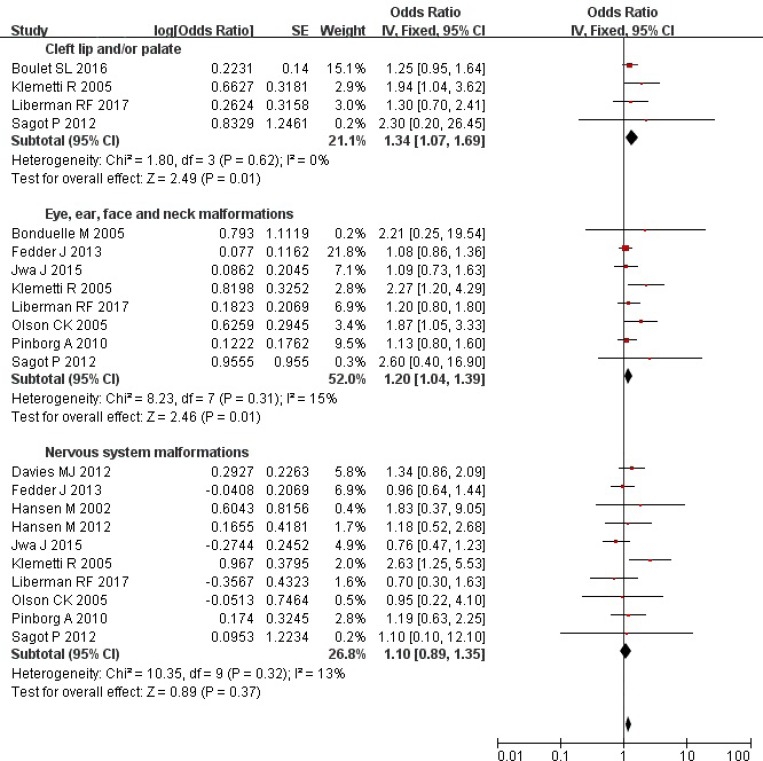
It is inconclusive nowadays for which type of congenital malformations(CMs) is increased in singleton pregnancies following after fertilization(IVF)/intracytoplasmic sperm injection(ICSI) compared with those after spontaneous conception; furthermore, a complete overview is missing. We conducted a meta-analysis of cohort studies to assess the risk of specific CMs associated with IVF/ICSI singleton pregnancies. Unrestricted searches were conducted, with an end date parameter of 1 June 2017, of PubMed, Embase, Google Scholar, Cochrane Libraries, and Chinese databases. Either a fixed- or a random-effects model was used to calculate the overall combined risk estimates. Subgroup and sensitivity analyses were performed to explore potential heterogeneity moderators when significant heterogeneity was observed. Sixteen cohort studies with a total of 129,648 IVF/ICSI and 5,491,949 spontaneously conceived singleton births fulfilled the inclusion criteria. The IVF/ICSI singleton pregnancies had a significantly increased risk of cleft lip and/or palate (OR = 1.34 [95% CI: 1.07-1.69]; = 0%), eye, ear, face and neck (odd ratios [OR] = 1.20 [95% CI: 1.04-1.39]; = 15%), chromosomal (OR = 1.23 [95% CI: 1.07-1.40]; = 32%), respiratory (OR = 1.28 [95% CI: 1.01-1.64]; = 37%), digestive (OR = 1.46 [95% CI: 1.29-1.65]; = 0%), musculoskeletal (OR = 1.47 [95% CI: 1.25-1.72]; = 64%), urogenital (OR = 1.43 [95% CI: 1.18-1.72]; = 62%), and circulatory (OR = 1.39 [95% CI: 1.23-1.58]; = 46%) system malformations. Relevant heterogeneity moderators have been identified by subgroup analysis. Sensitivity analysis yielded consistent results. No evidence of publication bias was observed. In conclusion, the IVF/ICSI singleton pregnancies are associated with higher risks for most specific CMs. Clinicians should provide appropriate information to counseling IVF/ICSI patients.
目前尚不确定与自然受孕相比,体外受精(IVF)/卵胞浆内单精子注射(ICSI)后的单胎妊娠中哪种类型的先天性畸形(CMs)会增加;此外,还缺少完整的概述。我们进行了一项队列研究的荟萃分析,以评估与IVF/ICSI单胎妊娠相关的特定CMs的风险。对PubMed、Embase、谷歌学术、Cochrane图书馆和中文数据库进行了无限制检索,截止日期参数为2017年6月1日。使用固定效应模型或随机效应模型计算总体合并风险估计值。当观察到显著异质性时,进行亚组和敏感性分析以探索潜在的异质性调节因素。16项队列研究,共129,648例IVF/ICSI单胎分娩和5,491,949例自然受孕单胎分娩符合纳入标准。IVF/ICSI单胎妊娠患唇裂和/或腭裂(比值比[OR]=1.34[95%可信区间:1.07-1.69];P=0%)、眼、耳、面和颈部(OR=1.20[95%可信区间:1.04-1.39];P=15%)、染色体(OR=1.23[95%可信区间:1.07-1.40];P=32%)、呼吸(OR=1.28[95%可信区间:1.01-1.64];P=37%)、消化(OR=1.46[95%可信区间:-1.29-1.65];P=0%)、肌肉骨骼(OR=1.47[95%可信区间:1.25-1.72];P=64%)、泌尿生殖(OR=1.43[95%可信区间:1.18-1.72];P=62%)和循环(OR=1.39[95%可信区间:1.23-1.58];P=46%)系统畸形的风险显著增加。通过亚组分析确定了相关的异质性调节因素。敏感性分析得出了一致的结果。未观察到发表偏倚的证据。总之,IVF/ICSI单胎妊娠与大多数特定CMs的较高风险相关。临床医生应向接受IVF/ICSI治疗的患者提供适当的信息咨询。