Kopyra Janina, Maciejewska Paulina, Maljković Jelena
Faculty of Sciences, Siedlce University, 3 Maja 54, 08-110 Siedlce, Poland.
Laboratory for Atomic Collision Processes, Institute of Physics Belgrade, University of Belgrade, Pregrevica 118, 11080 Belgrade, Serbia.
Beilstein J Nanotechnol. 2017 Oct 30;8:2257-2263. doi: 10.3762/bjnano.8.225. eCollection 2017.
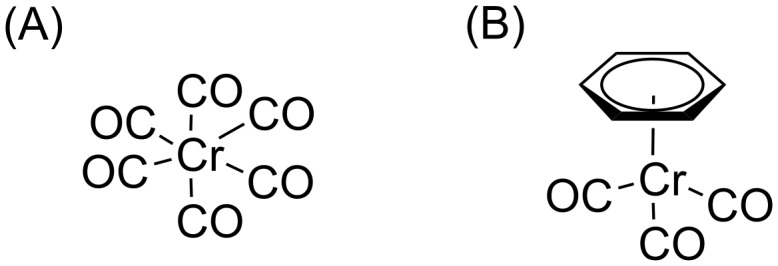
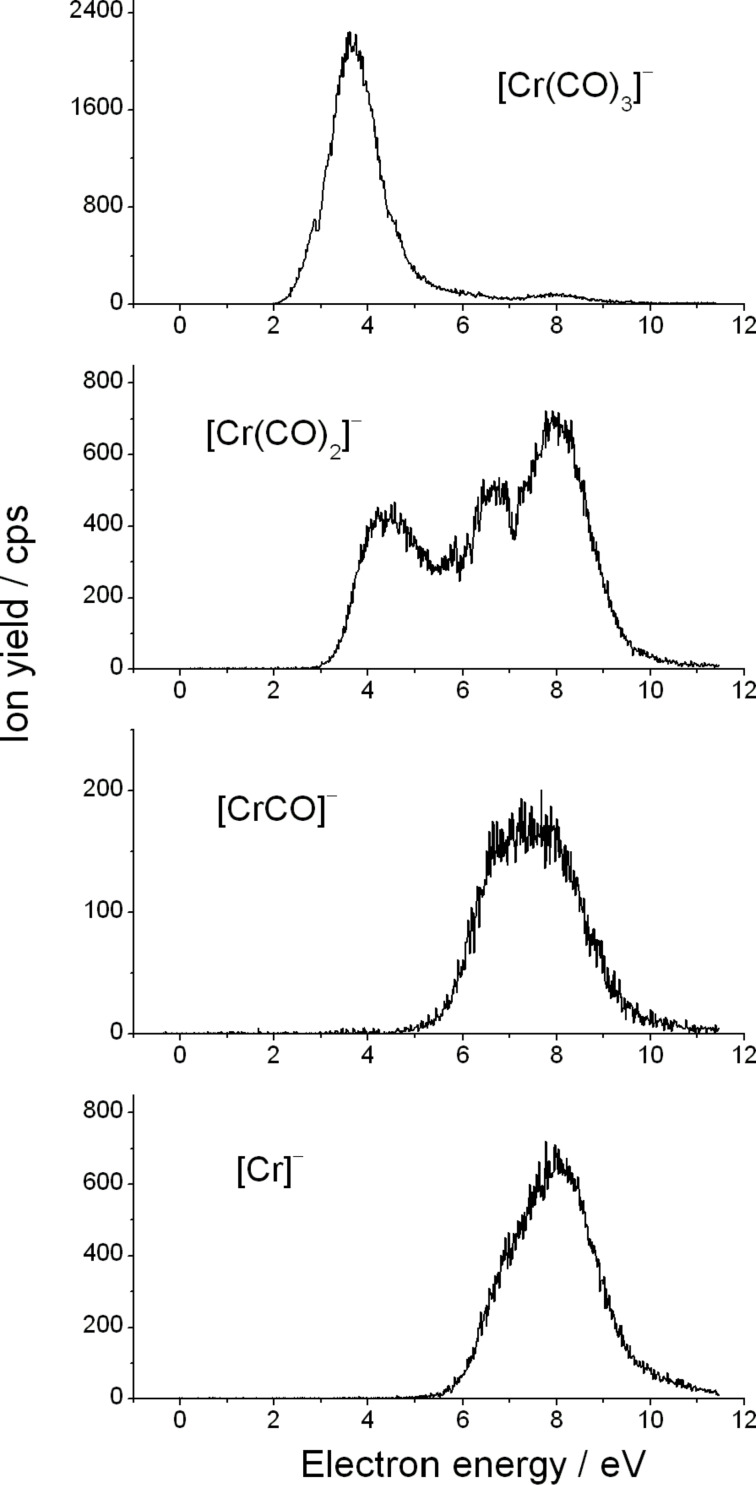
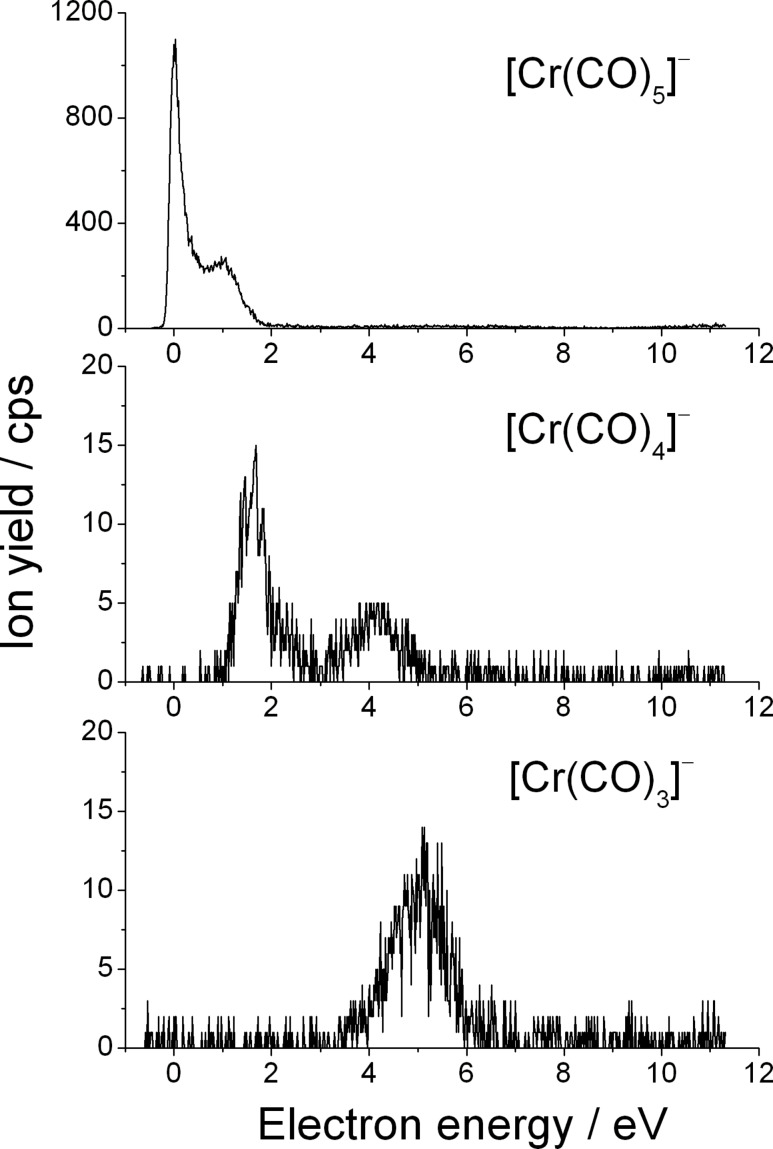
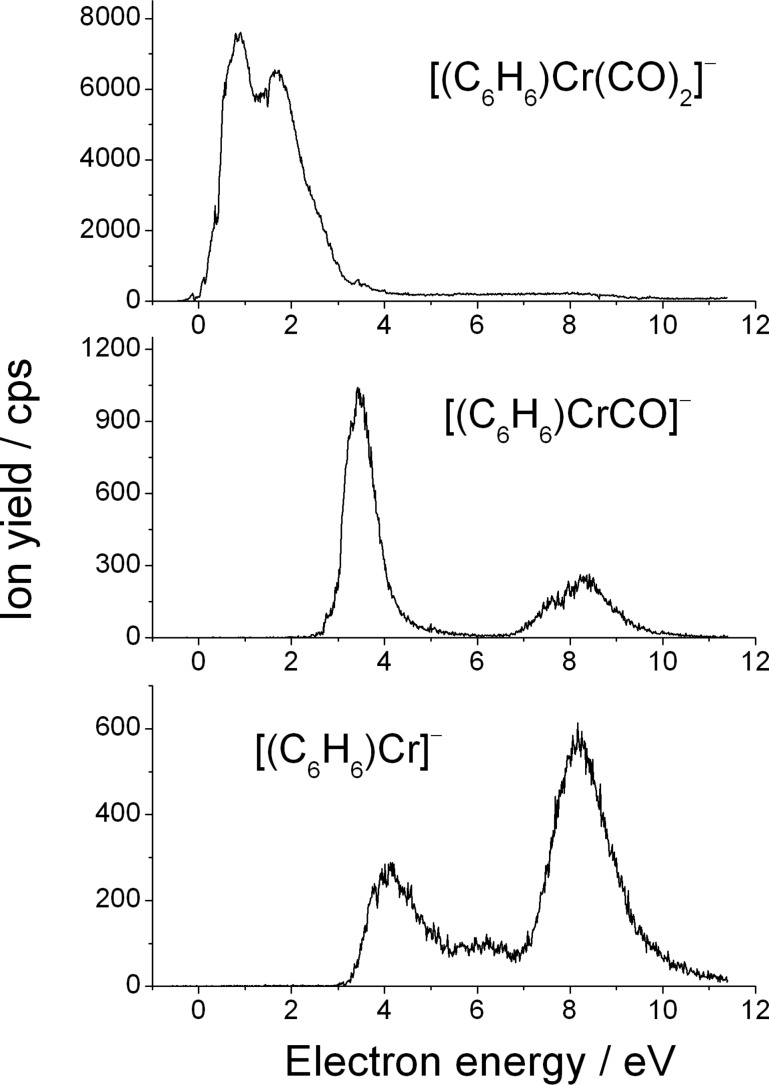
Here we report the results of dissociative electron attachment (DEA) to gas-phase chromium(0) hexacarbonyl (Cr(CO)) and benzene-chromium(0) tricarbonyl ((η-CH)Cr(CO)) in the energy range of 0-12 eV. Measurements have been performed utilizing an electron-molecular crossed beam setup. It was found that DEA to Cr(CO) results (under the given experimental conditions) in the formation of three fragment anions, namely [Cr(CO)], [Cr(CO)], and [Cr(CO)]. The predominant reaction channel is the formation of [Cr(CO)] due to the loss of one CO ligand from the transient negative ion. The [Cr(CO)] channel is visible via two overlapping resonant structures appearing in the energy range below 1.5 eV with a dominant structure peaking at around 0 eV. The peak maxima of the fragments generated by the loss of two or three CO ligands are blue-shifted and the most intense peaks within the ion yield curves appear at 1.4 eV and 4.7 eV, respectively. (η-CH)Cr(CO) shows a very rich fragmentation pattern with decomposition leading to the formation of seven fragment anions. Three of them are generated from the cleavage of one, two or three CO ligand(s). The energy of the peak maxima of the [(CH)Cr(CO)], [(CH)Cr(CO)], and [(CH)Cr] fragments is shifted towards higher energy with respect to the position of the respective fragments generated from Cr(CO). This phenomenon is most likely caused by the fact that chromium-carbonyl bonds are stronger in the heteroleptic complex (η-CH)Cr(CO) than in homoleptic Cr(CO). Besides, we have observed the formation of anions due to the loss of CH and one or more CO units. Finally, we found that Cr, when stripped of all ligands, is generated through a high-energy resonance, peaking at 8 eV.
在此,我们报告了在0至12电子伏特能量范围内,气相六羰基铬(0)(Cr(CO)₆)和苯三羰基铬(0)((η⁶-C₆H₆)Cr(CO)₃)的离解电子附着(DEA)结果。测量是利用电子-分子交叉束装置进行的。结果发现,在给定实验条件下,Cr(CO)₆的DEA会形成三种碎片阴离子,即[Cr(CO)₅]⁻、[Cr(CO)₄]²⁻和[Cr(CO)₃]³⁻。主要反应通道是由于瞬态负离子失去一个CO配体而形成[Cr(CO)₅]⁻。[Cr(CO)₅]⁻通道通过在低于1.5电子伏特能量范围内出现的两个重叠共振结构可见,其中一个主要结构在约0电子伏特处达到峰值。失去两个或三个CO配体产生的碎片的峰值最大值发生蓝移,离子产率曲线中最强烈的峰值分别出现在1.4电子伏特和4.7电子伏特处。(η⁶-C₆H₆)Cr(CO)₃显示出非常丰富的碎片化模式,分解会导致形成七种碎片阴离子。其中三种是由一个、两个或三个CO配体的断裂产生的。[(C₆H₆)Cr(CO)₂]⁻、[(C₆H₆)Cr(CO)]⁻和[(C₆H₆)Cr]⁻碎片的峰值最大值能量相对于由Cr(CO)₆产生的相应碎片的位置向更高能量移动。这种现象很可能是由于异质配合物(η⁶-C₆H₆)Cr(CO)₃中的铬-羰基键比同质Cr(CO)₆中的更强。此外,我们还观察到由于失去C₆H₆和一个或多个CO单元而形成阴离子。最后,我们发现当Cr失去所有配体时,是通过一个在8电子伏特处达到峰值的高能共振产生的。