Development Planning, Clinical Development Center, Asahi Kasei Pharma Corporation, 1-105 Kanda Jinbocho, Chiyoda-ku, Tokyo, 101-8101, Japan.
Certara G.K, 4-2-12, Toranomon, Minato-ku, Tokyo, 105-0001, Japan.
Osteoporos Int. 2018 May;29(5):1155-1163. doi: 10.1007/s00198-018-4376-1. Epub 2018 Feb 8.
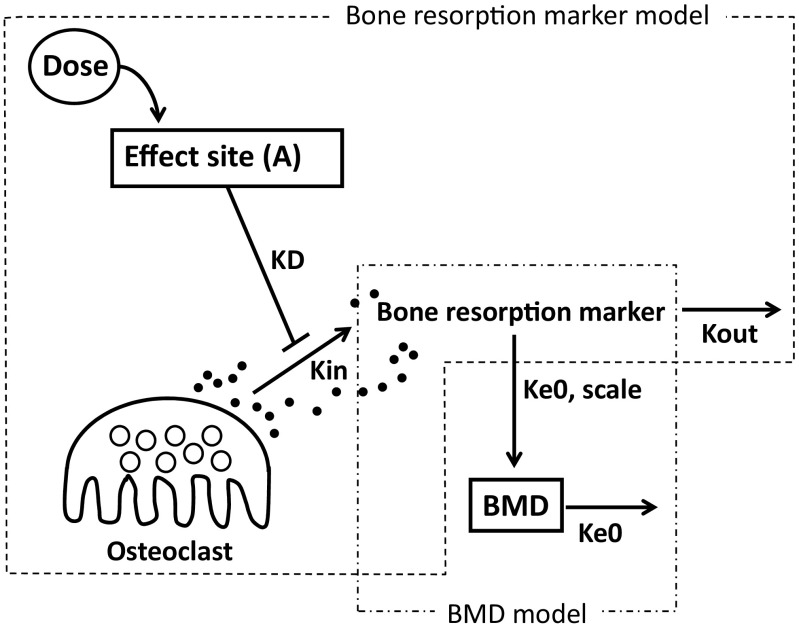
Annual intravenous administration of zoledronic acid is used in the treatment of osteoporosis. A mathematical model was developed to predict bone mineral density up to 2 years after two annual doses of zoledronic acid from the early values of a bone resorption marker in osteoporosis patients.
The measurement of bone mineral density (BMD) has been used as a surrogate marker instead of the observation of incident fractures to detect the efficacy of treatment. However, this method requires a long time to obtain significant changes. On the other hand, bone resorption markers respond to bone resorption inhibitors within a few weeks. Therefore, the aim of this study was to develop a mathematical model predicting long-term BMD after two annual doses of zoledronic acid (ZOL) using the early response of a bone resorption marker in osteoporosis patients.
The model was constructed using 3410 tartrate-resistant acid phosphatase 5b (TRACP-5b) serum concentrations and 1146 lumbar spine (L2-L4) BMD values from 306 patients with primary osteoporosis. A mathematical model was developed to describe the time-dependent profiles of TRACP-5b and BMD.
The percentage changes from baseline of the BMD (%BMD) at up to 2 years were predicted from patients' baseline BMD and baseline and 12-week TRACP-5b values by the model obtained. The simulated 90% prediction interval almost covered the observed %BMD distribution at each time point, and the predictions were comparable to the observed %BMD.
This is the first model to predict BMD for up to 2 years following two annual doses of ZOL using patients' background characteristics and the early response of TRACP-5b. This model allows us to inform patients at the initial stage of ZOL treatment of their predicted response to treatment.
唑来膦酸每年静脉给药用于骨质疏松症的治疗。本研究构建了一个数学模型,用于预测接受两次唑来膦酸(zoledronic acid,ZOL)年度治疗后 2 年内的骨密度(bone mineral density,BMD),该模型基于骨质疏松症患者骨吸收标志物的早期值。
骨密度(bone mineral density,BMD)的测量已被用作替代观察骨折事件的替代指标,以检测治疗效果。然而,这种方法需要很长时间才能获得显著变化。另一方面,骨吸收标志物在数周内对骨吸收抑制剂有反应。因此,本研究旨在使用骨质疏松症患者骨吸收标志物的早期反应,构建一个预测两次 ZOL 年度治疗后长期 BMD 的数学模型。
该模型是基于 306 例原发性骨质疏松症患者的 3410 次抗酒石酸酸性磷酸酶 5b(tartrate-resistant acid phosphatase 5b,TRACP-5b)血清浓度和 1146 次腰椎(L2-L4)BMD 值构建的。建立了一个数学模型来描述 TRACP-5b 和 BMD 的时间依赖性特征。
通过该模型,从患者的基线 BMD 以及基线和 12 周时的 TRACP-5b 值,预测了治疗后 2 年内 BMD 的百分比变化(%BMD)。模拟的 90%预测区间几乎覆盖了每个时间点的观察到的%BMD 分布,预测结果与观察到的%BMD 相似。
这是第一个使用患者的背景特征和 TRACP-5b 的早期反应来预测接受两次 ZOL 年度治疗后长达 2 年的 BMD 的模型。该模型可以让我们在 ZOL 治疗的初始阶段告知患者他们对治疗的预期反应。