Bengtson Angela M, Pence Brian W, Eaton Ellen F, Edwards Jessie K, Eron Joseph J, Mathews William C, Mollan Katie, Moore Richard D, O'Cleirigh Connall, Geng Elvin, Mugavero Michael J
Department of Epidemiology, Brown University, Providence, RI, USA.
Department of Epidemiology, University of North Carolina at Chapel Hill, Chapel Hill, NC, USA.
Antivir Ther. 2018;23(4):363-372. doi: 10.3851/IMP3223.
Efavirenz has been a mainstay of antiretroviral therapy (ART) for over 15 years in the US. Its association with neuropsychiatric side effects may influence clinical prescribing and management.
We included HIV-infected adults enrolled in care at seven sites across the US, who initiated combination ART between 1999 and 2015. We examined the proportion initiating and continuing on efavirenz, overall and by mental health status. Log binomial and Cox models were used to estimate associations between mental health, clinical and sociodemographic characteristics and initiating or switching from efavirenz as first-line ART.
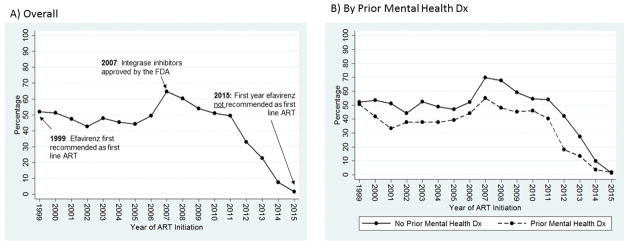
Of the 8,230 participants included, 3,710 (45%) initiated efavirenz. In multivariable analyses, prior mono- or dual-ART, ART initiation after 2006, being female, intravenous drug use, antidepressant prescription, previous mental health diagnosis and baseline CD4 T-cell count >350 cells/mm were inversely associated with initiating efavirenz. Participants initiating efavirenz had a faster time to a regimen switch, compared with those initiating an efavirenz-free regimen (P-value <0.01). Among efavirenz initiators, starting efavirenz in more recent time periods and a previous mental health diagnosis were associated with faster time to switching from efavirenz. Despite this, 40-50% of participants with a previous mental health diagnosis initiated and continued on efavirenz for much of the follow-up period.
Multiple clinical factors, including mental health diagnoses, appeared to influence efavirenz use. While mental health diagnosis status and more recent treatment starts were associated with shorter duration of efavirenz therapy, a previous mental health diagnosis did not preclude efavirenz initiation or continuation in many participants.
在美国,依法韦仑一直是抗逆转录病毒疗法(ART)15 年多来的主要药物。其与神经精神副作用的关联可能会影响临床处方和管理。
我们纳入了在美国七个地点接受治疗的 HIV 感染成人,他们在 1999 年至 2015 年间开始接受联合抗逆转录病毒疗法。我们按心理健康状况总体以及分别考察了开始使用和继续使用依法韦仑的比例。使用对数二项式模型和 Cox 模型来估计心理健康、临床及社会人口学特征与开始使用或从依法韦仑转换为一线抗逆转录病毒疗法之间的关联。
在纳入的 8230 名参与者中,3710 人(45%)开始使用依法韦仑。在多变量分析中,既往接受过单药或双药抗逆转录病毒疗法、2006 年后开始抗逆转录病毒治疗、女性、静脉吸毒、抗抑郁药处方、既往心理健康诊断以及基线 CD4 T 细胞计数>350 个细胞/mm³与开始使用依法韦仑呈负相关。与开始使用不含依法韦仑方案的参与者相比,开始使用依法韦仑的参与者改用其他方案的时间更快(P 值<0.01)。在开始使用依法韦仑的参与者中,在最近时间段开始使用依法韦仑以及既往有心理健康诊断与从依法韦仑转换的时间更快有关。尽管如此,在大部分随访期间,40 - 50%既往有心理健康诊断的参与者开始并继续使用依法韦仑。
包括心理健康诊断在内的多种临床因素似乎会影响依法韦仑的使用。虽然心理健康诊断状况和更近的治疗开始时间与依法韦仑治疗持续时间较短有关,但既往心理健康诊断并未妨碍许多参与者开始或继续使用依法韦仑。