Department of Medicine, Duke University Medical Center, Durham, NC.
Inova Heart & Vascular Institute, Falls Church, VA.
J Am Heart Assoc. 2018 Feb 3;7(3):e006740. doi: 10.1161/JAHA.117.006740.
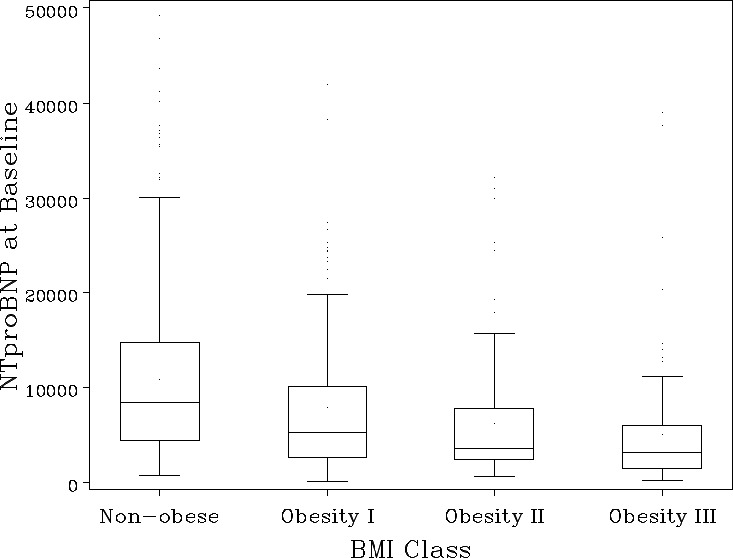
Higher body mass index (BMI) is associated with lower circulating levels of N-terminal-pro-b-type natriuretic peptide (NT-proBNP). The Interaction between BMI and NT-proBNP with respect to clinical outcomes is not well characterized in patients with acute heart failure.
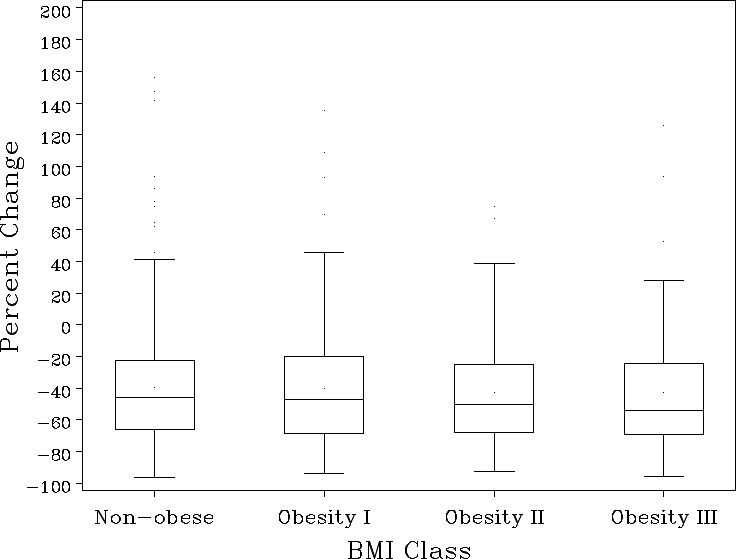
A total of 686 patients from the biomarker substudy of the ASCEND-HF (Acute Study of Clinical Effectiveness of Nesiritide in Decompensated HF ) clinical trial with documented NT-proBNP levels at baseline were included in the present analysis. Patients were classified by the World Health Organization obesity classification (nonobese: BMI <30 kg/m, Class I obesity: BMI 30-34.9 kg/m, Class II obesity BMI 35-39.9 kg/m, and Class III obesity BMI ≥40 kg/m). We assessed baseline characteristics and 30- and 180-day outcomes by BMI class and explored the interaction between BMI and NT-proBNP for these outcomes. Study participants had a median age of 67 years (55, 78) and 71% were female. NT-proBNP levels were inversely correlated with BMI (<0.001). Higher NT-proBNP levels were associated with higher 180-day mortality (adjusted hazard ratio for each doubling of NT-proBNP, 1.40; 95% confidence interval, 1.16, 1.71; <0.001), but not 30-day outcomes. The effect of NT-proBNP on 180-day death was not modified by BMI class (interaction =0.24).
The prognostic value of NT-proBNP was not modified by BMI in this acute heart failure population. NT-proBNP remains a useful prognostic indicator of long-term mortality in acute heart failure even in the obese patient.
URL: http://www.clinicaltrials.gov. Unique identifier: NCT00475852.
较高的体重指数(BMI)与循环中 N 末端前 B 型利钠肽(NT-proBNP)水平较低有关。在急性心力衰竭患者中,BMI 与 NT-proBNP 对临床结局的相互作用尚不清楚。
共纳入了 ASCEND-HF(急性失代偿性心力衰竭中奈西立肽的临床疗效研究)临床试验生物标志物亚研究中 686 例有基线 NT-proBNP 水平记录的患者,这些患者的 BMI 分类为世界卫生组织肥胖分类(非肥胖:BMI<30kg/m2,I 类肥胖:BMI 30-34.9kg/m2,II 类肥胖 BMI 35-39.9kg/m2,III 类肥胖 BMI≥40kg/m2)。我们按 BMI 分类评估了基线特征和 30 天和 180 天的结局,并探索了 BMI 和 NT-proBNP 对这些结局的交互作用。研究参与者的中位年龄为 67 岁(55 岁,78 岁),71%为女性。NT-proBNP 水平与 BMI 呈负相关(<0.001)。较高的 NT-proBNP 水平与 180 天死亡率较高相关(NT-proBNP 每增加一倍的调整后的危险比,1.40;95%置信区间,1.16,1.71;<0.001),但与 30 天结局无关。NT-proBNP 对 180 天死亡的影响不受 BMI 分类的影响(交互作用=0.24)。
在该急性心力衰竭人群中,NT-proBNP 的预后价值不受 BMI 的影响。即使在肥胖患者中,NT-proBNP 仍然是急性心力衰竭患者长期死亡率的有用预后指标。