Division of Cardiovascular Disease University of Alabama at Birmingham AL.
Department of Medicine University of Alabama at Birmingham AL.
J Am Heart Assoc. 2021 Apr 6;10(7):e018689. doi: 10.1161/JAHA.120.018689. Epub 2021 Mar 23.
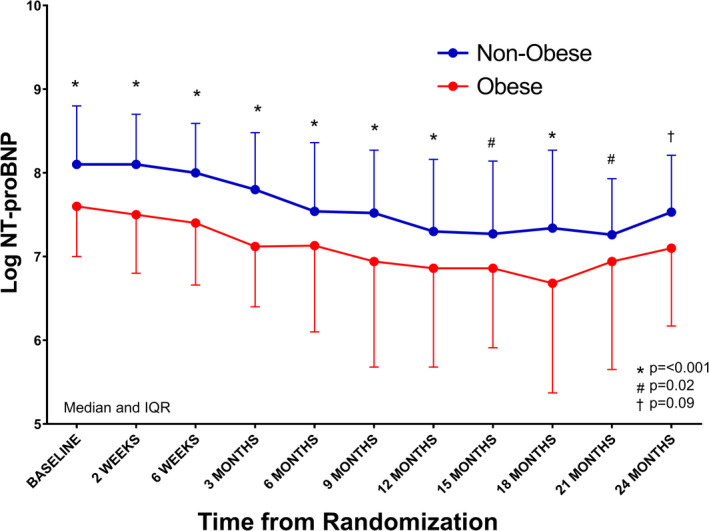
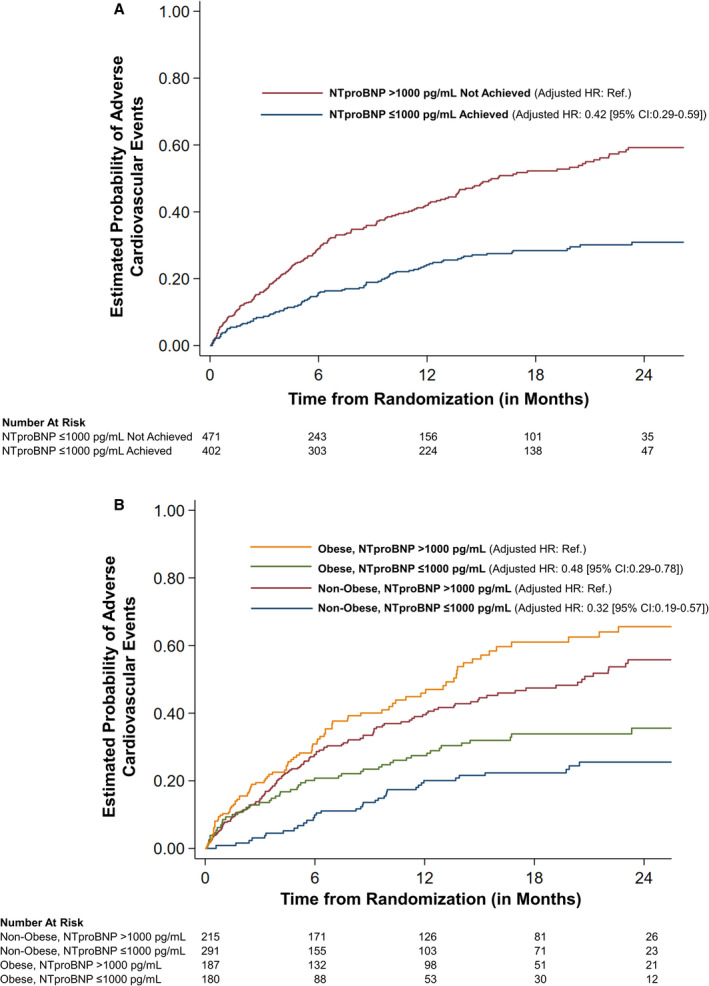
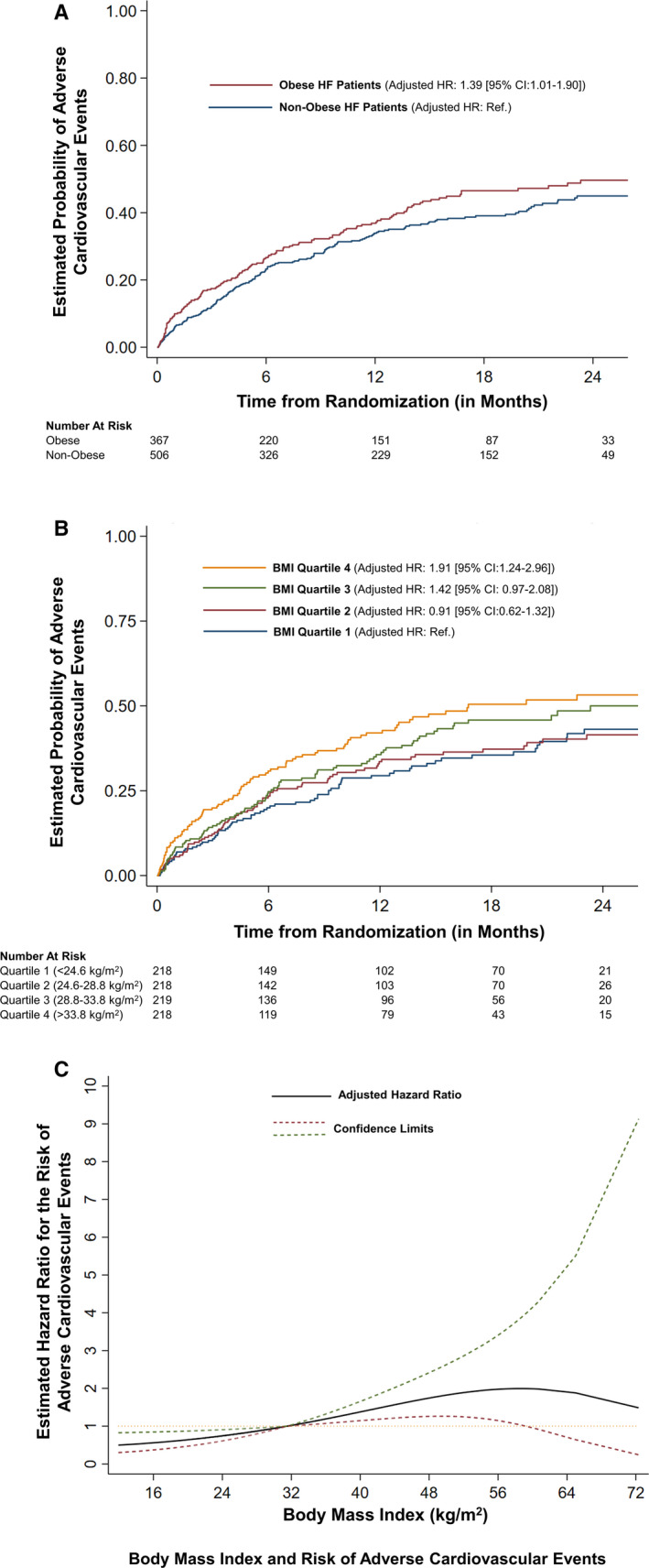
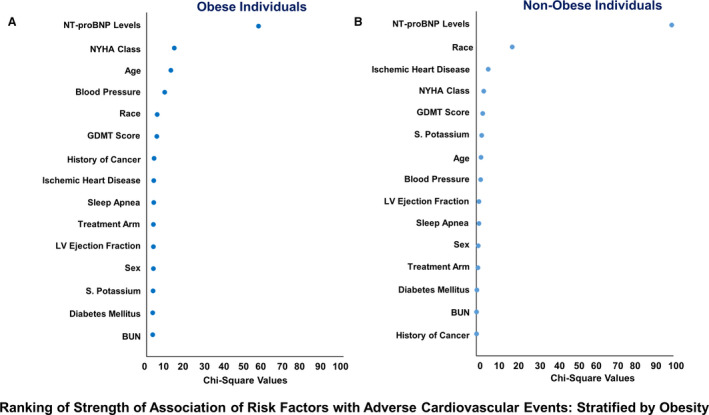
Background Obese patients have lower NT-proBNP (N-terminal pro-B-type natriuretic peptide) levels. The prognostic implications of achieving NT-proBNP levels ≤1000 pg/mL in obese patients with heart failure (HF) receiving biomarker-guided therapy are not completely known. We evaluated the prognostic implications of obesity and having NT-proBNP levels (≤1000 pg/mL) in the GUIDE-IT (Guiding Evidence-Based Therapy Using Biomarker-Intensified Treatment in HF) trial participants. Methods and Results The risk of adverse cardiovascular events (HF hospitalization or cardiovascular mortality) was assessed using multivariable-adjusted Cox proportional hazard models based on having NT-proBNP ≤1000 pg/mL (taken as a time-varying covariate), stratified by obesity status. The study outcome was also assessed on the basis of the body mass index at baseline. The predictive ability of NT-proBNP for adverse cardiovascular events was assessed using the likelihood ratio test. Compared with nonobese patients, obese patients were mostly younger, Black race, and more likely to be women. NT-proBNP levels were 59.0% (95% CI, 39.5%-83.5%) lower among obese individuals. The risk of adverse cardiovascular events was lower in obese (hazard ratio [HR], 0.48; 95% CI, 0.29-0.59) and nonobese (HR, 0.32; 95% CI, 0.19-0.57) patients with HF who had NT-proBNP levels ≤1000 pg/mL, compared with those who did not. There was no interaction between obesity and having NT-proBNP ≤1000 pg/mL on the study outcome (>0.10). Obese patients had a greater risk of developing adverse cardiovascular events (HR, 1.39; 95% CI, 1.01-1.90) compared with nonobese patients. NT-proBNP was the strongest predictor of adverse cardiovascular event risk in both obese and nonobese patients. Conclusions On-treatment NT-proBNP level ≤1000 pg/mL has favorable prognostic implications, irrespective of obesity status. NT-proBNP levels were the strongest predictor of cardiovascular events in both obese and nonobese individuals in this trial. Registration URL: https://www.clinicaltrials.gov; Unique identifier: NCT01685840.
肥胖患者的 N 末端脑利钠肽前体(NT-proBNP)水平较低。对于接受生物标志物指导治疗的心力衰竭(HF)肥胖患者,达到 NT-proBNP 水平≤1000pg/mL 的预后意义尚不完全清楚。我们评估了肥胖和 GUIDE-IT(HF 中使用基于生物标志物的强化治疗指导证据的治疗)试验参与者 NT-proBNP 水平(≤1000pg/mL)对预后的影响。
根据 NT-proBNP≤1000pg/mL(作为时变协变量),使用多变量调整 Cox 比例风险模型评估不良心血管事件(HF 住院或心血管死亡率)的风险,并根据肥胖状况进行分层。还根据基线时的体重指数评估研究结果。使用似然比检验评估 NT-proBNP 对不良心血管事件的预测能力。与非肥胖患者相比,肥胖患者更年轻,为黑人,且更可能为女性。肥胖个体的 NT-proBNP 水平低 59.0%(95%CI,39.5%-83.5%)。与 NT-proBNP 水平不高的肥胖(危险比[HR],0.48;95%CI,0.29-0.59)和非肥胖(HR,0.32;95%CI,0.19-0.57)HF 患者相比,HF 患者的不良心血管事件风险更低。肥胖和 NT-proBNP≤1000pg/mL 对研究结果(>0.10)之间没有相互作用。与非肥胖患者相比,肥胖患者发生不良心血管事件的风险更高(HR,1.39;95%CI,1.01-1.90)。在肥胖和非肥胖患者中,NT-proBNP 是不良心血管事件风险的最强预测因素。
治疗过程中 NT-proBNP 水平≤1000pg/mL 具有良好的预后意义,与肥胖状态无关。在该试验中,NT-proBNP 是肥胖和非肥胖个体心血管事件的最强预测因素。