Rakotonirina Hanitriniaina, Kappeler Peter M, Fichtel Claudia
Behavioral Ecology & Sociobiology Unit, German Primate Center, Göttingen, Germany.
Department of Sociobiology/Anthropology, Johann-Friedrich-Blumenbach Institute for Zoology, Georg-August University, Göttingen, Germany.
BMC Evol Biol. 2018 Feb 13;18(1):19. doi: 10.1186/s12862-018-1126-0.
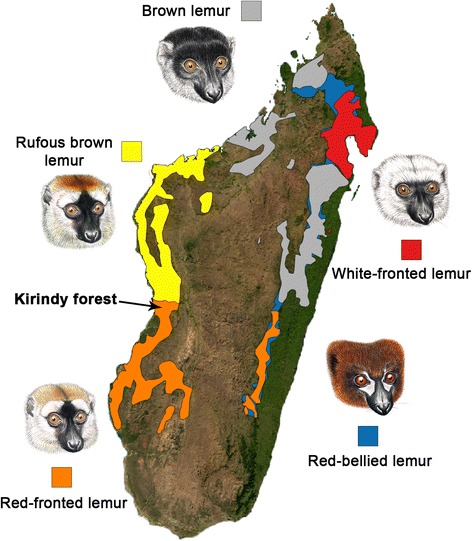
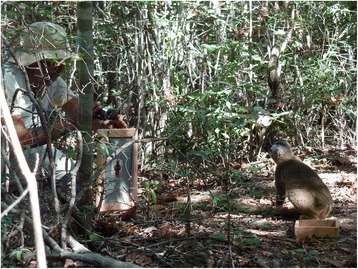
Species recognition, i.e., the ability to distinguish conspecifics from heterospecifics, plays an essential role in reproduction. The role of facial cues for species recognition has been investigated in several non-human primate species except for lemurs. We therefore investigated the role of facial cues for species recognition in wild red-fronted lemurs (Eulemur rufifrons) at Kirindy Forest. We presented adult red-fronted lemurs pictures of male faces from five species including red-fronted lemurs, three closely related species, white-fronted lemurs (E. albifrons), brown lemurs (E. fulvus), rufous brown lemurs (E. rufus), and genetically more distant red-bellied lemurs (E. rubriventer), occurring in allopatry with the study population. We predicted that red-fronted lemurs respond stronger to conspecific than to heterospecific pictures and that females show stronger responses than males. In addition, if genetic drift has played a role in the evolution of facial color patterns in the members of this genus, we predicted that responses of red-fronted lemurs correlate negatively with the genetic distance to the different species stimuli.
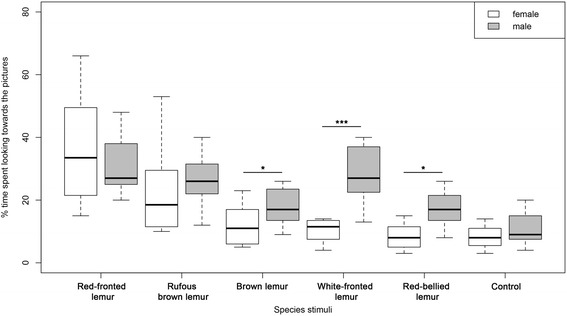
Red-fronted lemurs looked significantly longer at pictures of their own species than at those of heterospecifics. Females spent less time looking at pictures of white-fronted, brown and red-bellied lemurs than males did, but not to pictures of red-bellied lemurs and a control stimulus. Individuals also exhibited sniffing behavior while looking at visual stimuli, and the time spent sniffing was significantly longer for pictures of conspecifics compared to those of heterospecifics. Moreover, the time spent looking and sniffing towards the pictures correlated negatively with the genetic distance between their own species and the species presented as stimulus.
We conclude that red-fronted lemurs have the ability for species recognition using visual facial cues, which may allow them to avoid costly interbreeding. If so, sexual selection might have influenced the evolution of facial patterns in eulemurs. Since responses also correlated with genetic distance, our findings suggest a potential role of genetic drift as well as sexual selection in influencing the evolution of facial variation in eulemurs. Because study subjects looked and sniffed towards the presented pictures, red-fronted lemurs might have the ability for multi-modal species recognition.
物种识别,即区分同种个体与异种个体的能力,在繁殖过程中起着至关重要的作用。除狐猴外,面部线索在几种非人类灵长类动物物种的物种识别中的作用已得到研究。因此,我们研究了面部线索在基林迪森林野生红额狐猴(Eulemur rufifrons)物种识别中的作用。我们向成年红额狐猴展示了来自五个物种的雄性面部图片,包括红额狐猴、三个近缘物种,即白额狐猴(E. albifrons)、褐狐猴(E. fulvus)、棕褐狐猴(E. rufus),以及在地理分布上与研究种群异域分布的亲缘关系较远的红腹狐猴(E. rubriventer)。我们预测,红额狐猴对同种图片的反应比对异种图片的反应更强烈,且雌性的反应比雄性更强烈。此外,如果基因漂变在该属成员面部颜色模式的进化中起了作用,我们预测红额狐猴的反应与不同物种刺激的遗传距离呈负相关。
红额狐猴看自己物种图片的时间明显长于看异种图片的时间。雌性看白额、褐和红腹狐猴图片的时间比雄性少,但看红腹狐猴图片和对照刺激物的时间并非如此。个体在看视觉刺激物时也表现出嗅闻行为,与看异种图片相比,看同种图片时嗅闻的时间明显更长。此外,看图片和嗅闻图片所花费的时间与自身物种和作为刺激物呈现的物种之间的遗传距离呈负相关。
我们得出结论,红额狐猴具有利用面部视觉线索进行物种识别的能力,这可能使它们避免代价高昂的杂交。如果是这样,性选择可能影响了狐猴面部模式的进化。由于反应也与遗传距离相关,我们的研究结果表明基因漂变以及性选择在影响狐猴面部变异进化中可能发挥了作用。因为研究对象会看向并嗅闻所呈现的图片,红额狐猴可能具有多模式物种识别能力。