Institute for Health Metrics and Evaluation, University of Washington, Seattle, WA, USA.
Global Enterics, LLC, Seattle, WA, USA.
Lancet Glob Health. 2018 Mar;6(3):e255-e269. doi: 10.1016/S2214-109X(18)30045-7.
Diarrhoea is a leading cause of death and illness globally among children younger than 5 years. Mortality and short-term morbidity cause substantial burden of disease but probably underestimate the true effect of diarrhoea on population health. This underestimation is because diarrhoeal diseases can negatively affect early childhood growth, probably through enteric dysfunction and impaired uptake of macronutrients and micronutrients. We attempt to quantify the long-term sequelae associated with childhood growth impairment due to diarrhoea.
We used the Global Burden of Diseases, Injuries, and Risk Factors Study framework and leveraged existing estimates of diarrhoea incidence, childhood undernutrition, and infectious disease burden to estimate the effect of diarrhoeal diseases on physical growth, including weight and height, and subsequent disease among children younger than 5 years. The burden of diarrhoea was measured in disability-adjusted life-years (DALYs), a composite metric of mortality and morbidity. We hypothesised that diarrhoea is negatively associated with three common markers of growth: weight-for-age, weight-for-height, and height-for-age Z-scores. On the basis of these undernutrition exposures, we applied a counterfactual approach to quantify the relative risk of infectious disease (subsequent diarrhoea, lower respiratory infection, and measles) and protein energy malnutrition morbidity and mortality per day of diarrhoea and quantified the burden of diarrhoeal disease due to these outcomes caused by undernutrition.
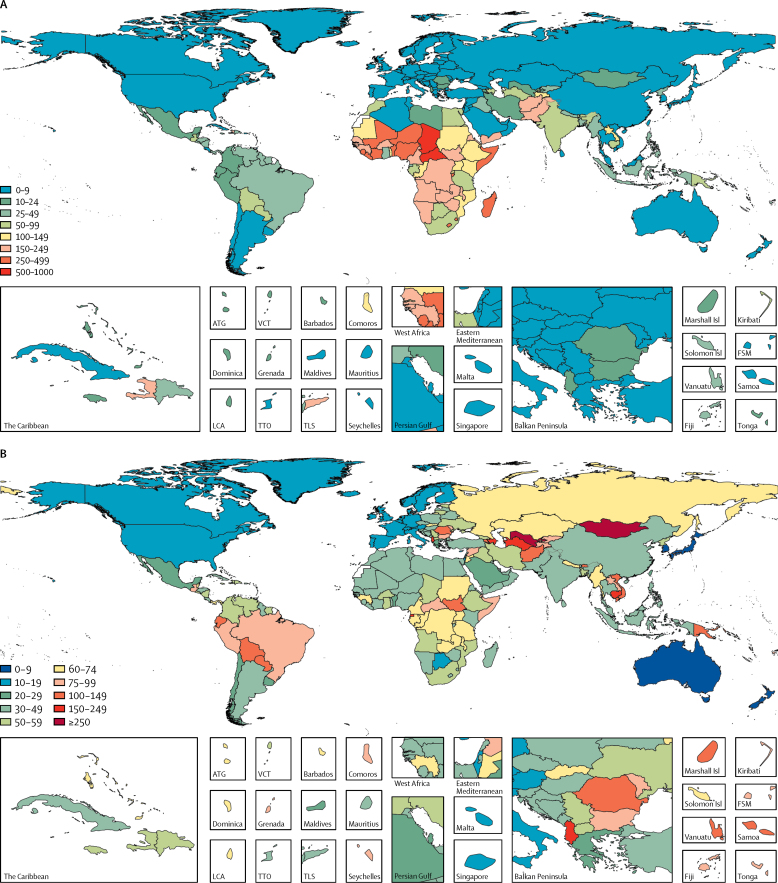
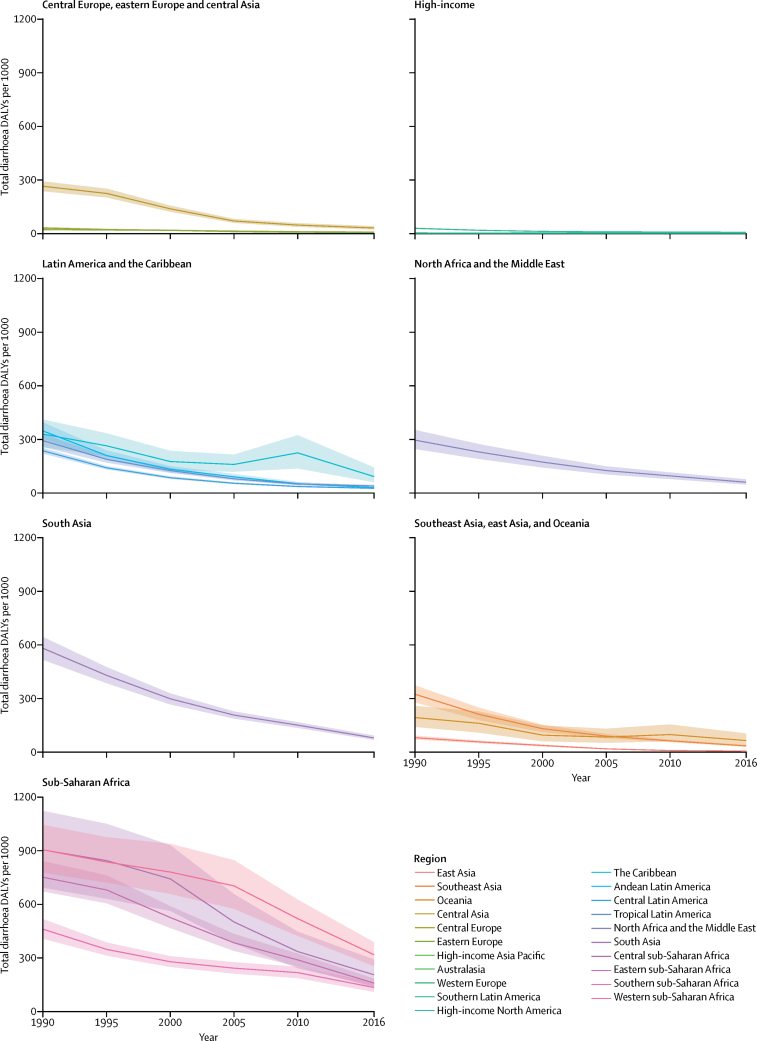
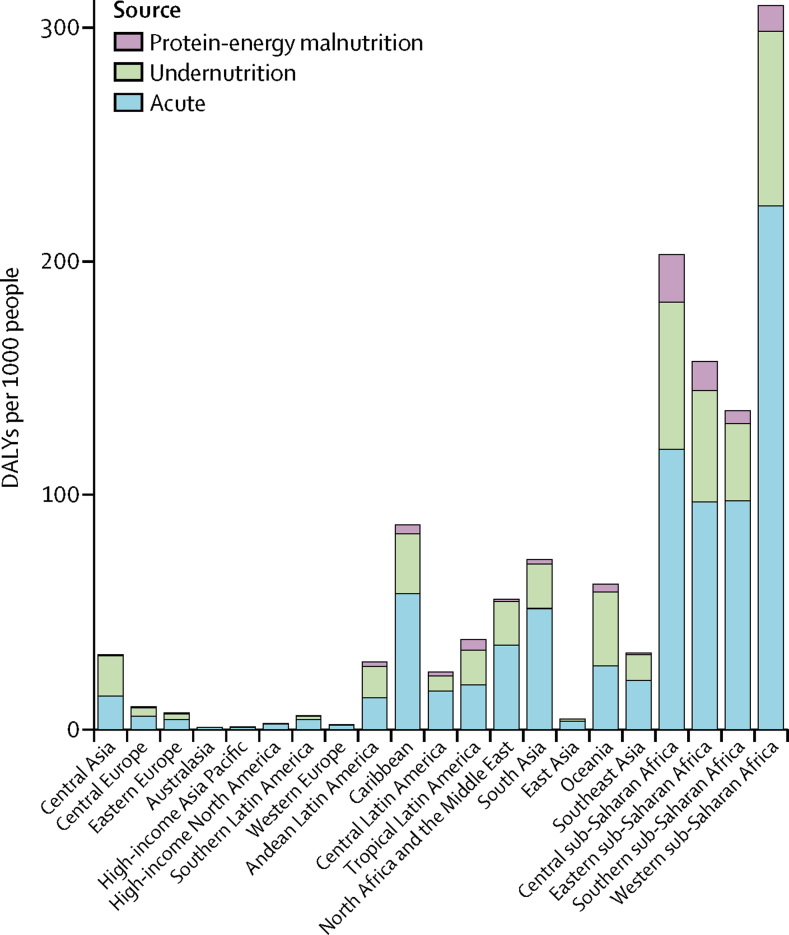
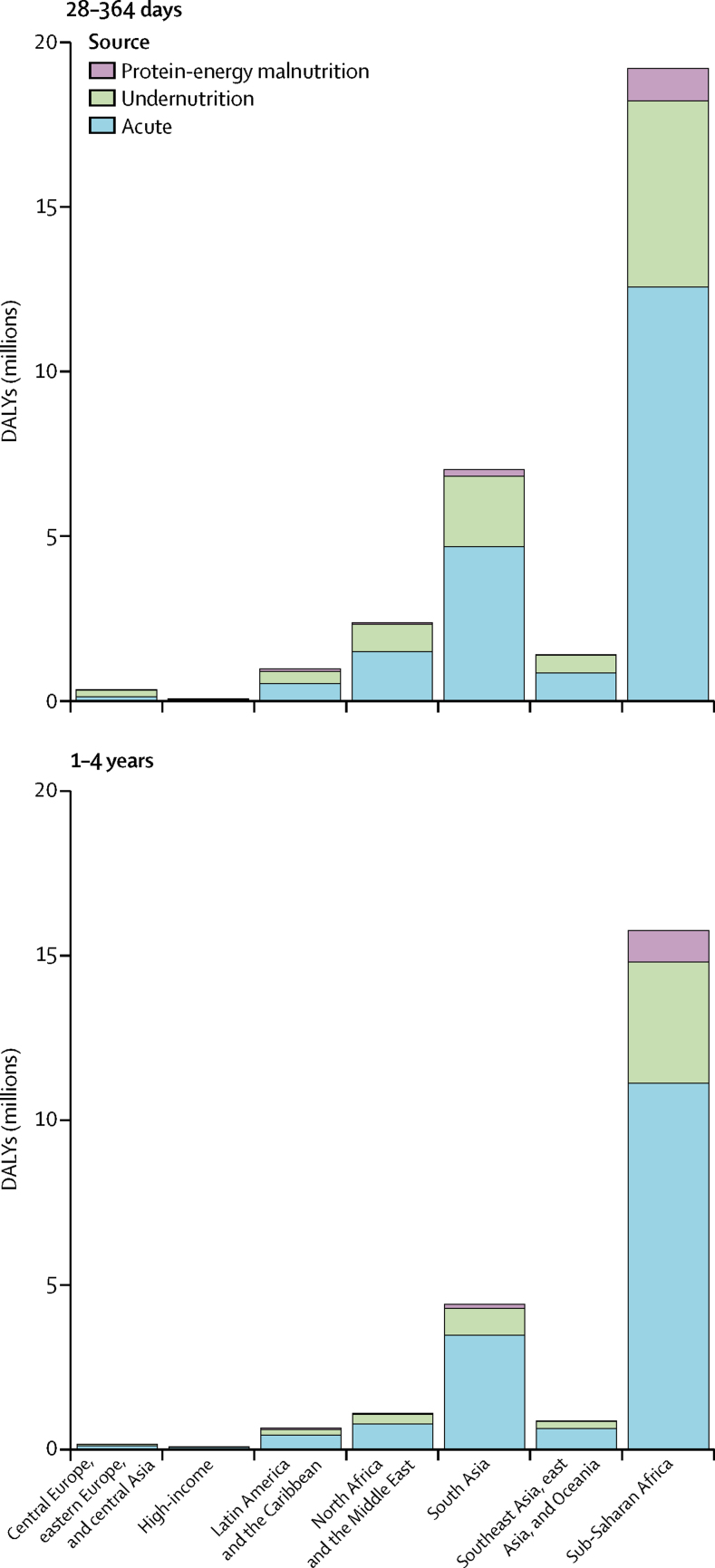
Diarrhoea episodes are significantly associated with childhood growth faltering. We found that each day of diarrhoea was associated with height-for-age Z-score (-0·0033 [95% CI -0·0024 to -0·0041]; p=4·43 × 10), weight-for-age Z-score (-0·0077 [-0·0058 to -0·0097]; p=3·19 × 10), and weight-for-height Z-score (-0·0096 [-0·0067 to -0·0125]; p=7·78 × 10). After addition of the DALYs due to the long-term sequelae as a consequence of undernutrition, the burden of diarrhoeal diseases increased by 39·0% (95% uncertainty interval [UI] 33·0-46·6) and was responsible for 55 778 000 DALYs (95% UI 49 125 400-62 396 200) among children younger than 5 years in 2016. Among the 15 652 300 DALYs (95% UI 12 951 300-18 806 100) associated with undernutrition due to diarrhoeal episodes, more than 84·7% are due to increased risk of infectious disease, whereas the remaining 15·3% of long-term DALYs are due to increased prevalence of protein energy malnutrition. The burden of diarrhoea has decreased substantially since 1990, but progress has been greater in long-term (78·7% reduction [95% UI 69·3-85·5]) than in acute (70·4% reduction [95% UI 61·7-76·5]) DALYs.
Diarrhoea represents an even larger burden of disease than was estimated in the Global Burden of Disease Study. In order to adequately address the burden of its long-term sequelae, a renewed emphasis on controlling the risk of diarrhoea incidence may be required. This renewed effort can help further prevent the potential lifelong cost on child health, growth, and overall potential.
Bill & Melinda Gates Foundation.
腹泻是全球 5 岁以下儿童死亡和发病的主要原因。死亡率和短期发病率导致了大量疾病负担,但可能低估了腹泻对人群健康的真实影响。这种低估是因为腹泻病可能通过肠道功能障碍和减少宏量营养素和微量营养素的吸收,对儿童早期生长产生负面影响。我们试图量化因腹泻导致的儿童生长受损的长期后果。
我们使用全球疾病、伤害和危险因素研究框架,并利用现有的腹泻发病率、儿童营养不良和传染病负担估计数,来估计腹泻病对 5 岁以下儿童的身体生长(包括体重和身高)以及随后的传染病的影响。腹泻病的负担用残疾调整生命年来衡量,残疾调整生命年是死亡和发病的综合指标。我们假设腹泻与三种常见的生长指标呈负相关:体重与年龄、体重与身高和身高与年龄 Z 分数。基于这些营养不良暴露,我们应用反事实方法来量化每天腹泻相关的传染病(随后的腹泻、下呼吸道感染和麻疹)和蛋白质能量营养不良发病和死亡率的相对风险,并量化由于这些由营养不良引起的腹泻病结果导致的腹泻病负担。
腹泻病与儿童生长迟缓显著相关。我们发现,每天腹泻与身高与年龄 Z 分数呈负相关(-0.0033 [95%置信区间 -0.0024 至 -0.0041];p=4.43 × 10),体重与年龄 Z 分数呈负相关(-0.0077 [-0.0058 至 -0.0097];p=3.19 × 10),体重与身高 Z 分数呈负相关(-0.0096 [-0.0067 至 -0.0125];p=7.78 × 10)。在因营养不良的长期后果而导致的 DALY 增加后,腹泻病的负担增加了 39.0%(95%不确定区间 33.0-46.6),导致 2016 年 5 岁以下儿童的 DALY 负担增加了 5577.8 万(95%不确定区间 4912.5 万至 6239.6 万)。在与腹泻病发作相关的 1565.23 万 DALY(95%不确定区间 1295.13 万至 1880.61 万)中,超过 84.7%是由于传染病风险增加所致,而其余 15.3%的长期 DALY 是由于蛋白质能量营养不良的发病率增加所致。自 1990 年以来,腹泻病的负担已大幅下降,但急性(70.4%减少 [95%不确定区间 61.7-76.5])和长期腹泻病(78.7%减少 [95%不确定区间 69.3-85.5])负担的改善情况相比,长期腹泻病的改善情况更为显著。
腹泻病是全球疾病负担研究中估计的疾病负担更大。为了充分解决其长期后果的负担,可能需要重新强调控制腹泻发病率的风险。这种新的努力可以帮助进一步防止腹泻对儿童健康、生长和整体潜力造成潜在的终身影响。
比尔及梅琳达·盖茨基金会。