Centre for Maternal, Adolescent, Reproductive and Child Health (MARCH), London School of Hygiene & Tropical Medicine, London, UK.
Centre Muraz, Bobo Dioulasso, Burkina Faso.
Lancet Glob Health. 2018 Mar;6(3):e330-e341. doi: 10.1016/S2214-109X(18)30004-4.
Media campaigns can potentially reach a large audience at relatively low cost but, to our knowledge, no randomised controlled trials have assessed their effect on a health outcome in a low-income country. We aimed to assess the effect of a radio campaign addressing family behaviours on all-cause post-neonatal under-5 child mortality in rural Burkina Faso.
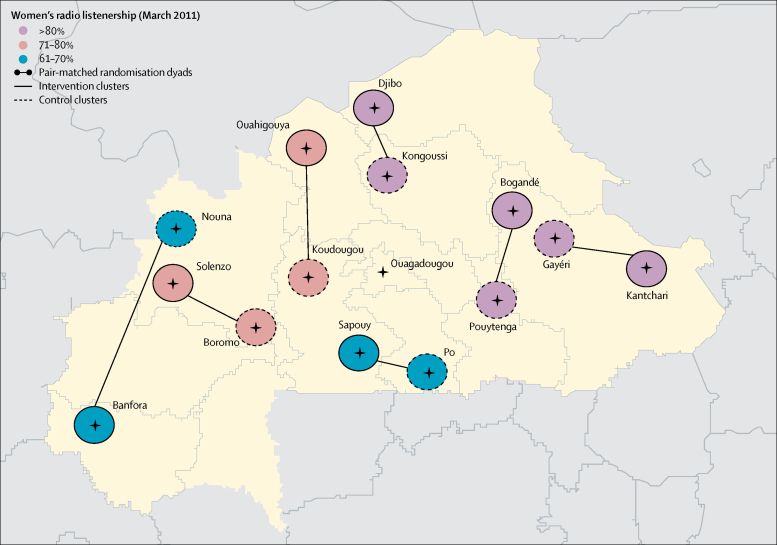
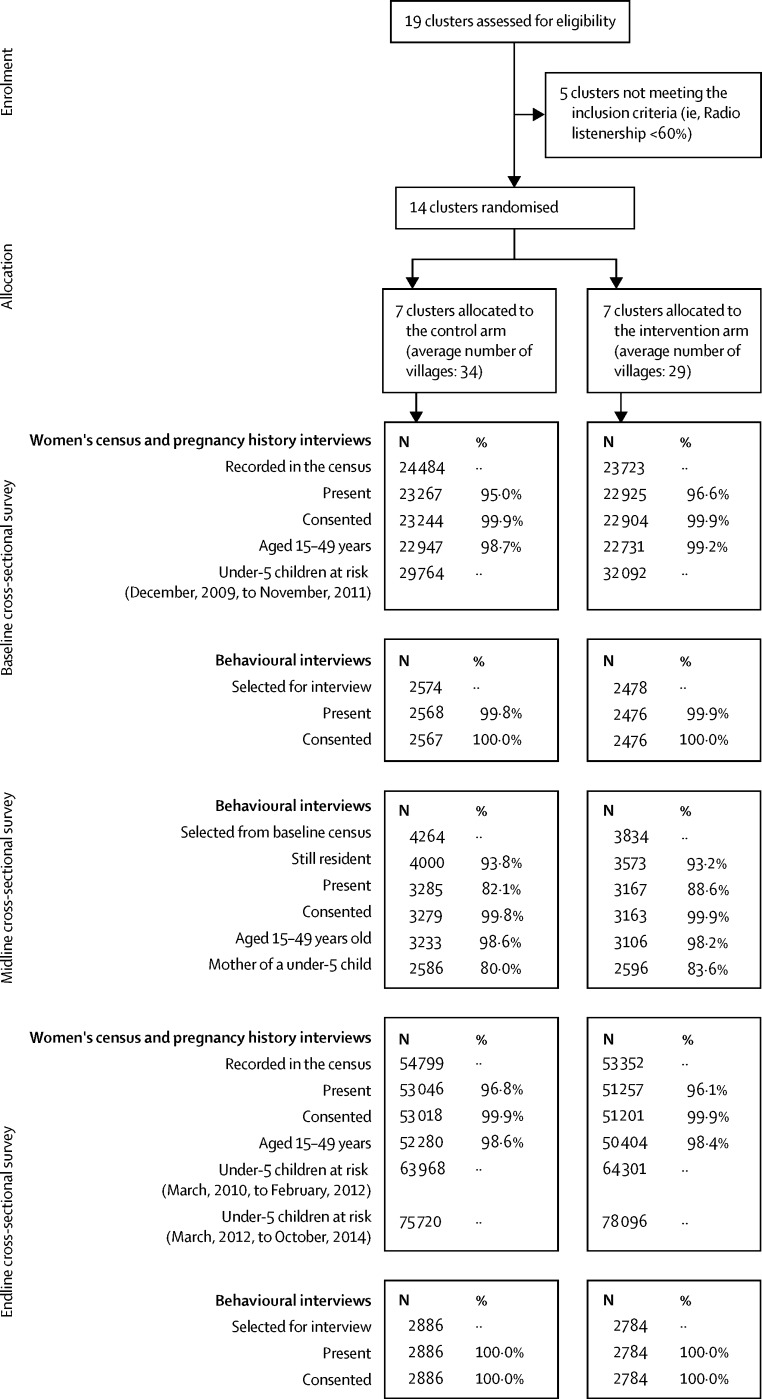
In this repeated cross-sectional, cluster randomised trial, clusters (distinct geographical areas in rural Burkina Faso with at least 40 000 inhabitants) were selected by Development Media International based on their high radio listenership (>60% of women listening to the radio in the past week) and minimum distances between radio stations to exclude population-level contamination. Clusters were randomly allocated to receive the intervention (a comprehensive radio campaign) or control group (no radio media campaign). Household surveys were performed at baseline (from December, 2011, to February, 2012), midline (in November, 2013, and after 20 months of campaigning), and endline (from November, 2014, to March, 2015, after 32 months of campaigning). Primary analyses were done on an intention-to-treat basis, based on cluster-level summaries and adjusted for imbalances between groups at baseline. The primary outcome was all-cause post-neonatal under-5 child mortality. The trial was designed to detect a 20% reduction in the primary outcome with a power of 80%. Routine data from health facilities were also analysed for evidence of changes in use and these data had high statistical power. The indicators measured were new antenatal care attendances, facility deliveries, and under-5 consultations. This trial is registered with ClinicalTrial.gov, number NCT01517230.
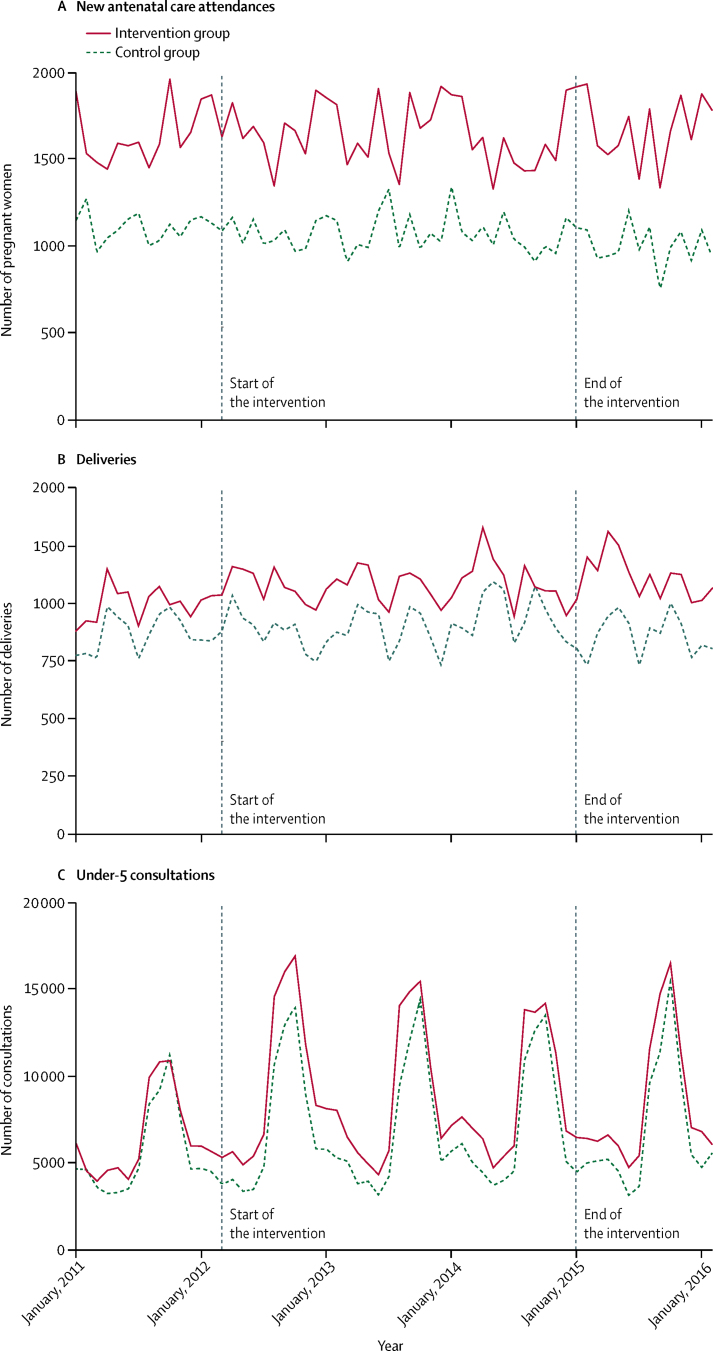
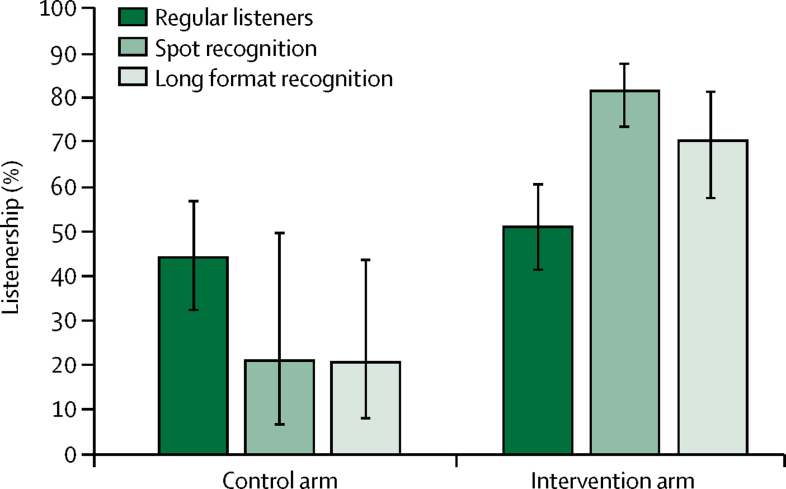
The intervention ran from March, 2012, to January, 2015. 14 clusters were selected and randomly assigned to the intervention group (n=7) or the control group (n=7). The average number of villages included per cluster was 34 in the control group and 29 in the intervention group. 2269 (82%) of 2784 women in the intervention group reported recognising the campaign's radio spots at endline. Post-neonatal under-5 child mortality decreased from 93·3 to 58·5 per 1000 livebirths in the control group and from 125·1 to 85·1 per 1000 livebirths in the intervention group. There was no evidence of an intervention effect (risk ratio 1·00, 95% CI 0·82-1·22; p>0·999). In the first year of the intervention, under-5 consultations increased from 68 681 to 83 022 in the control group and from 79 852 to 111 758 in the intervention group. The intervention effect using interrupted time-series analysis was 35% (95% CI 20-51; p<0·0001). New antenatal care attendances decreased from 13 129 to 12 997 in the control group and increased from 19 658 to 20 202 in the intervention group in the first year (intervention effect 6%, 95% CI 2-10; p=0·004). Deliveries in health facilities decreased from 10 598 to 10 533 in the control group and increased from 12 155 to 12 902 in the intervention group in the first year (intervention effect 7%, 95% CI 2-11; p=0·004).
A comprehensive radio campaign had no detectable effect on child mortality. Substantial decreases in child mortality were observed in both groups over the intervention period, reducing our ability to detect an effect. This, nevertheless, represents the first randomised controlled trial to show that mass media alone can change health-seeking behaviours.
Wellcome Trust and Planet Wheeler Foundation.
媒体活动可以以相对较低的成本覆盖大量受众,但据我们所知,在低收入国家,没有随机对照试验评估过其对健康结果的影响。我们旨在评估一项针对家庭行为的广播活动对布基纳法索农村地区所有原因的新生儿后 5 岁以下儿童死亡率的影响。
在这项重复的横断面、集群随机试验中,集群(布基纳法索农村地区的独特地理区域,至少有 400000 名居民)由发展媒体国际根据其高广播收听率(过去一周中有 60%以上的女性收听广播)和广播电台之间的最小距离选择,以排除人群水平的污染。集群被随机分配接受干预(全面的广播活动)或对照组(没有广播媒体活动)。在基线(2011 年 12 月至 2012 年 2 月)、中期(2013 年 11 月和 20 个月的活动后)和末期(2014 年 11 月至 2015 年 3 月,32 个月的活动后)进行家庭调查。主要分析基于意向治疗原则,根据集群水平的总结进行调整,并针对基线时的组间不平衡进行调整。主要结果是所有原因的新生儿后 5 岁以下儿童死亡率。该试验旨在检测主要结果降低 20%,具有 80%的功效。还对来自卫生设施的常规数据进行了分析,以证明使用情况的变化,这些数据具有很高的统计功效。测量的指标是新的产前保健就诊、医疗机构分娩和 5 岁以下儿童就诊。这项试验在 ClinicalTrial.gov 注册,编号为 NCT01517230。
干预措施从 2012 年 3 月持续到 2015 年 1 月。选择了 14 个集群,并随机分配到干预组(n=7)或对照组(n=7)。对照组每集群平均包括 34 个村庄,干预组包括 29 个村庄。在干预组的 2784 名女性中,2269 名(82%)报告在末期识别出了广播活动的广播点。新生儿后 5 岁以下儿童死亡率从对照组的每 1000 例活产 93.3 例降至 58.5 例,从干预组的每 1000 例活产 125.1 例降至 85.1 例。没有证据表明干预有效果(风险比 1.00,95%CI 0.82-1.22;p>0.999)。在干预的第一年,对照组的 5 岁以下儿童就诊次数从 68681 次增加到 83022 次,从干预组的 79852 次增加到 111758 次。使用中断时间序列分析的干预效果为 35%(95%CI 20-51;p<0.0001)。新的产前保健就诊次数从对照组的 13129 次减少到 12997 次,从干预组的 19658 次增加到 20202 次,在第一年干预效应为 6%(95%CI 2-10;p=0.004)。在对照组中,医疗机构分娩次数从 10598 次减少到 10533 次,从干预组的 12155 次增加到 12902 次,在第一年干预效应为 7%(95%CI 2-11;p=0.004)。
一项全面的广播活动对儿童死亡率没有明显影响。在干预期间,两组的儿童死亡率都显著下降,降低了我们检测效果的能力。尽管如此,这仍然是第一项随机对照试验,表明大众媒体单独可以改变健康寻求行为。
惠康信托基金和行星惠勒基金会。