Numerical Terradynamic Simulation Group, W.A. Franke College of Forestry & Conservation, University of Montana, Missoula, MT, 59812, USA.
Department of Ecosystem and Conservation Sciences, W.A. Franke College of Forestry & Conservation, University of Montana, Missoula, Montana, 59812, USA.
Sci Rep. 2018 Feb 12;8(1):2870. doi: 10.1038/s41598-018-21172-9.
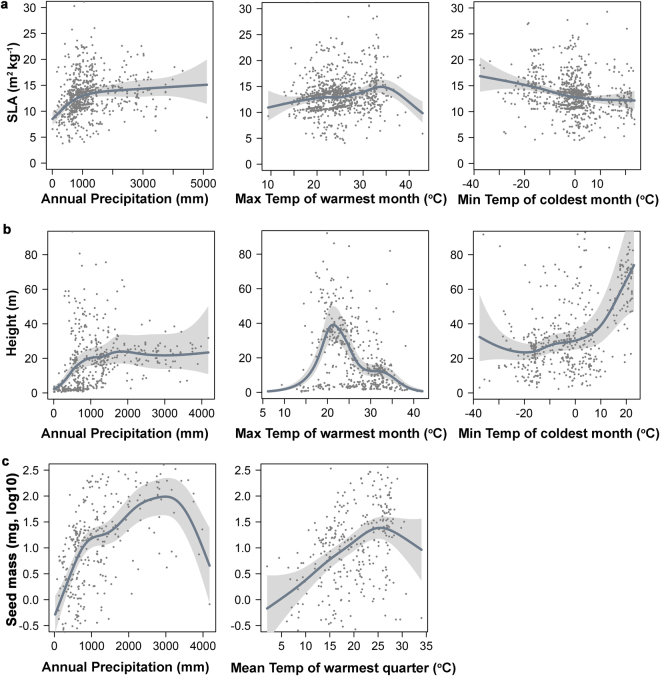
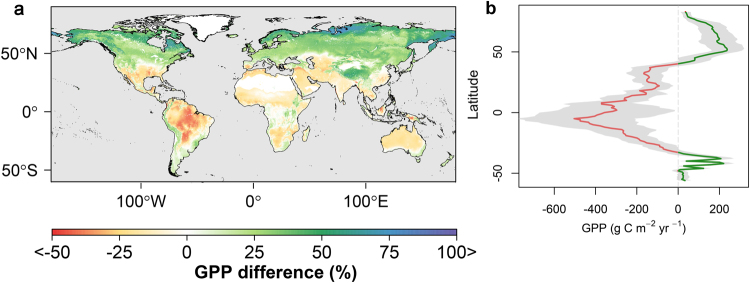
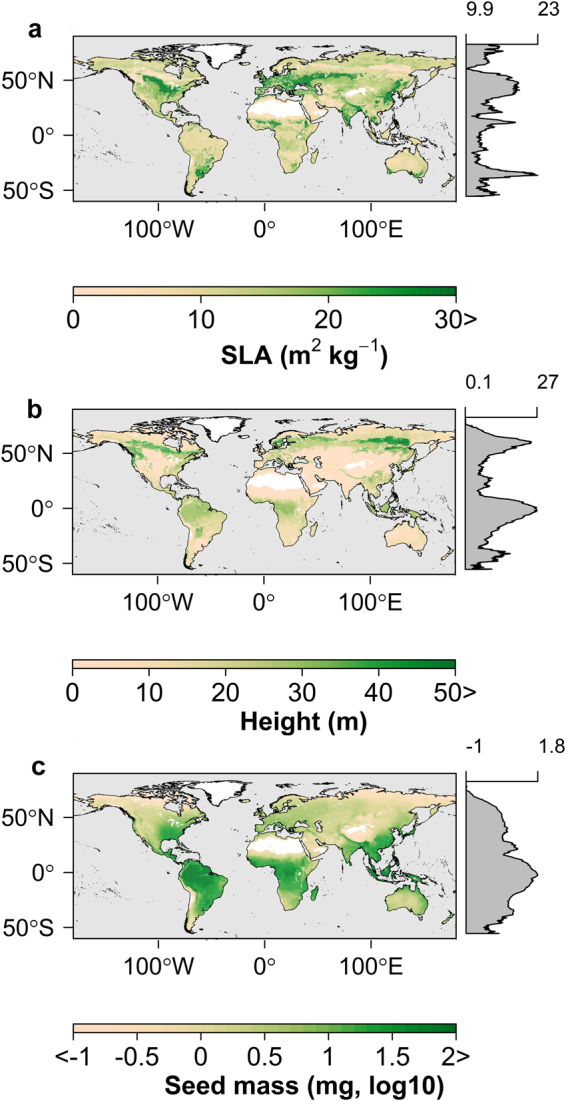
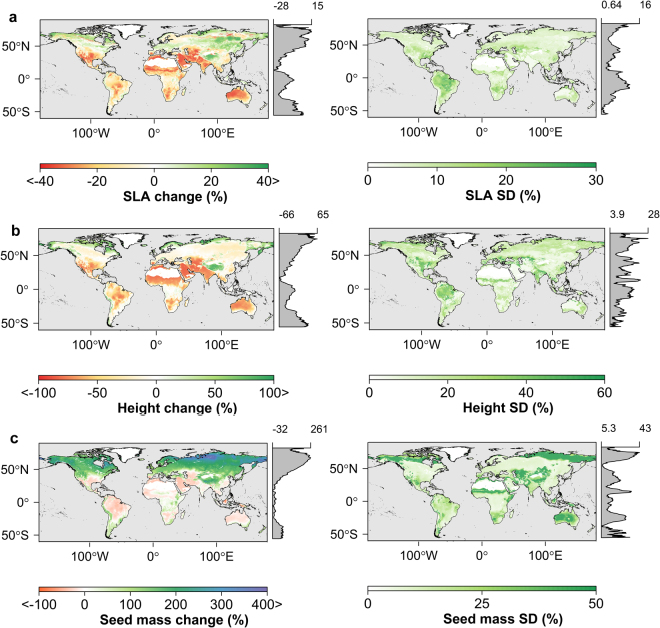
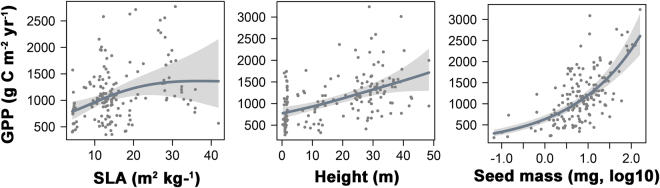
Plant traits are both responsive to local climate and strong predictors of primary productivity. We hypothesized that future climate change might promote a shift in global plant traits resulting in changes in Gross Primary Productivity (GPP). We characterized the relationship between key plant traits, namely Specific Leaf Area (SLA), height, and seed mass, and local climate and primary productivity. We found that by 2070, tropical and arid ecosystems will be more suitable for plants with relatively lower canopy height, SLA and seed mass, while far northern latitudes will favor woody and taller plants than at present. Using a network of tower eddy covariance CO2 flux measurements and the extrapolated plant trait maps, we estimated the global distribution of annual GPP under current and projected future plant community distribution. We predict that annual GPP in northern biomes (≥45 °N) will increase by 31% (+8.1 ± 0.5 Pg C), but this will be offset by a 17.9% GPP decline in the tropics (-11.8 ± 0.84 Pg C). These findings suggest that regional climate changes will affect plant trait distributions, which may in turn affect global productivity patterns.
植物特性既对当地气候有响应,又是初级生产力的重要预测因子。我们假设未来的气候变化可能会促进全球植物特性的转变,从而导致总初级生产力(GPP)的变化。我们描述了关键植物特性(即比叶面积、高度和种子质量)与当地气候和初级生产力之间的关系。我们发现,到 2070 年,热带和干旱生态系统将更适合具有相对较低冠层高度、比叶面积和种子质量的植物,而远北纬度地区将比现在更有利于木本植物和更高的植物。我们利用塔架涡度协方差 CO2 通量测量网络和外推的植物特性图,估计了当前和未来预计的植物群落分布下的全球年 GPP 分布。我们预测,北方生物群系(≥45°N)的年 GPP 将增加 31%(+8.1±0.5Pg C),但热带地区的 GPP 将下降 17.9%(-11.8±0.84Pg C)。这些发现表明,区域气候变化将影响植物特性的分布,这可能反过来又会影响全球生产力模式。