Hatazawa Yuri, Yano Yoshihiko, Okada Rina, Tanahashi Toshihito, Hayashi Hiroki, Hirano Hirotaka, Minami Akihiro, Kawano Yuki, Tanaka Motofumi, Fukumoto Takumi, Murakami Yoshiki, Yoshida Masaru, Hayashi Yoshitake
1Division of Gastroenterology, Department of Internal Medicine, Kobe University Graduate School of Medicine, Kobe, Hyogo 650-0017 Japan.
2Division of Molecular Medicine & Medical Genetics, Department of Pathology, Kobe University Graduate School of Medicine, Kobe, Japan.
Infect Agent Cancer. 2018 Feb 2;13:7. doi: 10.1186/s13027-018-0179-4. eCollection 2018.
Hepatocellular carcinoma (HCC) can develop in patients who are negative for the hepatitis B surface antigen (HBsAg) in serum but positive for hepatitis B virus (HBV) DNA in the liver, referred to as occult HBV infection (OBI). Previous reports showed that HBV variants in OBI-related HCC are different from those in HBsAg-positive HCC. In the present study, HBV quasispecies based on the pre-S/S gene in OBI-related HCC patients were examined by high throughput sequencing and compared with those in HBsAg-positive HCC.
Nineteen tissue samples (9 OBI-related and 10 HBsAg-positive non-cancerous tissues) were collected at the time of surgery at Kobe University Hospital. The quasispecies with more than 1% variation in the pre-S/S region were isolated and analysed by ultra-deep sequencing.
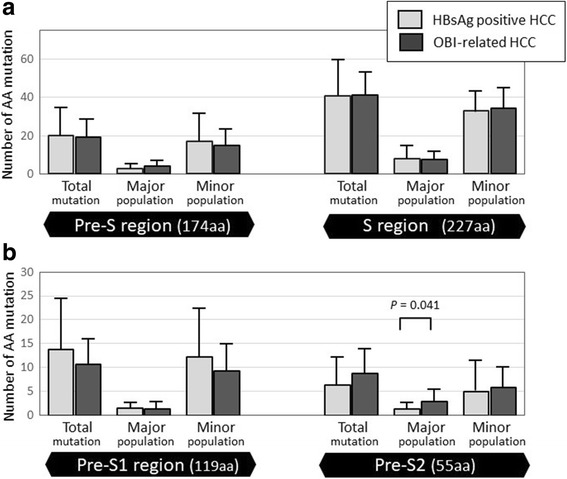
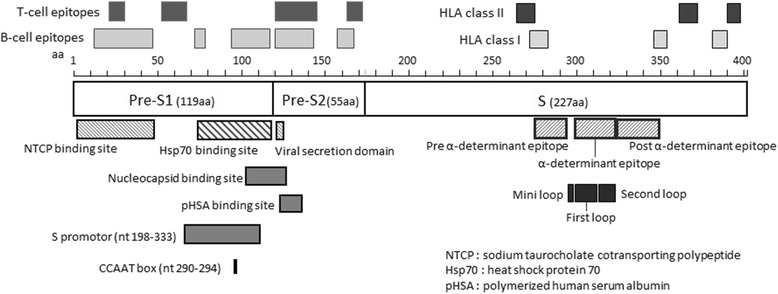
There were no significant differences in the major HBV populations, which exhibit more than 20% variation within the entire pre-S/S region, between OBI-related HCC and HBsAg-positive HCC. However, the prevalences of major populations with pre-S2 region mutations and of minor populations with polymerized human serum albumin-binding domain mutations were significantly higher in OBI-related HCC than in HBsAg-positive HCC. Moreover, the major variant populations associated with the B-cell epitope, located within the pre-S1 region, and the a determinant domain, located in the S region, were detected frequently in HBsAg-positive HCC. The minor populations of variants harbouring the W4R, L30S, Q118R/Stop, N123D and S124F/P mutations in the pre-S region and the L21F/S and L42F/S mutations in the S region were detected more frequently in OBI-related HCC than in HBsAg-positive HCC.
Ultra-deep sequencing revealed that the B-cell epitope domain in the pre-S1 region and alpha determinant domain in the S region were variable in HBsAg-positive HCC, although the quasispecies associated with the pre-S2 region were highly prevalent in OBI-related HCC.
Ref: R000034382/UMIN000030113; Retrospectively registered 25 November 2017.
肝细胞癌(HCC)可发生于血清乙肝表面抗原(HBsAg)阴性但肝脏乙肝病毒(HBV)DNA阳性的患者,即隐匿性HBV感染(OBI)。既往报道显示,OBI相关HCC中的HBV变异体与HBsAg阳性HCC中的不同。在本研究中,通过高通量测序检测了OBI相关HCC患者基于前S/S基因的HBV准种,并与HBsAg阳性HCC中的进行比较。
在神户大学医院手术时收集了19份组织样本(9份OBI相关组织和10份HBsAg阳性非癌组织)。通过超深度测序分离并分析前S/S区域变异超过1%的准种。
在整个前S/S区域变异超过20%的主要HBV群体在OBI相关HCC和HBsAg阳性HCC之间无显著差异。然而,前S2区域突变的主要群体以及聚合人血清白蛋白结合域突变的次要群体在OBI相关HCC中的患病率显著高于HBsAg阳性HCC。此外,位于前S1区域的B细胞表位相关的主要变异群体以及位于S区域的a决定簇域在HBsAg阳性HCC中频繁检测到。在前S区域携带W4R、L30S、Q118R/Stop、N123D和S124F/P突变以及在S区域携带L21F/S和L42F/S突变的变异次要群体在OBI相关HCC中比在HBsAg阳性HCC中更频繁检测到。
超深度测序显示,前S1区域的B细胞表位域和S区域的α决定簇域在HBsAg阳性HCC中是可变的,尽管与前S2区域相关的准种在OBI相关HCC中高度流行。
参考文献:R000034382/UMIN000030113;2017年11月25日回顾性注册。