Pang Tongtao, Gong Mingzhi, Han Jiangtao, Liu Dan
Department of Trauma and Orthopedics, The Second Hospital of Shandong University, Jinan, Shandong 250033, P.R. China.
Exp Ther Med. 2018 Feb;15(2):1293-1297. doi: 10.3892/etm.2017.5513. Epub 2017 Nov 16.
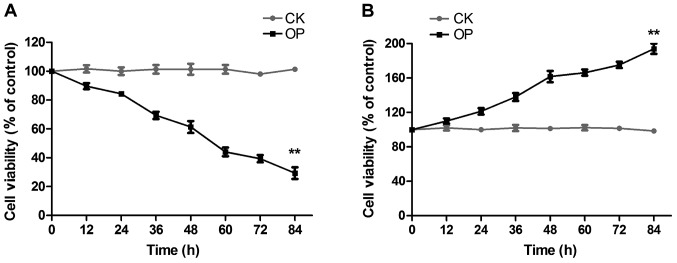
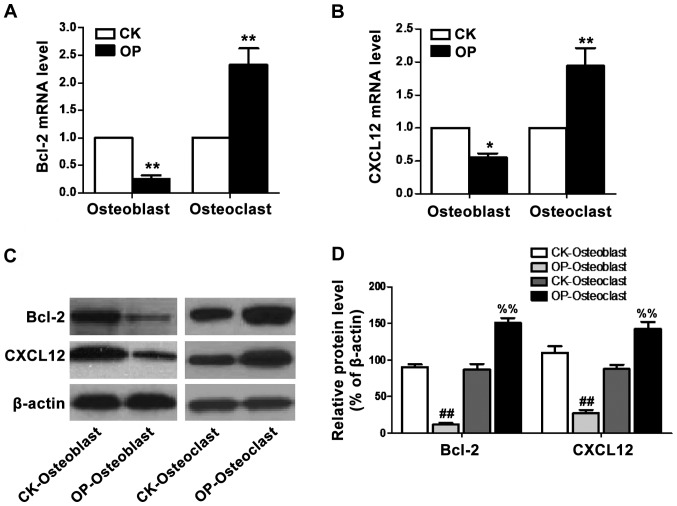
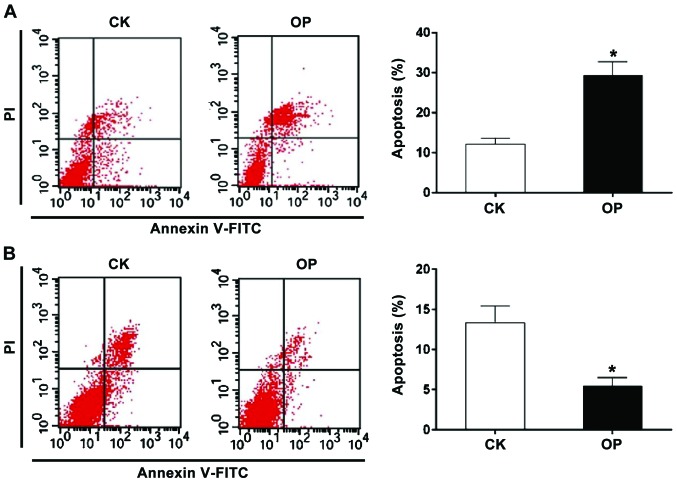
The changes of expression of anti-apoptotic factor B-cell lymphoma 2 (Bcl-2) and chemokine C-X-C motif ligand 12 (CXCL12) in the pathological process of osteoporosis (OP) were investigated, to provide new ideas for the diagnosis and treatment of OP. A total of 60 postmenopausal women who needed to undergo hip replacement surgery were enrolled and divided into osteoporosis group (OP, n=32) and control group (CK, n=28) according to the results of dual-energy X-ray bone density measure; after operation, cancellousbone from the femoral head or femoral neck was removed, and osteoblasts and osteoclasts were isolated and cultured . The proliferation and apoptosis in the two groups of osteoblasts and osteoclasts were detected by 3-(4,5-dimethylthiazol-2-yl)-2,5-diphenyltetrazolium bromide (MTT) colorimetry and Annexin V/PI double staining method, respectively. The expression levels of Bcl-2 and CXCL12 mRNA and protein in the two groups of osteoblasts and osteoclasts were determined by reverse transcription quantitative polymerase chain reaction (RT-qPCR) and western blot analysis. The analysis of cell proliferation and apoptosis showed that compared with the CK group, osteoblast proliferation was significantly inhibited and apoptosis rate was distinctly increased in the OP group, compared with the CK group, osteoclast proliferation was distinctly enhanced and apoptosis rate was remarkably reduced in the OP group. The results of RT-qPCR and western blot analysis displayed that Bcl-2 and CXCL12 mRNA and protein levels in osteoblasts of the OP group were significantly lower than those of the CK group, while mRNA and protein levels of Bcl-2 and CXCL12 in osteoclast of the OP group were distinctly increased compared to those in the CK group. The incidence of OP is closely associated with the bone balance maintained by osteoblasts and osteoclasts, and this mechanism may be achieved by inhibiting osteoblast proliferation and osteoclast apoptosis via regulating Bcl-2 and CXCL12 gene expression changes.
研究抗凋亡因子B细胞淋巴瘤2(Bcl-2)和趋化因子C-X-C基序配体12(CXCL12)在骨质疏松症(OP)病理过程中的表达变化,为OP的诊断和治疗提供新思路。选取60例需行髋关节置换手术的绝经后女性,根据双能X线骨密度测量结果分为骨质疏松组(OP,n = 32)和对照组(CK,n = 28);术后取股骨头或股骨颈松质骨,分离培养成骨细胞和破骨细胞。分别采用3-(4,5-二甲基噻唑-2)-2,5-二苯基四氮唑溴盐(MTT)比色法和膜联蛋白V/碘化丙啶(Annexin V/PI)双染法检测两组成骨细胞和破骨细胞的增殖及凋亡情况。采用逆转录定量聚合酶链反应(RT-qPCR)和蛋白质印迹法检测两组成骨细胞和破骨细胞中Bcl-2和CXCL12 mRNA及蛋白的表达水平。细胞增殖与凋亡分析结果显示,与CK组相比,OP组成骨细胞增殖明显受抑制,凋亡率明显升高;与CK组相比,OP组破骨细胞增殖明显增强,凋亡率显著降低。RT-qPCR和蛋白质印迹分析结果显示,OP组成骨细胞中Bcl-2和CXCL12 mRNA及蛋白水平均显著低于CK组,而OP组破骨细胞中Bcl-2和CXCL12的mRNA及蛋白水平与CK组相比明显升高。OP的发病与成骨细胞和破骨细胞维持的骨平衡密切相关,该机制可能是通过调节Bcl-2和CXCL12基因表达变化抑制成骨细胞增殖和破骨细胞凋亡来实现的。