Gao Chun-Lin, Wang Gao-Wei, Yang Guan-Qin, Yang Hong, Zhuang Li
Department of Oncology, The Third Affiliated Hospital of Kunming Medical University, Kunming, Yunnan 650118, P.R. China.
Department of Oncology, The Second Affiliated Hospital of Kunming Medical University, Kunming, Yunnan 650101, P.R. China.
Oncol Lett. 2018 Mar;15(3):2815-2820. doi: 10.3892/ol.2017.7691. Epub 2017 Dec 27.
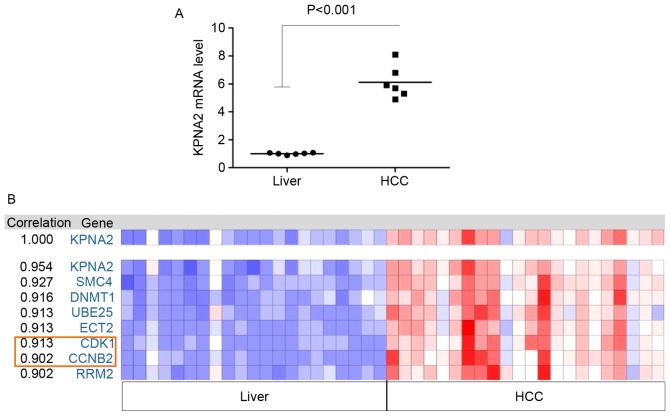
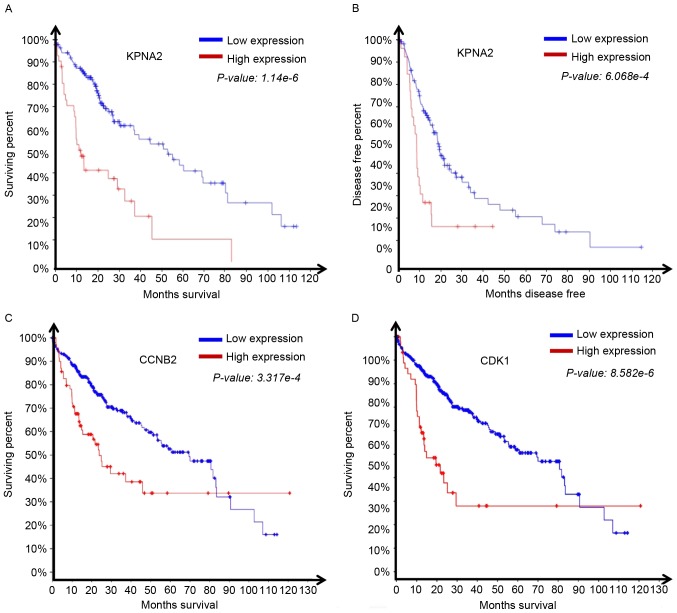
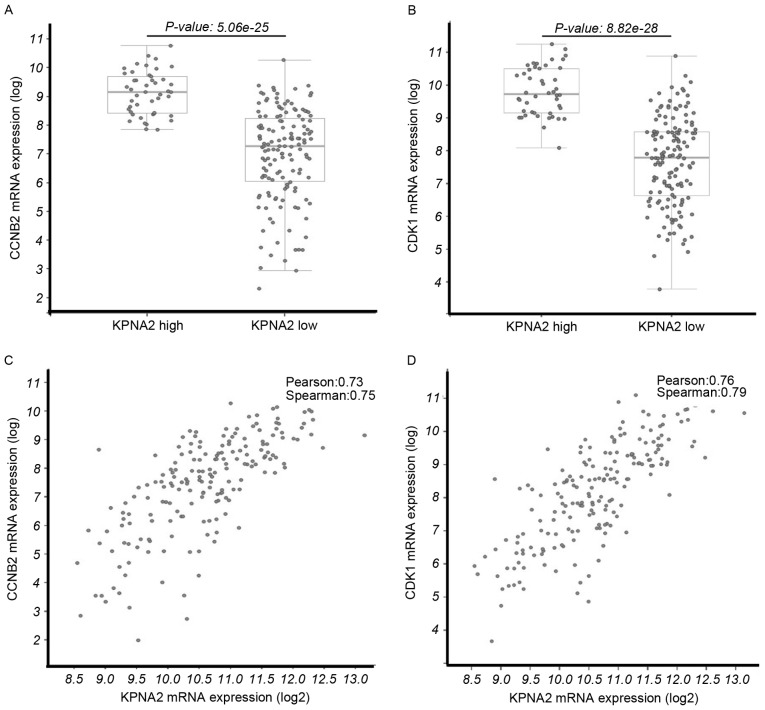
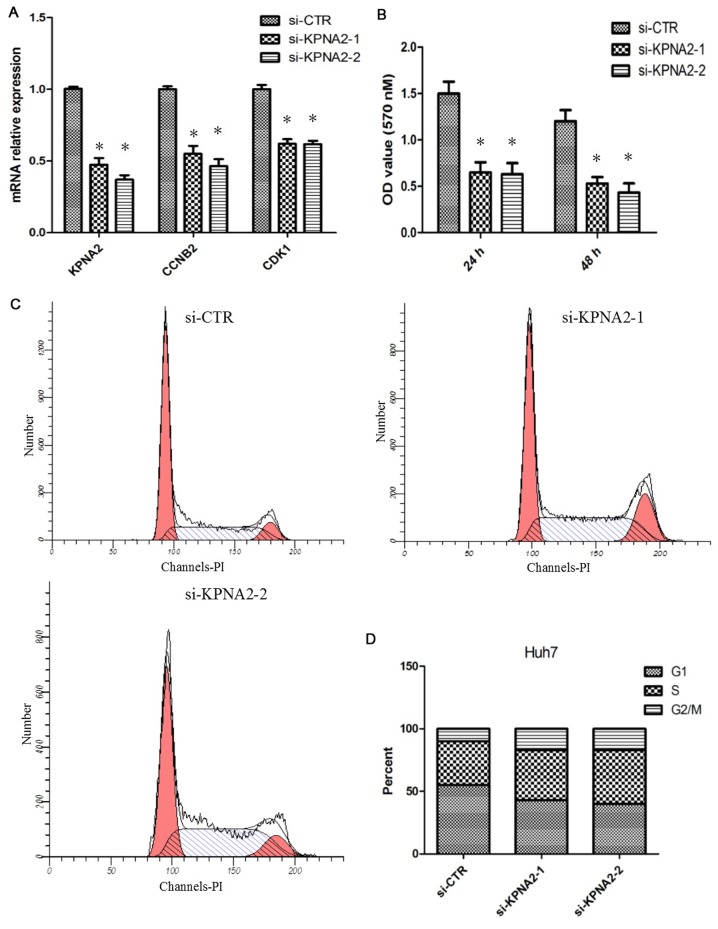
Different types of cancer exhibit distinct gene expression profiles. The present study aimed to identify a specific gene dysregulated in hepatocellular carcinoma (HCC) that was essential for cancer progression. The whole transcriptomes of primary HCC tissue samples were analyzed with microarrays. The most significantly differentially expressed gene was identified, specifically karyopherin subunit-α 2 (KPNA2), and an analysis using the Oncomine online tool was performed with data from The Cancer Genome Atlas to predict associated genes in HCC. Reverse transcription-quantitative polymerase chain reaction was performed to confirm the gene expression levels of KPNA2, and the RNA interference knockdown of KPNA2 was performed to identify the effect on putative downstream target genes. A proliferation assay and flow cytometry analysis was used to assess the function of KPNA2 in the regulation of the cell cycle. The results demonstrated that KPNA2 expression was significantly upregulated in HCC tumor tissues compared with liver tissues and was associated with cyclin B2 (CCNB2) and cyclin-dependent kinase 1 (CDK1) expression. KPNA2 expression was identified a novel marker to predict the outcome of patients. In addition, KPNA2 knockdown downregulated CCNB2 and CDK1, inhibited cell proliferation and induced cell cycle arrest in the G/M phase. In conclusion, it was demonstrated that KPNA2 may promote tumor cell proliferation by increasing the expression of CCNB2/CDK1. KPNA2 could be a target for therapeutic intervention in HCC.
不同类型的癌症表现出不同的基因表达谱。本研究旨在鉴定肝细胞癌(HCC)中一种失调的特定基因,该基因对癌症进展至关重要。使用微阵列分析原发性HCC组织样本的全转录组。鉴定出差异表达最显著的基因,即核转运蛋白亚基-α2(KPNA2),并使用Oncomine在线工具对来自癌症基因组图谱的数据进行分析,以预测HCC中的相关基因。进行逆转录定量聚合酶链反应以确认KPNA2的基因表达水平,并进行KPNA2的RNA干扰敲低以确定对假定的下游靶基因的影响。使用增殖测定和流式细胞术分析来评估KPNA2在细胞周期调控中的功能。结果表明,与肝组织相比,KPNA2在HCC肿瘤组织中的表达显著上调,并且与细胞周期蛋白B2(CCNB2)和细胞周期蛋白依赖性激酶1(CDK1)的表达相关。KPNA2表达被鉴定为预测患者预后的新标志物。此外,KPNA2敲低下调了CCNB2和CDK1,抑制了细胞增殖并诱导细胞周期在G/M期停滞。总之,结果表明KPNA2可能通过增加CCNB2/CDK1的表达来促进肿瘤细胞增殖。KPNA2可能成为HCC治疗干预的靶点。