Zhu Yazhen, Guo Zhiwei, Liu Ying, Zheng Xiyun, Yang Guohua, Zheng Guangjuan
Department of Pathology, Guangdong Provincial Hospital of TCM, Guangzhou University of Chinese Medicine, Guangdong Provincial Academy of Chinese Medical Sciences, Guangzhou, Guangdong 510120, P.R. China.
GenoSaber Biotech Co., Ltd., Shanghai 201203, P.R. China.
Oncol Lett. 2018 Mar;15(3):2905-2912. doi: 10.3892/ol.2017.7679. Epub 2017 Dec 21.
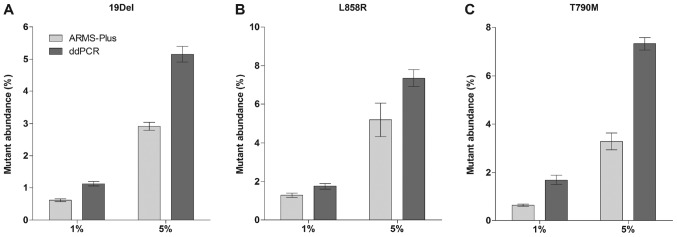
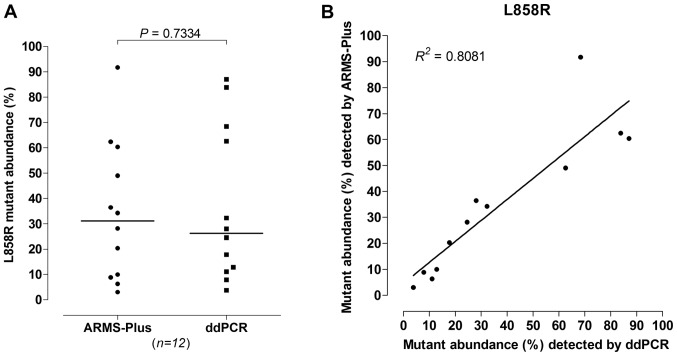
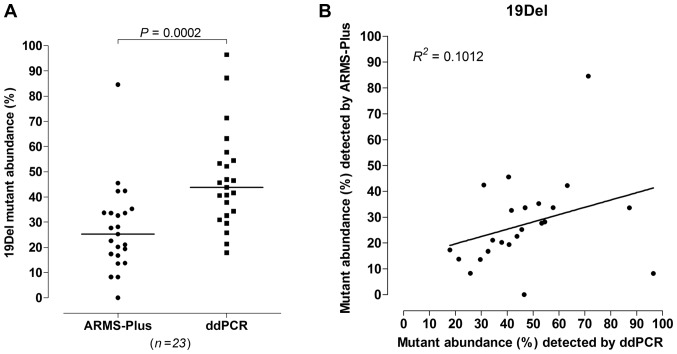
Quantification of epidermal growth factor receptor () mutations is important for the prediction of tyrosine kinase inhibitor (TKI) efficacy in patients with non-small cell lung cancer (NSCLC). However, clinicians lack a sensitive and convenient method to quantify mutant abundance. The present study introduces a novel method, namely amplification refractory mutation system (ARMS)-Plus, for the quantitative analysis of exon 19 deletion (), and mutations. Formalin-fixed paraffin-embedded tumor samples were collected from 77 patients with lung adenocarcinoma. DNA was extracted and analyzed for mutations using ARMS-Plus. The performance of ARMS-Plus was then compared with that of conventional ARMS-polymerase chain reaction (ARMS-PCR) and droplet digital PCR (ddPCR). The results demonstrated that the concordance rate of mutation testing between ARMS-Plus and ddPCR was 98.7% (76/77, Kappa=0.9739). and mutations were detected in 23 and 12 patients, respectively. There was a significant difference between ARMS-Plus and ddPCR in the evaluation of mutant abundance (P=0.0002); however, not in that of mutant abundance (P=0.7334). The ARMS-Plus results in mutant abundance were concordant with that of ddPCR (=0.8081). These results indicated that the sensitivity and specificity of ARMS-Plus in identifying mutations were similar to that of ddPCR. For quantitative analysis, the results of ARMS-Plus in evaluating mutant abundance revealed a positive correlation with the ddPCR results. Thus, ARMS-Plus provides an alternative method, which is reliable and cost-effective, to quantify mutations and thereby, aid treatment decisions in patients with lung adenocarcinoma.
表皮生长因子受体(EGFR)突变的定量分析对于预测非小细胞肺癌(NSCLC)患者酪氨酸激酶抑制剂(TKI)的疗效至关重要。然而,临床医生缺乏一种灵敏且便捷的方法来定量EGFR突变丰度。本研究引入了一种新方法,即扩增阻滞突变系统升级版(ARMS-Plus),用于对EGFR第19外显子缺失(del19)、L858R和T790M突变进行定量分析。从77例肺腺癌患者中收集福尔马林固定石蜡包埋的肿瘤样本。提取DNA并使用ARMS-Plus分析EGFR突变。然后将ARMS-Plus的性能与传统的ARMS聚合酶链反应(ARMS-PCR)和液滴数字PCR(ddPCR)进行比较。结果表明,ARMS-Plus与ddPCR之间EGFR突变检测的一致性率为98.7%(76/77,Kappa = 0.9739)。分别在23例和12例患者中检测到del19和L858R突变。在评估EGFR del19突变丰度方面,ARMS-Plus与ddPCR之间存在显著差异(P = 0.0002);然而,在评估L858R突变丰度方面则无显著差异(P = 0.7334)。ARMS-Plus检测EGFR del19突变丰度的结果与ddPCR结果一致(r = 0.8081)。这些结果表明,ARMS-Plus在识别EGFR del19突变方面的敏感性和特异性与ddPCR相似。对于定量分析,ARMS-Plus评估EGFR del19突变丰度的结果与ddPCR结果呈正相关。因此,ARMS-Plus提供了一种可靠且经济高效的替代方法,用于定量EGFR突变,从而辅助肺腺癌患者的治疗决策。