Kadowaki Takashi, Sasaki Kazuyo, Ishii Manabu, Matsukawa Miyuki, Ushirogawa Yoshiteru
Department of Diabetes and Metabolic Diseases, Graduate School of Medicine, The University of Tokyo, Tokyo, Japan.
Ikuyaku. Integrated Value Development Division, Mitsubishi Tanabe Pharma Corporation, Osaka, Japan.
Diabetes Ther. 2018 Apr;9(2):623-636. doi: 10.1007/s13300-018-0372-x. Epub 2018 Feb 12.
Teneligliptin, an antihyperglycemic agent belonging to the dipeptidyl peptidase-4 inhibitor class, is usually prescribed at a dose of 20 mg/day. In Japan, the dose can be increased to 40 mg/day if needed. We examined the treatment response when the teneligliptin dose was increased from 20 to 40 mg in a post hoc pooled analysis of data from two 52-week, open-label, phase III clinical trials of teneligliptin 20-40 mg/day as monotherapy or combination treatment in Japanese patients with type 2 diabetes.
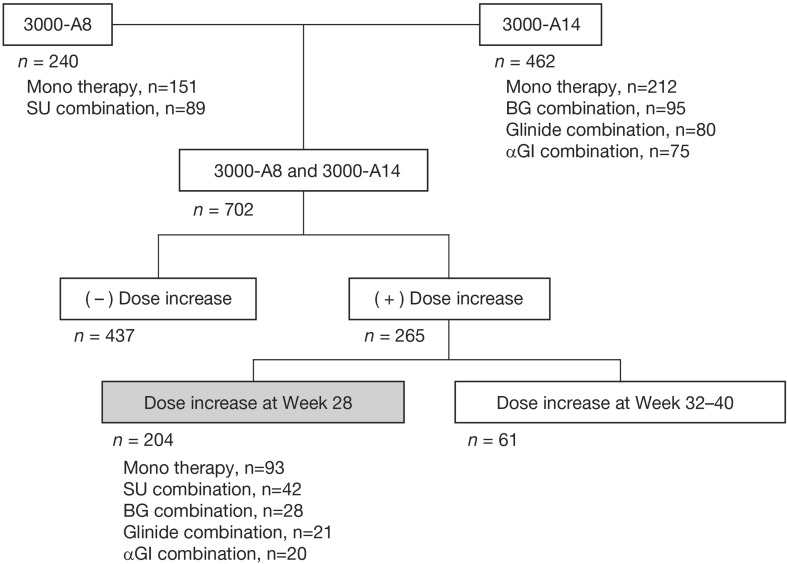
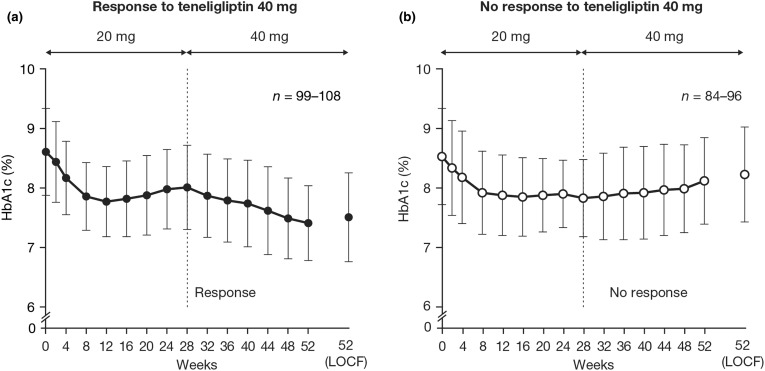
In both studies, patients received teneligliptin 20 mg for at least 28 weeks; thereafter the dose was increased if glycemic control was inadequate. The data set for this post hoc analysis comprised those patients whose teneligliptin dose was increased to 40 mg at week 28 (N = 204). We assessed (i) the proportion of patients achieving HbA1c reduction after teneligliptin dose increase [≤ - 0.1% change in HbA1c during weeks 28-52 (24 weeks); responders] and (ii) the response to teneligliptin 40 mg according to whether or not patients experienced HbA1c re-elevation (≥ 0.1% increase) during 28 weeks of teneligliptin 20 mg.
Of 204 patients, 108 (52.9%) showed a response to teneligliptin 40 mg (HbA1c change ≤ - 0.1% during weeks 28-52) and had mean (± SD) HbA1c reduction of 0.50 ± 0.44%. Of patients showing re-elevation of HbA1c during treatment with teneligliptin 20 mg, 89/143 (62.2%) achieved HbA1c reduction after dose increase to 40 mg. Logistic regression analyses suggested that change in body weight is one of the parameters linked to HbA1c reduction after dose increase to teneligliptin 40 mg. The incidence of adverse events was not changed after teneligliptin dose increase.
Increasing the dosage of teneligliptin from 20 to 40 mg/day has potential as a well-tolerated and effective option for treating type 2 diabetes.
Mitsubishi Tanabe Pharma Corporation.
替格列汀是一种二肽基肽酶-4抑制剂类降糖药,通常的处方剂量为20毫克/天。在日本,如果需要,剂量可增加至40毫克/天。我们在一项事后汇总分析中,研究了在日本2型糖尿病患者中,将替格列汀剂量从20毫克增加到40毫克时的治疗反应,该分析的数据来自两项为期52周的开放标签III期临床试验,试验中替格列汀20 - 40毫克/天作为单药治疗或联合治疗。
在两项研究中,患者接受替格列汀20毫克治疗至少28周;此后,如果血糖控制不佳则增加剂量。这项事后分析的数据集包括那些在第28周时替格列汀剂量增加到40毫克的患者(N = 204)。我们评估了(i)替格列汀剂量增加后实现糖化血红蛋白(HbA1c)降低的患者比例[在第28 - 52周(24周)期间HbA1c变化≤ - 0.1%;反应者],以及(ii)根据患者在20毫克替格列汀治疗的28周内是否经历HbA1c再次升高(≥ 0.1%)来评估对40毫克替格列汀的反应。
204例患者中,108例(52.9%)对40毫克替格列汀有反应(在第28 - 52周期间HbA1c变化≤ - 0.1%),平均(±标准差)HbA1c降低0.50 ± 0.44%。在20毫克替格列汀治疗期间HbA1c升高的患者中,89/143例(62.2%)在剂量增加到40毫克后实现了HbA1c降低。逻辑回归分析表明,体重变化是与替格列汀剂量增加到40毫克后HbA1c降低相关的参数之一。替格列汀剂量增加后不良事件的发生率没有变化。
将替格列汀剂量从20毫克/天增加到40毫克/天,对于治疗2型糖尿病是一种耐受性良好且有效的潜在选择。
三菱田边制药株式会社