Berger Ariel, Inglese Gary, Skountrianos George, Karlsmark Tonny, Oguz Mustafa
Ariel Berger, MPH, Evidera Inc, Waltham, Massachusetts. Gary Inglese, RN, MBA, Hollister Incorporated, Libertyville, Illinois. George Skountrianos, MS, Hollister Incorporated, Libertyville, Illinois. Tonny Karlsmark, MD, DMSc, University of Copenhagen, Denmark. Mustafa Oguz, PhD, Evidera Inc, Hammersmith, London, United Kingdom.
J Wound Ostomy Continence Nurs. 2018 Mar/Apr;45(2):146-155. doi: 10.1097/WON.0000000000000416.
To assess the cost-effectiveness of a ceramide-infused skin barrier (CIB) versus other skin barriers (standard of care) among patients who have undergone ostomy creation.
Cost-effectiveness analysis, based on a decision-analytic model that was estimated using data from the ADVOCATE (A Study Determining Variances in Ostomy Skin Conditions And The Economic Impact) trial, which investigated stoma-related healthcare costs over 12 weeks among patients who recently underwent fecal ostomy, and from other sources.
Analysis was based on a hypothetical cohort of 1000 patients who recently underwent fecal ostomy; over a 1-year period, 500 patients were assumed to use CIB and 500 were assumed to use standard of care.
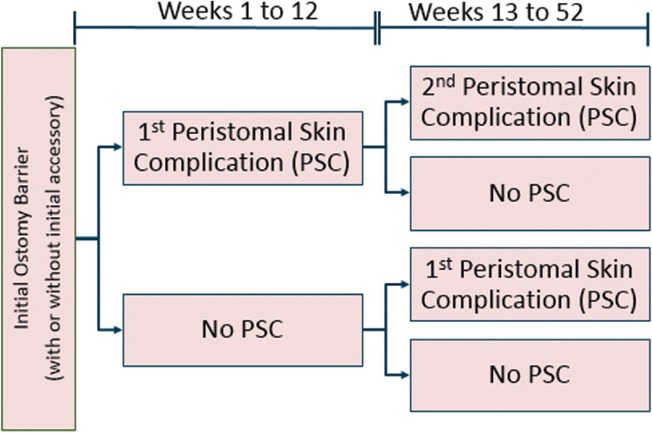
We adapted a previous economic model to estimate expected 1-year costs and outcomes among persons with a new ostomy assumed to use CIB versus standard of care. Outcomes of interest included peristomal skin complications (PSCs) (up to 2 during the 1-year period of interest) and quality-adjusted life days (QALDs); QALDs vary from 1, indicating a day of perfect health to 0, indicating a day with the lowest possible health (deceased). Subjects were assigned QALDs on a daily basis, with the value of the QALD on any given day based on whether the patient was experiencing a PSC. Costs included those related to skin barriers, ostomy accessories, and care of PSCs. The incremental cost-effectiveness of CIB versus standard of care was estimated as the incremental cost per PSC averted and QALD gained, respectively; net monetary benefit of CIB was also estimated. All analyses were run using the perspective of an Australian payer.
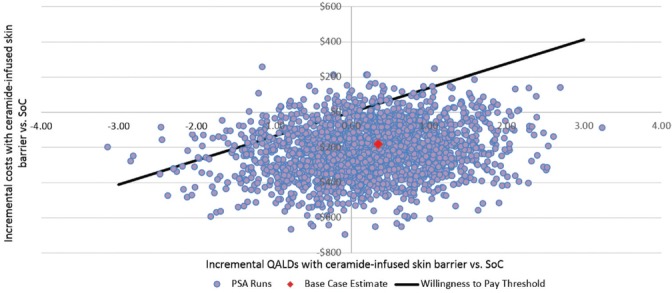
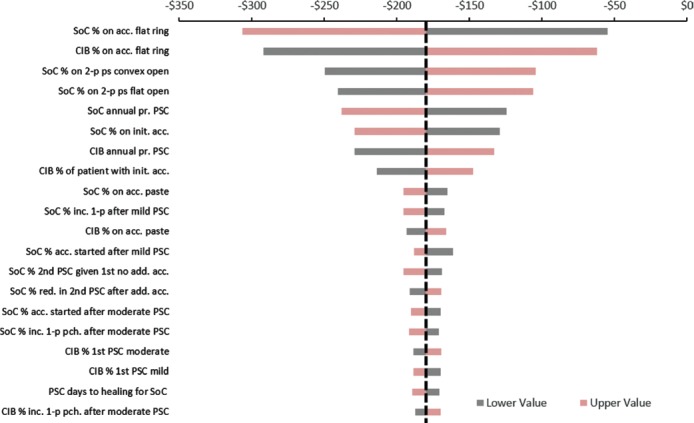
On a per-patient basis, use of CIB was expected over a 1-year period to result in 0.16 fewer PSCs, an additional 0.35 QALDs, and a savings of A$180 (Australian dollars, US $137) in healthcare costs all versus standard of care. Management with CIB provided a net monetary benefit (calculated as the product of maximum willingness to pay for 1 QALD times additional QALDs with CIB less the incremental cost of CIB) of A$228 (US $174). Probabilistic sensitivity analysis was also completed; it revealed that 97% of model runs resulted in fewer expected PSCs with CIB; 92% of these runs resulted in lower expected costs with CIB.
Findings suggest that the CIB is a cost-effective skin barrier for persons living with an ostomy.
评估在接受造口术的患者中,含神经酰胺的皮肤屏障(CIB)与其他皮肤屏障(护理标准)相比的成本效益。
成本效益分析,基于一个决策分析模型,该模型使用来自ADVOCATE(一项确定造口皮肤状况差异及其经济影响的研究)试验的数据进行估计,该试验调查了近期接受粪便造口术的患者在12周内与造口相关的医疗保健成本,以及来自其他来源的数据。
分析基于一个假设的1000名近期接受粪便造口术的患者队列;在1年期间,假设500名患者使用CIB,500名患者使用护理标准。
我们采用了先前的经济模型来估计假设使用CIB与护理标准的新造口患者的预期1年成本和结局。感兴趣的结局包括造口周围皮肤并发症(PSC)(在感兴趣的1年期间最多2次)和质量调整生命天数(QALD);QALD范围从1(表示完全健康的一天)到0(表示健康状况最差的一天,即死亡)。受试者每天被分配QALD,任何一天的QALD值基于患者是否经历PSC。成本包括与皮肤屏障、造口配件和PSC护理相关的成本。CIB与护理标准相比的增量成本效益分别估计为避免每例PSC和获得每QALD的增量成本;还估计了CIB的净货币效益。所有分析均从澳大利亚付款人的角度进行。
在每位患者的基础上,预计在1年期间使用CIB与护理标准相比,PSC减少0.16例,QALD增加0.35个,医疗保健成本节省180澳元(137美元)。使用CIB进行管理提供了228澳元(174美元)的净货币效益(计算为为1个QALD支付的最大意愿乘以使用CIB时额外的QALD减去CIB的增量成本的乘积)。还完成了概率敏感性分析;结果显示,97%的模型运行结果显示使用CIB时预期的PSC更少;其中92%的运行结果显示使用CIB时预期成本更低。
研究结果表明,CIB对于造口患者是一种具有成本效益的皮肤屏障。