Nagata Isao, Abe Toshikazu, Uchida Masatoshi, Saitoh Daizoh, Tamiya Nanako
Department of Health Services Research, Faculty of Medicine, University of Tsukuba, Tsukuba, Japan.
Graduate School of Comprehensive Human Sciences, Majors of Medical Sciences, University of Tsukuba, Tsukuba, Japan.
BMJ Open. 2018 Feb 8;8(2):e018635. doi: 10.1136/bmjopen-2017-018635.
Trauma is one of the main causes of death in Japan, and treatments and prognoses of these injuries are constantly changing. We therefore aimed to investigate a 10-year trend (2004-2013) in inhospital mortality among patients with trauma in Japan.
Multicentre observational study.
Japanese nationwide trauma registry (the Japan Trauma Data Bank) data.
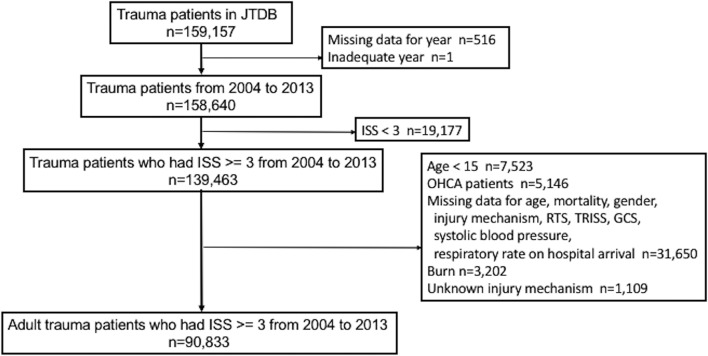
All patients with trauma whose Injury Severity Score (ISS) were 3 and above, who were aged 15 years or older, and whose mechanisms of injury (MOI) were blunt and penetrating between 2004 and 2013 (n=90 833).
A 10-year trend in inhospital mortality.
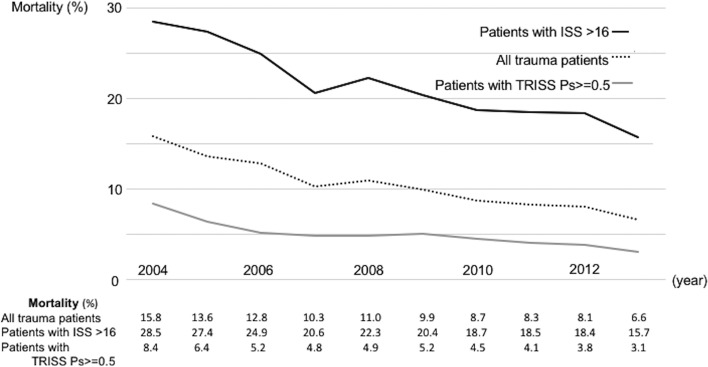
Inhospital mortality for all patients with trauma significantly decreased over the study decade in our Cochran-Armitage test (P<0.001). Similarly, inhospital mortality for patients with ISS 16 or more and patients who scored 50% or better on the Trauma and Injury Severity Score (TRISS) probability of survival scale significantly decreased (P<0.001). In addition, the OR for inhospital mortality of these three patient groups decreased yearly after adjusting for age, gender, MOI, ISS, Glasgow Coma Scale, systolic blood pressure and respiratory rate on hospital arrival in multivariable logistic regression analyses. Furthermore, inhospital mortality for patient with blunt trauma significantly decreased in injury mechanism-stratified Mantel-extension testing (P<0.001). Finally, multivariable logistic regression analyses showed that the OR for inhospital mortality of patients with ISS 16 and over decreased each year after adding and adjusting for means of transportation and usage of whole-body CT.
Inhospital mortality for patients with trauma in Japan significantly decreased during the study decade after adjusting for patient characteristics, injury severity and the response environment after injury.
创伤是日本主要的死亡原因之一,此类损伤的治疗方法和预后情况也在不断变化。因此,我们旨在调查日本创伤患者10年(2004 - 2013年)的院内死亡率趋势。
多中心观察性研究。
日本全国创伤登记处(日本创伤数据库)数据。
2004年至2013年期间所有损伤严重程度评分(ISS)为3及以上、年龄15岁及以上、损伤机制(MOI)为钝性和穿透性的创伤患者(n = 90833)。
10年的院内死亡率趋势。
在我们的 Cochr an - Armitage检验中,所有创伤患者的院内死亡率在研究的十年间显著下降(P < 0.001)。同样,ISS为16或更高的患者以及在创伤和损伤严重程度评分(TRISS)生存概率量表上得分50%或更高的患者的院内死亡率也显著下降(P < 0.001)。此外,在多变量逻辑回归分析中,在调整了年龄、性别、MOI、ISS、格拉斯哥昏迷量表、入院时收缩压和呼吸频率后,这三组患者的院内死亡率比值比逐年下降。此外,在损伤机制分层的Mantel - 扩展检验中,钝性创伤患者的院内死亡率显著下降(P < 0.001)。最后,多变量逻辑回归分析表明,在加入并调整了交通方式和全身CT使用情况后,ISS为16及以上患者的院内死亡率比值比逐年下降。
在调整了患者特征、损伤严重程度和损伤后的反应环境后,日本创伤患者的院内死亡率在研究的十年间显著下降。