Department of Pharmacology, Physiology and Neurosciences, New Jersey Medical School, Rutgers University, 185 South Orange Ave, Newark, NJ, 07103, USA.
Department of Mathematical Sciences, New Jersey Institute of Technology, University Heights, Newark, NJ, 07102, USA.
J Neuroinflammation. 2018 Feb 13;15(1):42. doi: 10.1186/s12974-018-1069-9.
Trovafloxacin is a broad-spectrum antibiotic, recently identified as an inhibitor of pannexin-1 (Panx1) channels. Panx1 channels are important conduits for the adenosine triphosphate (ATP) release from live and dying cells that enhances the inflammatory response of immune cells. Elevated extracellular levels ATP released upon injury activate purinergic pathways in inflammatory cells that promote migration, proliferation, phagocytosis, and apoptotic signals. Here, we tested whether trovafloxacin administration attenuates the neuroinflammatory response and improves outcomes after brain trauma.
The murine controlled cortical impact (CCI) model was used to determine whether in vivo delivery of trovafloxacin has anti-inflammatory and neuroprotective actions after brain trauma. Locomotor deficit was assessed using the rotarod test. Levels of tissue damage markers and inflammation were measured using western blot, qPCR, and immunofluorescence. In vitro assays were used to evaluate whether trovafloxacin blocks ATP release and cell migration in a chemotactic-stimulated microglia cell line.
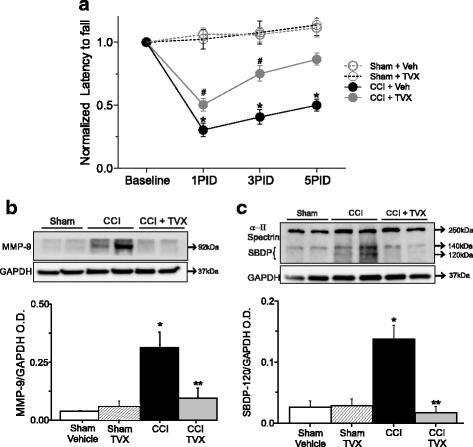
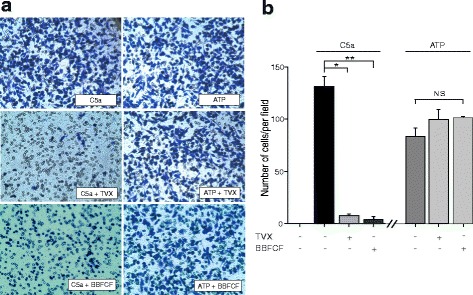
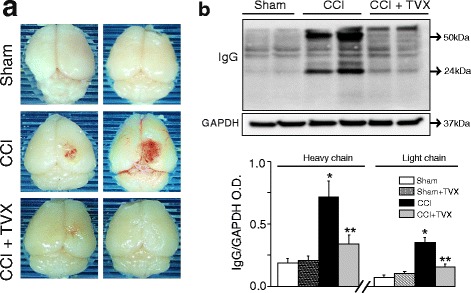
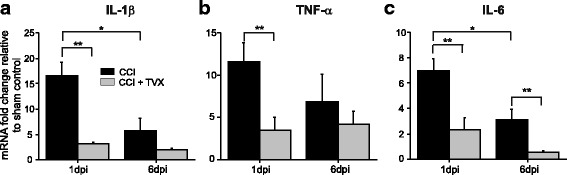
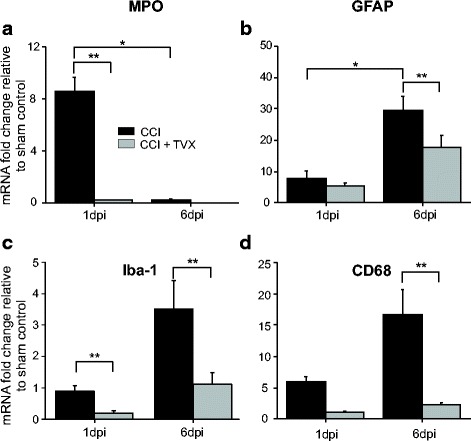
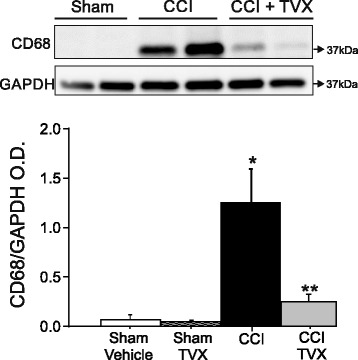
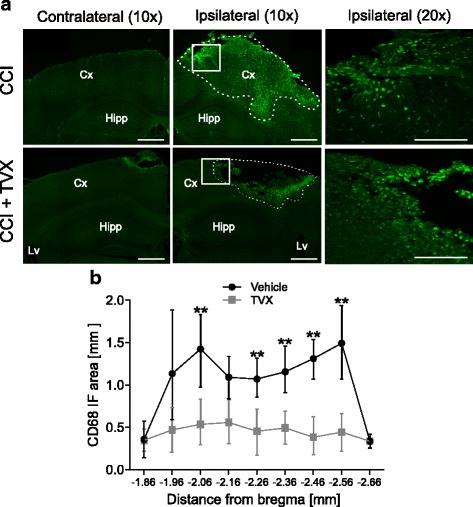
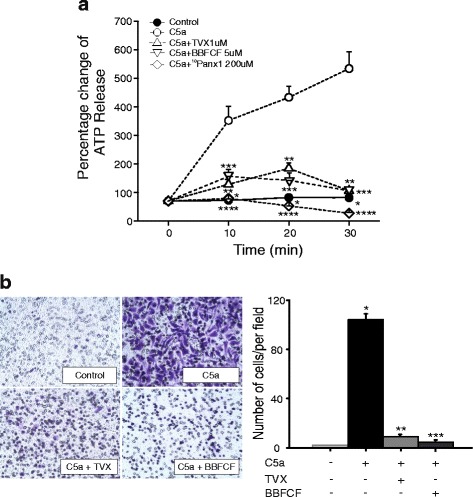
Trovafloxacin treatment of CCI-injured mice significantly reduced tissue damage markers and improved locomotor deficits. In addition, trovafloxacin treatment significantly reduced mRNA levels of several pro-inflammatory cytokines (IL-1β, IL-6, and TNF-α), which correlates with an overall reduction in the accumulation of inflammatory cell types (neutrophils, microglia/macrophages, and astroglia) at the injury zone. To determine whether trovafloxacin exerted these effects by direct action on immune cells, we evaluated its effect on ATP release and cell migration using a chemotactic-stimulated microglial cell line. We found that trovafloxacin significantly inhibited both ATP release and migration of these cells.
Our results show that trovafloxacin administration has pronounced anti-inflammatory and neuroprotective effects following brain injury. These findings lay the foundation for future studies to directly test a role for Panx1 channels in pathological inflammation following brain trauma.
曲伐沙星是一种广谱抗生素,最近被确定为质孔蛋白-1(Panx1)通道的抑制剂。Panx1 通道是活细胞和死细胞中三磷酸腺苷(ATP)释放的重要通道,可增强免疫细胞的炎症反应。损伤后细胞外 ATP 水平升高可激活炎症细胞中的嘌呤能途径,促进细胞迁移、增殖、吞噬和凋亡信号。在这里,我们测试了曲伐沙星给药是否能减轻脑外伤后的神经炎症反应并改善预后。
使用小鼠控制性皮质撞击(CCI)模型来确定曲伐沙星在脑外伤后是否具有抗炎和神经保护作用。使用转棒测试评估运动缺陷。使用 Western blot、qPCR 和免疫荧光法测量组织损伤标志物和炎症水平。体外实验用于评估曲伐氟沙星是否可阻断趋化刺激的小胶质细胞系中的 ATP 释放和细胞迁移。
CCI 损伤小鼠的曲伐氟沙星治疗显著降低了组织损伤标志物并改善了运动缺陷。此外,曲伐氟沙星治疗还显著降低了几种促炎细胞因子(IL-1β、IL-6 和 TNF-α)的 mRNA 水平,这与炎症细胞类型(中性粒细胞、小胶质细胞/巨噬细胞和星形胶质细胞)在损伤区的总积累减少相关。为了确定曲伐氟沙星是否通过直接作用于免疫细胞而产生这些作用,我们使用趋化刺激的小胶质细胞系评估了它对 ATP 释放和细胞迁移的影响。我们发现,曲伐氟沙星显著抑制了这些细胞的 ATP 释放和迁移。
我们的结果表明,曲伐沙星给药在脑损伤后具有明显的抗炎和神经保护作用。这些发现为进一步研究质孔蛋白-1 通道在脑外伤后的病理性炎症中的作用奠定了基础。