London School of Hygiene and Tropical Medicine, London, UK; Jenner Institute, University of Oxford, Oxford, UK(1).
GSK Vaccines, Rixensart, Belgium.
Vaccine. 2018 Mar 14;36(12):1637-1642. doi: 10.1016/j.vaccine.2018.01.069. Epub 2018 Feb 10.
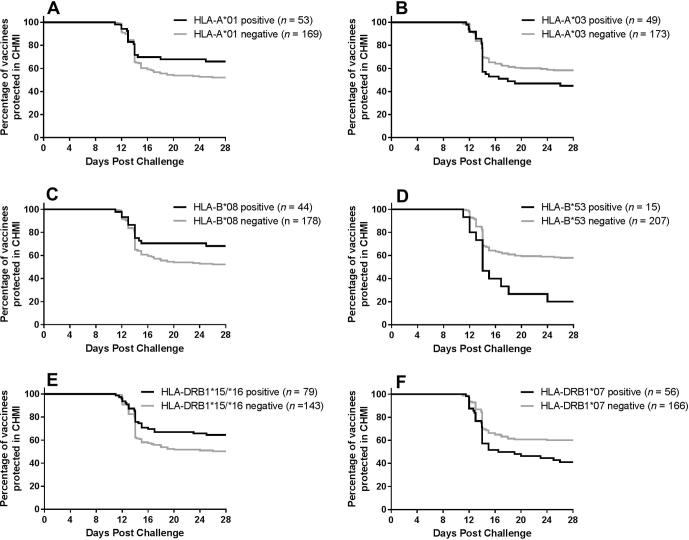
Although RTS,S remains the most advanced malaria vaccine, the factors influencing differences in vaccine immunogenicity or efficacy between individuals or populations are still poorly characterised. The analyses of genetic determinants of immunogenicity have previously been restricted by relatively small sample sizes from individual trials. Here we combine data from six Phase II RTS,S trials and evaluate the relationship between HLA allele groups and RTS,S-mediated protection in controlled human malaria infections (CHMI), using multivariate logistic or linear regression. We observed significant associations between three allele groups (HLA-A01, HLA-B08, and HLA-DRB115/16) and protection, while another three allele groups (HLA-A03, HLA-B53, and HLA-DRB107) were significantly associated with lack of protection. It is noteworthy that these 'protective' allele groups are thought to be at a lower prevalence in sub-Saharan African populations than in the UK or USA where these Phase II trials occurred. Taken together, the analyses presented here give an indication that HLA genotype may influence RTS,S-mediated protective efficacy against malaria infection.
虽然 RTS,S 仍然是最先进的疟疾疫苗,但影响个体或人群疫苗免疫原性或疗效差异的因素仍未得到很好的描述。先前对免疫原性遗传决定因素的分析受到来自单个试验的相对较小样本量的限制。在这里,我们结合了六项 II 期 RTS,S 试验的数据,并使用多元逻辑回归或线性回归来评估 HLA 等位基因组与受控人体疟疾感染(CHMI)中 RTS,S 介导的保护之间的关系。我们观察到三个等位基因组(HLA-A01、HLA-B08 和 HLA-DRB115/16)与保护之间存在显著关联,而另外三个等位基因组(HLA-A03、HLA-B53 和 HLA-DRB107)与缺乏保护之间存在显著关联。值得注意的是,这些“保护性”等位基因组被认为在撒哈拉以南非洲人群中的流行率低于英国或美国,这些 II 期试验就是在那里进行的。总之,这里提出的分析表明,HLA 基因型可能会影响 RTS,S 介导的对疟疾感染的保护效力。