Department of Otorhinolaryngology-Head and Neck Surgery, Chung-Ang University College of Medicine, 102 Heukseok-ro, Dongjak-gu, Seoul, 06973, Republic of Korea.
Medical Research Collaborating Center, Seoul National University Bundang Hospital, 82 Gumi-ro 173 beon-gil, Bundang-gu, Seongnam, 13620, Republic of Korea.
Sci Rep. 2018 Feb 13;8(1):2877. doi: 10.1038/s41598-018-21236-w.
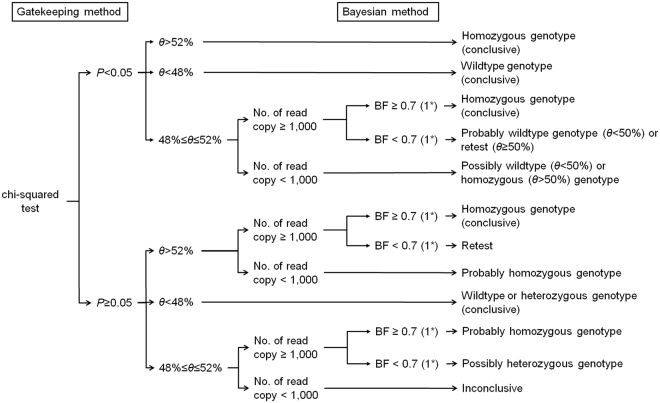
Previously, we introduced a noninvasive prenatal testing (NIPT) protocol for diagnosing compound heterozygous autosomal recessive point mutations via maternal plasma DNA and simulated control genomic DNA sampling based on fetal DNA fraction. In our present study, we have improved our NIPT protocol to make it possible to diagnose homozygous autosomal recessive point mutations without the need to acquire fetal DNA fraction. Moreover, chi-squared test and empirical statistical range based on the proportion of mutant allele reads among the total reads served as the gatekeeping method. If this method yielded inconclusive results, then the Bayesian method was performed; final conclusion was drawn from the results of both methods. This protocol was applied to three families co-segregating congenital sensorineural hearing loss with monogenic homozygous mutations in prevalent deafness genes. This protocol successfully predicted the fetal genotypes from all families without the information about fetal DNA fraction using one-step dPCR reactions at least for these three families. Furthermore, we suspect that confirmatory diagnosis under this protocol is possible, not only by using picodroplet dPCR, but also by using the more readily available chip-based dPCR, making our NIPT protocol more useful in the diagnosis of autosomal recessive point mutations in the future.
先前,我们介绍了一种无创性产前检测(NIPT)方案,通过母体外周血 DNA 并模拟基于胎儿 DNA 分数的对照基因组 DNA 采样,来诊断常染色体隐性点突变的复合杂合子。在本研究中,我们改进了 NIPT 方案,使其能够在无需获取胎儿 DNA 分数的情况下诊断纯合子常染色体隐性点突变。此外,卡方检验和基于总读段中突变等位基因读段比例的经验统计范围作为门控方法。如果该方法得出不确定的结果,则进行贝叶斯方法;最终结论来自两种方法的结果。该方案应用于三个共分离先天性感觉神经性听力损失和常见耳聋基因中纯合子突变的家族。该方案成功地预测了所有三个家系的胎儿基因型,而无需关于胎儿 DNA 分数的信息,至少对于这三个家系使用一步 dPCR 反应。此外,我们怀疑该方案下的确认诊断不仅可以通过使用皮升级别的 dPCR 来实现,也可以通过使用更易获得的基于芯片的 dPCR 来实现,从而使我们的 NIPT 方案在未来的常染色体隐性点突变诊断中更加有用。