Visco Denise
Eyes of York Cataract & Laser Center, York, PA, USA.
Clin Ophthalmol. 2018 Feb 5;12:301-305. doi: 10.2147/OPTH.S149522. eCollection 2018.
To evaluate the effect of intracameral phenylephrine/ketorolac (1%/0.3%) during cataract surgery on the use of iris fixation ring and surgical time in patients with poor pupil dilation (≤5.0 mm) or intraoperative floppy iris syndrome (IFIS).
Private practice outpatient surgical center.
This retrospective analysis was conducted from January 1, 2014 to October 7, 2015.
The use of iris fixation rings was evaluated in a retrospective analysis of 46 patients who underwent cataract surgery from January 1, 2014, to October 7, 2015, and who were identified before surgery to be at risk for intraoperative miosis. The qualifying factors were presurgical examination of pupil dilation ≤5.0 mm after being administered topical tropicamide 1% and phenylephrine 2.5% or history of IFIS during surgery in the fellow eye. All patients received a 2-day preoperative course of topical nonsteroidal anti-inflammatory drugs (NSAIDs) and day-of-surgery preoperative dilation using topical cyclopentolate 1%, tropicamide 1%, and phenylephrine 10%. Phenylephrine/ketorolac 1%/0.3% (Omidria) or epinephrine 1:1,000 with sulfites was added to the ophthalmic irrigation solution and delivered intracamerally at the start of the procedure and throughout surgery. The use of iris fixation rings and surgical time for each patient were captured for each group.
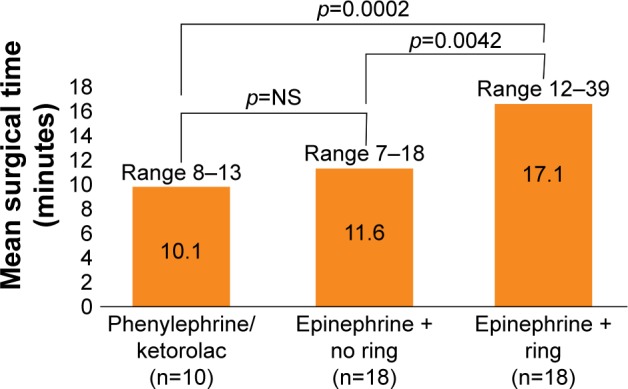
Eighteen (50%) of the patients in the epinephrine group and no patients in the phenylephrine/ketorolac group required iris fixation ring insertion to maintain pupil dilation or to control IFIS (=0.0034). Mean surgical time was significantly shorter in the group of patients who received phenylephrine/ketorolac (=0.0068).
In this retrospective cohort analysis of patients with poorly dilated pupils and/or IFIS, the use of intracameral phenylephrine/ketorolac in patients at risk for intraoperative miosis resulted in significantly less iris fixation ring use and significantly shorter surgical time when compared with intracameral epinephrine use.
评估白内障手术中前房内注射去氧肾上腺素/酮咯酸(1%/0.3%)对瞳孔散大不佳(≤5.0毫米)或术中虹膜松弛综合征(IFIS)患者使用虹膜固定环及手术时间的影响。
私人门诊手术中心。
本回顾性分析于2014年1月1日至2015年10月7日进行。
在一项回顾性分析中,对2014年1月1日至2015年10月7日接受白内障手术且术前被确定有术中瞳孔缩小风险的46例患者的虹膜固定环使用情况进行评估。入选标准为术前使用1%托吡卡胺和2.5%去氧肾上腺素后瞳孔散大≤5.0毫米的术前检查结果,或同一只眼手术时有IFIS病史。所有患者术前接受为期2天的局部非甾体抗炎药(NSAIDs)治疗,并在手术当天术前使用1%环喷托酯、1%托吡卡胺和10%去氧肾上腺素进行散瞳。将1%/0.3%的去氧肾上腺素/酮咯酸(奥米德瑞亚)或含亚硫酸盐的1:1000肾上腺素加入眼科冲洗液中,并在手术开始时及整个手术过程中前房内给药。记录每组每位患者虹膜固定环的使用情况及手术时间。
肾上腺素组18例(50%)患者需要插入虹膜固定环以维持瞳孔散大或控制IFIS,而去氧肾上腺素/酮咯酸组无患者需要(P = 0.0034)。接受去氧肾上腺素/酮咯酸治疗的患者组平均手术时间显著更短(P = 0.0068)。
在这项对瞳孔散大不佳和/或IFIS患者的回顾性队列分析中,与前房内使用肾上腺素相比,有术中瞳孔缩小风险的患者前房内使用去氧肾上腺素/酮咯酸导致虹膜固定环的使用显著减少,手术时间显著缩短。