Hausser Nicole, Johnson Kathia, Parsley Margaret A, Guptarak Jutatip, Spratt Heidi, Sell Stacy L
Department of Anesthesiology, University of Texas Medical Branch.
Department of Anesthesiology, University of Texas Medical Branch;
J Vis Exp. 2018 Jan 30(131):56044. doi: 10.3791/56044.
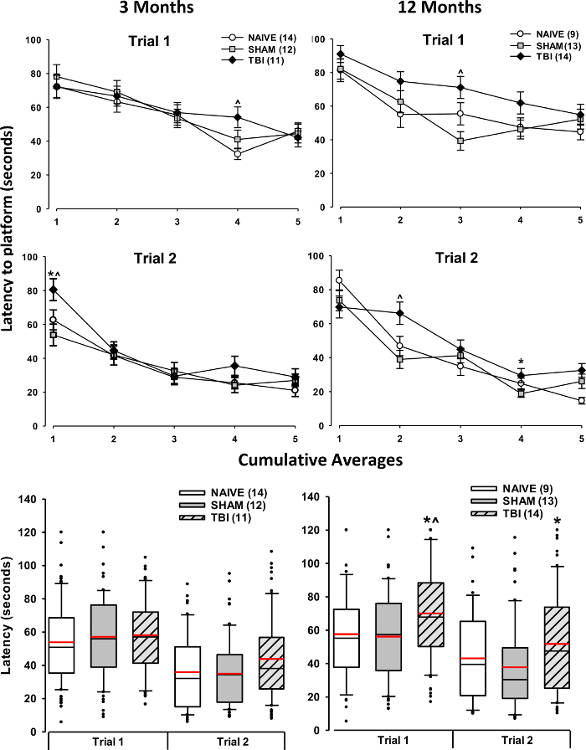
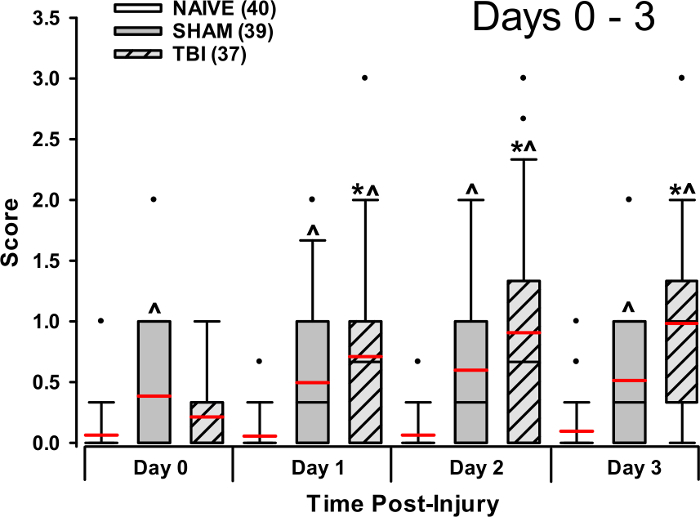
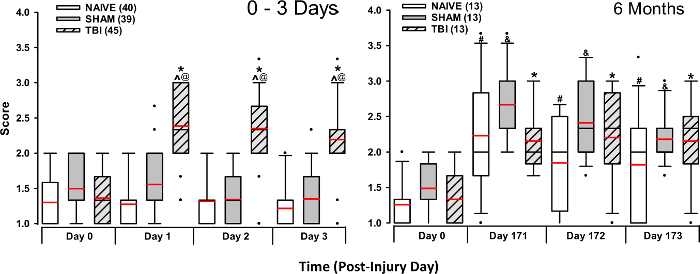
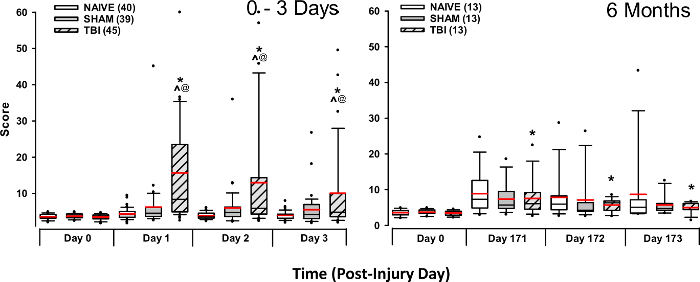
With the increasing incidence of traumatic brain injury (TBI) in both civilian and military populations, TBI is now considered a chronic disease; however, few studies have investigated the long-term effects of injury in rodent models of TBI. Shown here are behavioral measures that are well-established in TBI research for times early after injury, such as two weeks, until two months. Some of these methods have previously been used at later times after injury, up to one year, but by very few laboratories. The methods demonstrated here are a short neurological assessment to test reflexes, a Beam-Balance to test balance, a Beam-Walk to test balance and motor coordination, and a working memory version of the Morris water maze that can be sensitive to deficits in reference memory. Male rats were handled and pre-trained to neurological, balance, and motor coordination tests prior to receiving parasagittal fluid percussion injury (FPI) or sham injury. Rats can be tested on the short neurological assessment (neuroscore), the beam-balance, and the Beam-Walk multiple times, while testing on the water maze can only be done once. This difference is because rats can remember the task, thus confounding the results if repeated testing is attempted in the same animal. When testing from one to three days after injury, significant differences are detected in all three non-cognitive tasks. However, differences in the Beam-Walk task were not detectable at later time points (after 3 months). Deficits were detected at 3 months in the Beam-Balance and at 6 months in the neuroscore. Deficits in working memory were detected out to 12 months after injury, and a deficit in a reference memory first appeared at 12 months. Thus, standard behavioral tests can be useful measures of persistent behavioral deficits after FPI.
随着创伤性脑损伤(TBI)在平民和军人中的发病率不断上升,TBI现在被认为是一种慢性疾病;然而,很少有研究在TBI的啮齿动物模型中调查损伤的长期影响。这里展示的是在TBI研究中损伤后早期(如两周直至两个月)已确立的行为测量方法。其中一些方法此前曾在损伤后的较晚时间(长达一年)使用,但只有极少数实验室采用。这里展示的方法包括用于测试反射的简短神经学评估、用于测试平衡的横梁平衡测试、用于测试平衡和运动协调性的横梁行走测试,以及对参考记忆缺陷敏感的工作记忆版莫里斯水迷宫。雄性大鼠在接受矢状旁流体冲击伤(FPI)或假伤之前,先进行神经学、平衡和运动协调性测试的处理和预训练。大鼠可以多次接受简短神经学评估(神经评分)、横梁平衡测试和横梁行走测试,而水迷宫测试只能进行一次。这种差异是因为大鼠可以记住任务,因此如果在同一只动物身上尝试重复测试会混淆结果。在损伤后1至3天进行测试时,在所有三项非认知任务中都检测到了显著差异。然而,在后期时间点(3个月后),横梁行走任务中的差异无法检测到。在3个月时检测到横梁平衡测试有缺陷,在6个月时神经评分有缺陷。损伤后12个月内检测到工作记忆缺陷,参考记忆缺陷首次出现在12个月时。因此,标准行为测试可以作为FPI后持续性行为缺陷的有用测量方法。