Institute of Endemic Diseases, University of Khartoum, Khartoum, Sudan.
Foundation for Innovative New Diagnostics-FIND, Geneva, Switzerland.
PLoS Negl Trop Dis. 2018 Feb 14;12(2):e0006264. doi: 10.1371/journal.pntd.0006264. eCollection 2018 Feb.
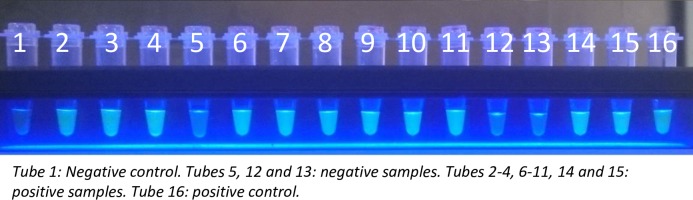
Confirmatory diagnosis of visceral leishmaniasis (VL), as well as diagnosis of relapses and test of cure, usually requires examination by microscopy of samples collected by invasive means, such as splenic, bone marrow or lymph node aspirates. This causes discomfort to patients, with risks of bleeding and iatrogenic infections, and requires technical expertise. Molecular tests have great potential for diagnosis of VL using peripheral blood, but require well-equipped facilities and trained personnel. More user-friendly, and field-amenable options are therefore needed. One method that could meet these requirements is loop-mediated isothermal amplification (LAMP) using the Loopamp Leishmania Detection Kit, which comes as dried down reagents that can be stored at room temperature, and allows simple visualization of results.
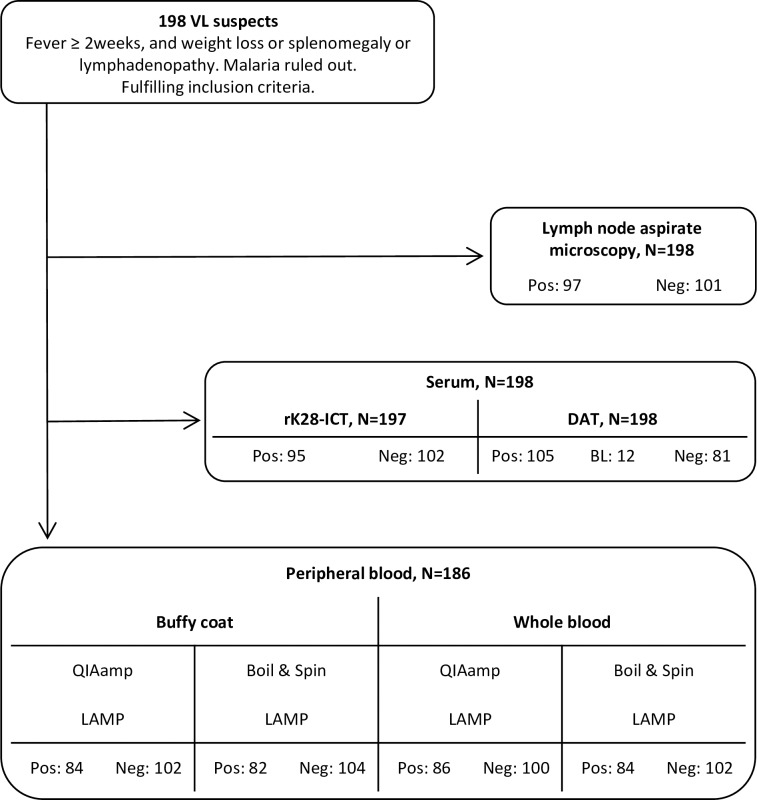
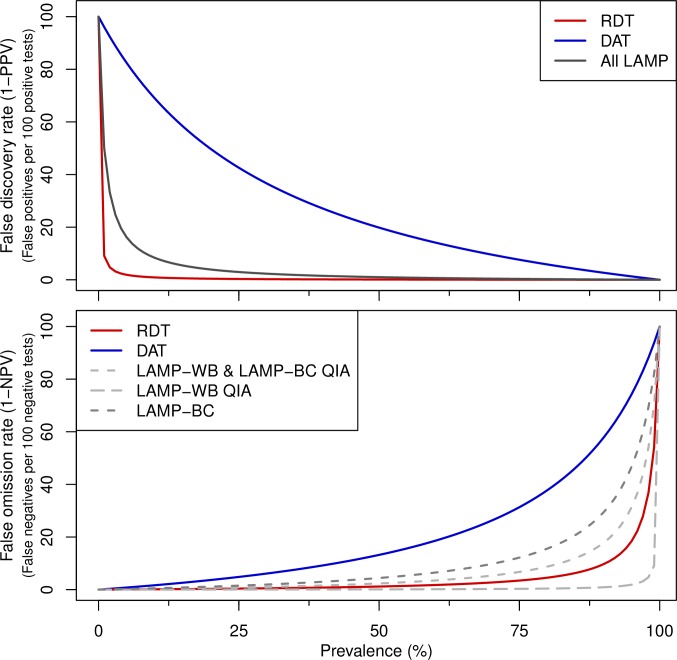
METHODOLOGY/PRINCIPAL FINDINGS: The Loopamp Leishmania Detection Kit (Eiken Chemical Co., Japan), was evaluated in the diagnosis of VL in Sudan. A total of 198 VL suspects were tested by microscopy of lymph node aspirates (the reference test), direct agglutination test-DAT (in house production) and rK28 antigen-based rapid diagnostic test (OnSite Leishmania rK39-Plus, CTK Biotech, USA). LAMP was performed on peripheral blood (whole blood and buffy coat) previously processed by: i) a direct boil and spin method, and ii) the QIAamp DNA Mini Kit (QIAgen). Ninety seven of the VL suspects were confirmed as cases by microscopy of lymph node aspirates. The sensitivity and specificity for each of the tests were: rK28 RDT 98.81% and 100%; DAT 88.10% and 78.22%; LAMP-boil and spin 97.65% and 99.01%; LAMP-QIAgen 100% and 99.01%.
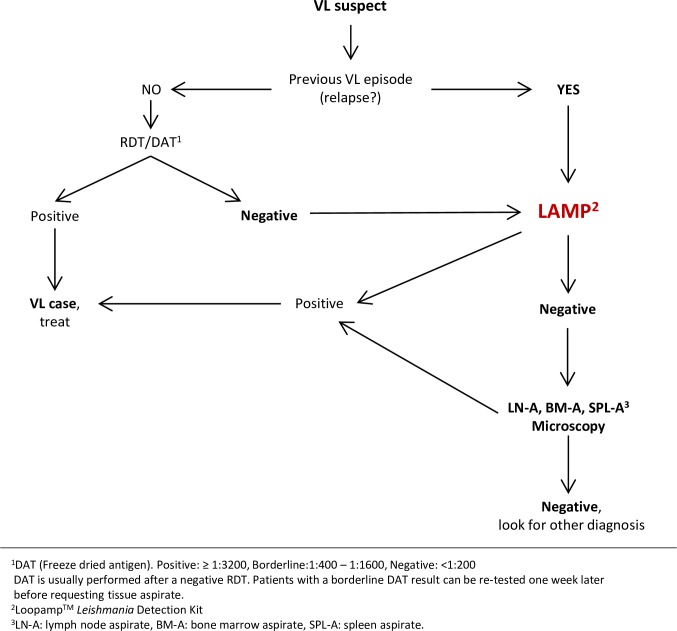
CONCLUSIONS/SIGNIFICANCE: Due to its simplicity and high sensitivity, rK28 RDT can be used first in the diagnostic algorithm for primary VL diagnosis, the excellent performance of LAMP using peripheral blood indicates that it can be also included in the algorithm for diagnosis of VL as a simple test when parasitological confirmatory diagnosis is required in settings that are lower than the reference laboratory, avoiding the need for invasive lymph node aspiration.
内脏利什曼病(VL)的确诊以及复发和治愈的检测通常需要通过侵入性手段采集样本进行显微镜检查,如脾、骨髓或淋巴结抽吸物。这会给患者带来不适,有出血和医源性感染的风险,并且需要技术专业知识。分子检测在外周血中诊断 VL 具有很大的潜力,但需要设备齐全的设施和经过培训的人员。因此,需要更方便用户使用且适合现场使用的选项。一种可能满足这些要求的方法是使用环介导等温扩增(LAMP)的环amp 利什曼检测试剂盒,该试剂盒以干燥的试剂形式提供,可以在室温下储存,并允许简单地可视化结果。
方法/主要发现:在苏丹,使用环amp 利什曼检测试剂盒(日本荣研化学株式会社)评估了 VL 的诊断。总共对 198 例 VL 疑似病例进行了检查,方法是对淋巴结抽吸物进行显微镜检查(参考测试)、直接凝集试验-DAT(内部生产)和 rK28 抗原基于快速诊断测试(OnSite Leishmania rK39-Plus,CTK Biotech,USA)。LAMP 是在外周血(全血和白细胞层)上进行的,这些血样之前经过了以下处理:i)直接煮沸和离心方法,和 ii)QIAamp DNA Mini 试剂盒(Qiagen)。97 例 VL 疑似病例通过淋巴结抽吸物显微镜检查被确认为病例。每种检测方法的灵敏度和特异性如下:rK28 RDT 为 98.81%和 100%;DAT 为 88.10%和 78.22%;LAMP-煮沸和离心为 97.65%和 99.01%;LAMP-QIAgen 为 100%和 99.01%。
结论/意义:由于其简单性和高灵敏度,rK28 RDT 可首先用于原发性 VL 诊断的诊断算法中,使用外周血的 LAMP 表现出优异的性能,表明在寄生虫学确认诊断需要低于参考实验室的环境中,也可以将其纳入 VL 诊断算法中,作为一种简单的检测方法,避免了对侵入性淋巴结抽吸的需求。