Uranga Ane, Quintana Jose M, Aguirre Urko, Artaraz Amaia, Diez Rosa, Pascual Silvia, Ballaz Aitor, España Pedro P
Department of Respiratory Medicine, Galdakao-Usansolo Hospital, Galdakao, Bizkaia, Spain.
Research Unit, Galdakao-Usansolo Hospital - Health Services Research on Chronic Patients Network (REDISSEC), Galdakao, Bizkaia, Spain.
PLoS One. 2018 Feb 14;13(2):e0192750. doi: 10.1371/journal.pone.0192750. eCollection 2018.
Community-acquired pneumonia (CAP) is a major public health problem with high short- and long-term mortality. The main aim of this study was to develop and validate a specific prognostic index for one-year mortality in patients admitted for CAP.
This was an observational, prospective study of adults aged ≥18 years admitted to Galdakao-Usansolo Hospital (Bizkaia, Spain) from January 2001 to July 2009 with a diagnosis of CAP surviving the first 15 days. The entire cohort was divided into two parts, in order to develop a one-year mortality predictive model in the derivation cohort, before validation using the second cohort.
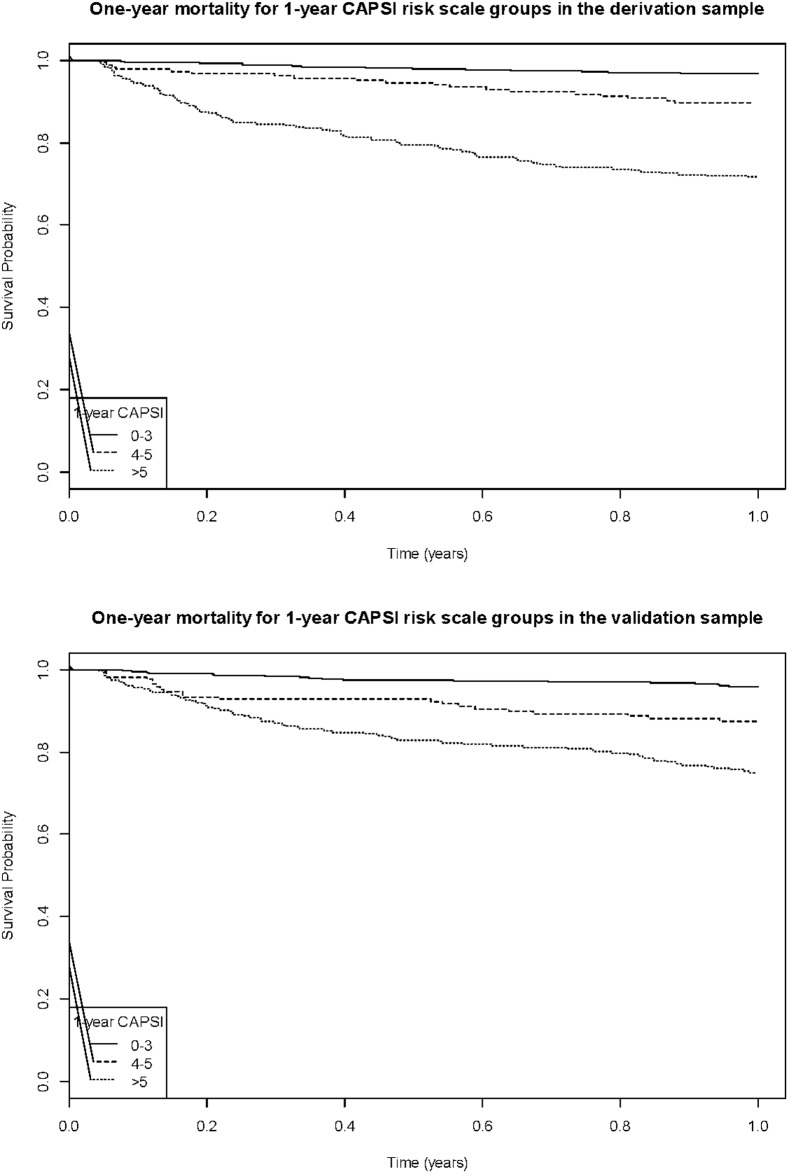
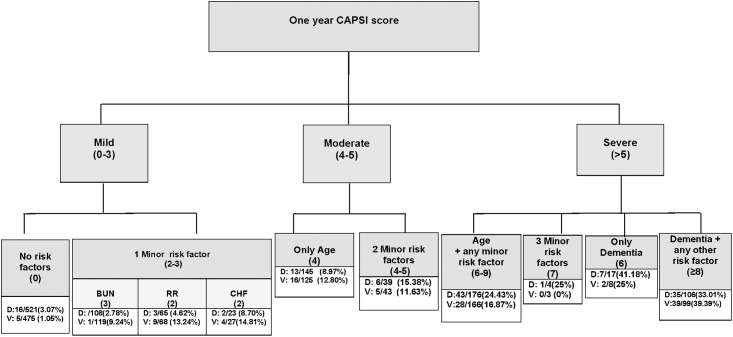
A total of 2351 patients were included and divided into a derivation and a validation cohort. After deaths within 15 days were excluded, one-year mortality was 10.63%. A predictive model was created in order to predict one-year mortality, with a weighted score that included: aged over 80 years (4 points), congestive heart failure (2 points), dementia (6 points), respiratory rate ≥30 breaths per minute (2 points) and blood urea nitrogen >30 mg/dL (3 points) as predictors of higher risk with C-index of 0.76. This new model showed better predictive ability than current risk scores, PSI, CURB65 and SCAP with C-index of 0.73, 0.69 and 0.70, respectively.
An easy-to-use score, called the one-year CAPSI, may be useful for identifying patients with a high probability of dying after an episode of CAP.
社区获得性肺炎(CAP)是一个重大的公共卫生问题,具有较高的短期和长期死亡率。本研究的主要目的是开发并验证一种针对因CAP入院患者的一年期死亡率的特异性预后指数。
这是一项对2001年1月至2009年7月入住西班牙比斯开省加尔达考-乌桑索洛医院、年龄≥18岁且诊断为CAP并存活前15天的成年人进行的观察性前瞻性研究。整个队列分为两部分,以便在推导队列中建立一年期死亡率预测模型,然后在第二个队列中进行验证。
共纳入2351例患者,分为推导队列和验证队列。排除15天内死亡病例后,一年期死亡率为10.63%。创建了一个预测模型来预测一年期死亡率,其加权评分包括:年龄超过80岁(4分)、充血性心力衰竭(2分)、痴呆(6分)、呼吸频率≥30次/分钟(2分)和血尿素氮>30mg/dL(3分)作为高风险预测因素,C指数为0.76。这个新模型显示出比当前风险评分(PSI、CURB65和SCAP,C指数分别为0.73、0.69和0.70)更好的预测能力。
一种名为一年期CAPSI的易于使用的评分,可能有助于识别CAP发作后死亡概率高的患者。