Grattan Emily S, Velozo Craig A, Skidmore Elizabeth R, Page Stephen J, Woodbury Michelle L
1 Medical University of South Carolina, Charleston, USA.
2 University of Pittsburgh, PA, USA.
OTJR (Thorofare N J). 2019 Jan;39(1):64-73. doi: 10.1177/1539449218757740. Epub 2018 Feb 15.
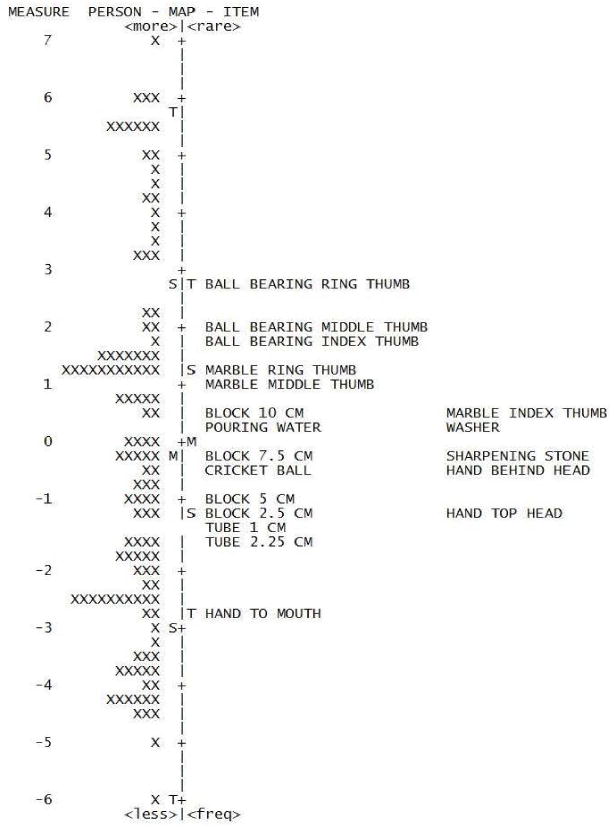
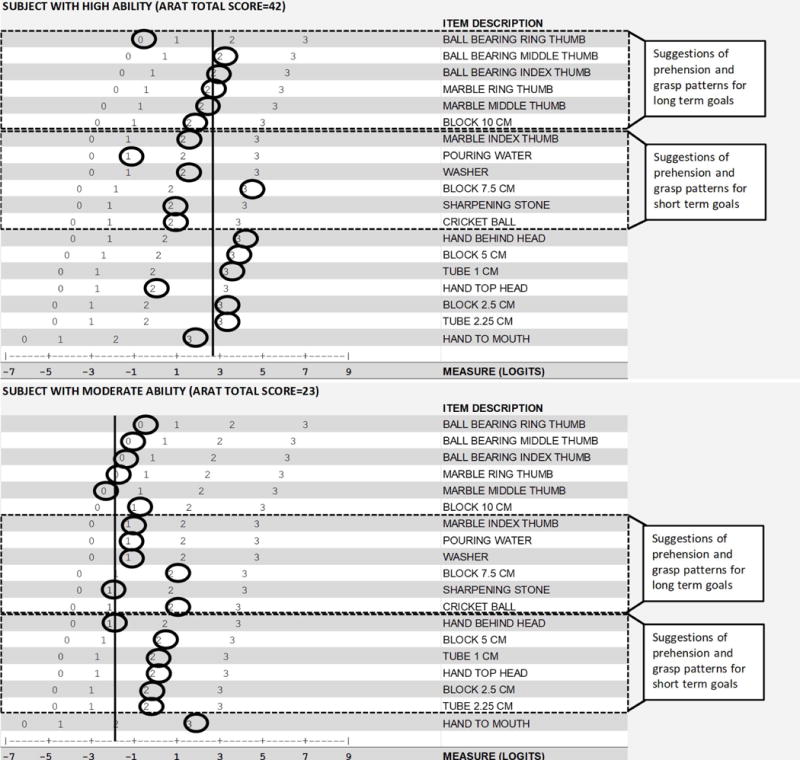
Rasch keyforms can help interpret clinical assessment scores. The Action Research Arm Test (ARAT) is a commonly used assessment, yet no keyform currently exists. The aim is to provide a keyform for the ARAT and demonstrate how a clinician can use the keyform to design optimally challenging rehabilitation sessions. Secondary analysis of ARAT data ( n = 122) using confirmatory factor and Rasch analyses were used to examine the measurement properties and generate a keyform. The item standardized factor loadings were >0.40 (range = 0.82-0.96) and R values were >.60 (range = .65-.96). All items exhibited adequate infit statistics with point measure correlations >.60 (range = .72-.97). Person reliability was .98, and person separation was 7.07. Item-difficulty measures ranged from -2.78 logits to 2.64 logits. The ARAT has strong measurement properties, and a keyform was provided. We showed how the keyform can be utilized by clinicians to interpret scores, set goals, and plan treatment.
拉施克关键形式有助于解释临床评估分数。动作研究臂测试(ARAT)是一种常用的评估方法,但目前尚无关键形式。目的是为ARAT提供一种关键形式,并展示临床医生如何使用该关键形式来设计具有最佳挑战性的康复训练课程。使用验证性因子分析和拉施克分析对ARAT数据(n = 122)进行二次分析,以检验测量属性并生成关键形式。项目标准化因子载荷>0.40(范围 = 0.82 - 0.96),R值>.60(范围 = .65 - .96)。所有项目均表现出足够的拟合统计量,点测量相关性>.60(范围 = .72 - .97)。人员可靠性为.98,人员分离度为7.07。项目难度测量范围从-2.78对数单位到2.64对数单位。ARAT具有很强的测量属性,并提供了一种关键形式。我们展示了临床医生如何利用关键形式来解释分数、设定目标和规划治疗。