Rocky Mountain Laboratories, NIAID, NIH, Hamilton, Montana, United States of America.
Division of Immunobiology, Cincinnati Children's Hospital Medical Center, Cincinnati, Ohio, United States of America.
PLoS Pathog. 2018 Feb 15;14(2):e1006776. doi: 10.1371/journal.ppat.1006776. eCollection 2018 Feb.
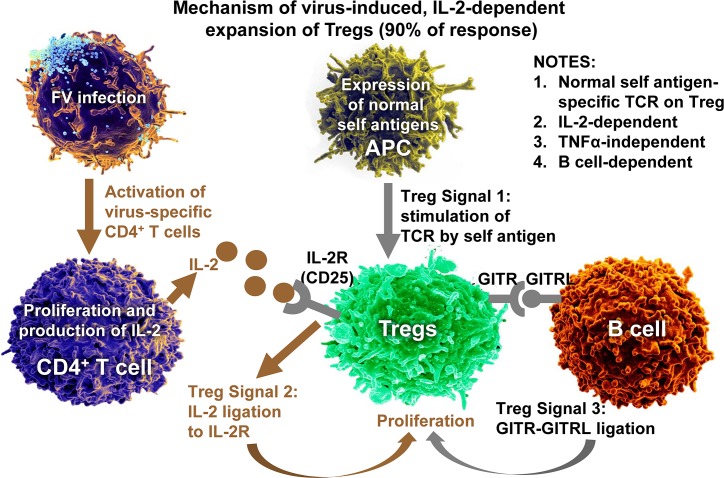
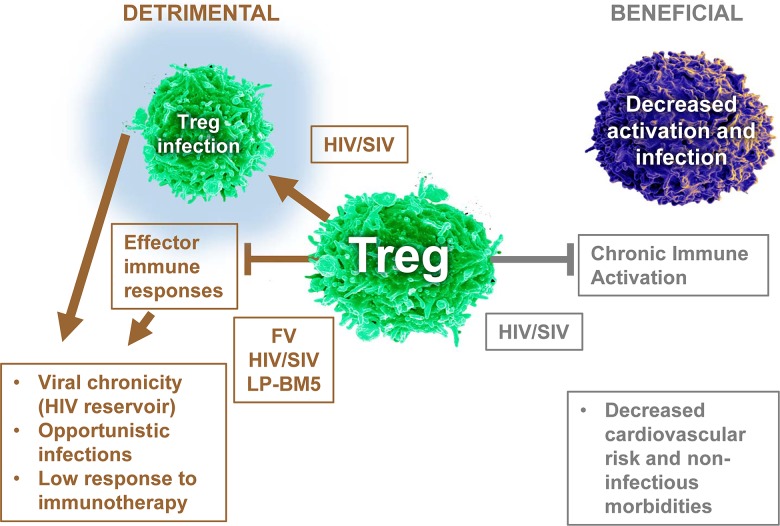
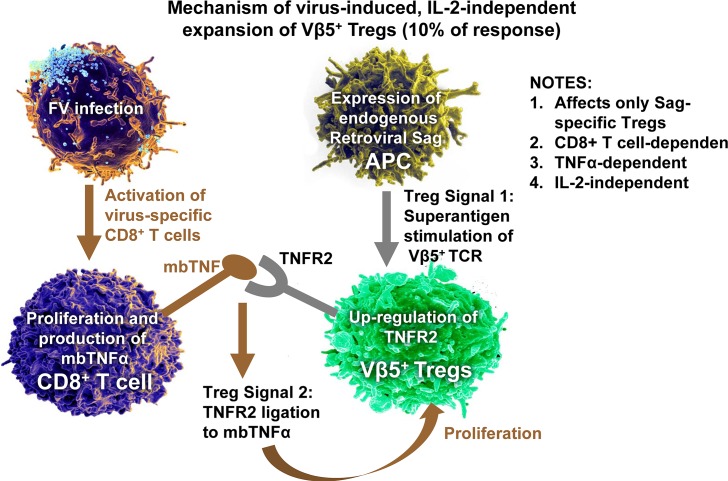
Tight regulation of immune responses is not only critical for preventing autoimmune diseases but also for preventing immunopathological damage during infections in which overactive immune responses may be more harmful for the host than the pathogen itself. Regulatory T cells (Tregs) play a critical role in this regulation, which was discovered using the Friend retrovirus (FV) mouse model. Subsequent FV studies revealed basic biological information about Tregs, including their suppressive activity on effector cells as well as the molecular mechanisms of virus-induced Treg expansion. Treg suppression not only limits immunopathology but also prevents complete elimination of pathogens contributing to chronic infections. Therefore, Tregs play a complex role in the pathogenesis of persistent retroviral infections. New therapeutic concepts to reactivate effector T-cell responses in chronic viral infections by manipulating Tregs also came from work with the FV model. This knowledge initiated many studies to characterize the role of Tregs in HIV pathogenesis in humans, where a complex picture is emerging. On one hand, Tregs suppress HIV-specific effector T-cell responses and are themselves targets of infection, but on the other hand, Tregs suppress HIV-induced immune hyperactivation and thus slow the infection of conventional CD4+ T cells and limit immunopathology. In this review, the basic findings from the FV mouse model are put into perspective with clinical and basic research from HIV studies. In addition, the few Treg studies performed in the simian immunodeficiency virus (SIV) monkey model will also be discussed. The review provides a comprehensive picture of the diverse role of Tregs in different retroviral infections and possible therapeutic approaches to treat retroviral chronicity and pathogenesis by manipulating Treg responses.
免疫反应的严格调控不仅对于防止自身免疫性疾病至关重要,对于防止感染过程中过度活跃的免疫反应对宿主造成的免疫病理损伤也至关重要,而过度活跃的免疫反应可能比病原体本身对宿主更有害。调节性 T 细胞(Treg)在这种调控中起着关键作用,这一发现是使用 Friend 逆转录病毒(FV)小鼠模型得出的。随后的 FV 研究揭示了 Treg 的基本生物学信息,包括它们对效应细胞的抑制活性以及病毒诱导 Treg 扩增的分子机制。Treg 的抑制不仅限制了免疫病理损伤,还防止了病原体的完全清除,从而导致慢性感染。因此,Treg 在持续性逆转录病毒感染的发病机制中发挥着复杂的作用。通过操纵 Treg 来重新激活慢性病毒感染中的效应 T 细胞反应的新治疗概念也来自 FV 模型的工作。这一知识引发了许多研究,以阐明 Treg 在人类 HIV 发病机制中的作用,目前正在出现复杂的情况。一方面,Treg 抑制 HIV 特异性效应 T 细胞反应,并且本身是感染的靶标,但另一方面,Treg 抑制 HIV 诱导的免疫过度激活,从而减缓常规 CD4+T 细胞的感染并限制免疫病理损伤。在这篇综述中,将从 FV 小鼠模型中得出的基本发现与来自 HIV 研究的临床和基础研究联系起来。此外,还将讨论在食蟹猴免疫缺陷病毒(SIV)猴模型中进行的少数 Treg 研究。该综述全面描述了 Treg 在不同逆转录病毒感染中的多样化作用,以及通过操纵 Treg 反应来治疗逆转录病毒慢性和发病机制的可能治疗方法。