Université de Versailles Saint Quentin, Institut Pasteur, Inserm, Paris, France.
London School of Hygiene & Tropical Medicine, London, United Kingdom.
PLoS Pathog. 2018 Feb 15;14(2):e1006770. doi: 10.1371/journal.ppat.1006770. eCollection 2018 Feb.
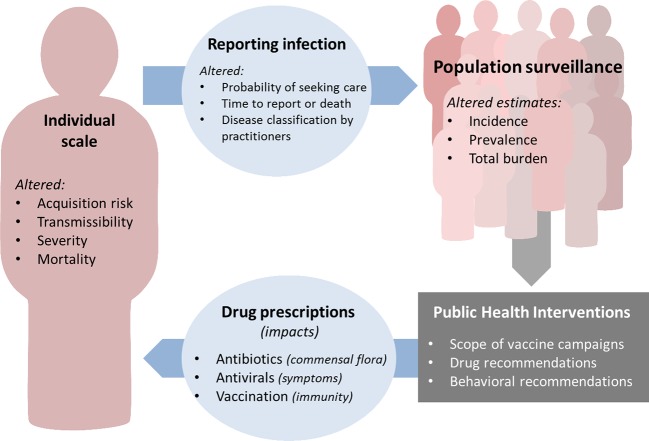
Evidence is mounting that influenza virus interacts with other pathogens colonising or infecting the human respiratory tract. Taking into account interactions with other pathogens may be critical to determining the real influenza burden and the full impact of public health policies targeting influenza. This is particularly true for mathematical modelling studies, which have become critical in public health decision-making. Yet models usually focus on influenza virus acquisition and infection alone, thereby making broad oversimplifications of pathogen ecology. Herein, we report evidence of influenza virus interactions with bacteria and viruses and systematically review the modelling studies that have incorporated interactions. Despite the many studies examining possible associations between influenza and Streptococcus pneumoniae, Staphylococcus aureus, Haemophilus influenzae, Neisseria meningitidis, respiratory syncytial virus (RSV), human rhinoviruses, human parainfluenza viruses, etc., very few mathematical models have integrated other pathogens alongside influenza. The notable exception is the pneumococcus-influenza interaction, for which several recent modelling studies demonstrate the power of dynamic modelling as an approach to test biological hypotheses on interaction mechanisms and estimate the strength of those interactions. We explore how different interference mechanisms may lead to unexpected incidence trends and possible misinterpretation, and we illustrate the impact of interactions on public health surveillance using simple transmission models. We demonstrate that the development of multipathogen models is essential to assessing the true public health burden of influenza and that it is needed to help improve planning and evaluation of control measures. Finally, we identify the public health, surveillance, modelling, and biological challenges and propose avenues of research for the coming years.
越来越多的证据表明,流感病毒与定植或感染人类呼吸道的其他病原体相互作用。考虑到与其他病原体的相互作用可能是确定流感实际负担和针对流感的公共卫生政策全面影响的关键。对于数学模型研究来说尤其如此,这些研究在公共卫生决策中变得至关重要。然而,这些模型通常仅关注流感病毒的获得和感染,从而对病原体生态学进行了广泛的过度简化。在此,我们报告了流感病毒与细菌和病毒相互作用的证据,并系统地回顾了纳入相互作用的模型研究。尽管有许多研究检查了流感与肺炎链球菌、金黄色葡萄球菌、流感嗜血杆菌、脑膜炎奈瑟菌、呼吸道合胞病毒(RSV)、人鼻病毒、人副流感病毒等之间的可能关联,但很少有数学模型将其他病原体与流感一起整合。一个显著的例外是肺炎球菌与流感的相互作用,最近的几项建模研究表明,动态建模作为一种检验相互作用机制的生物学假设并估计这些相互作用强度的方法具有强大的作用。我们探讨了不同的干扰机制如何导致意想不到的发病趋势和可能的误解,并使用简单的传播模型说明了相互作用对公共卫生监测的影响。我们证明了开发多病原体模型对于评估流感对公共卫生的真正负担至关重要,并且需要帮助改进控制措施的规划和评估。最后,我们确定了公共卫生、监测、建模和生物学方面的挑战,并提出了未来几年的研究途径。