IHPE, University of Montpellier, CNRS, IFREMER, University of Perpignan Via Domitia, Perpignan, France.
Institute of Science and Technology Austria, Klosterneuburg, Austria.
Genome Biol Evol. 2018 Mar 1;10(3):840-856. doi: 10.1093/gbe/evy037.
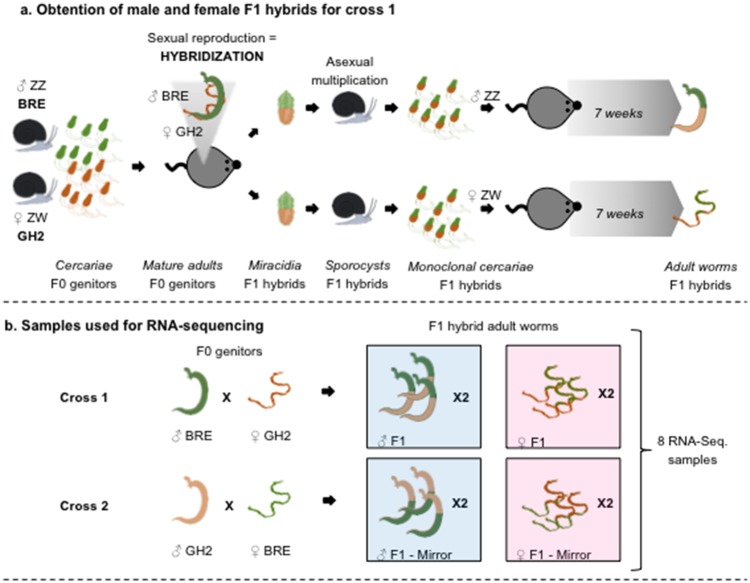
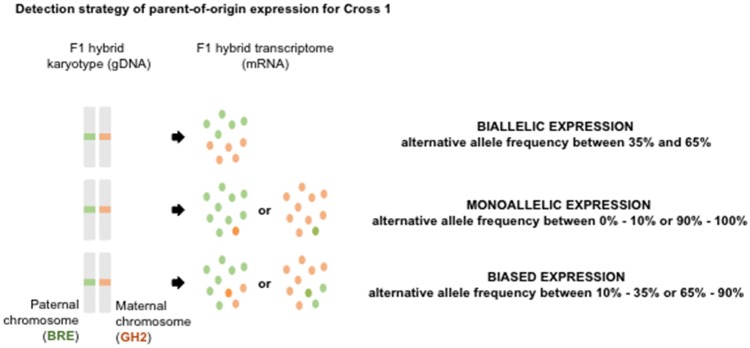
Schistosomes are the causative agents of schistosomiasis, a neglected tropical disease affecting over 230 million people worldwide. Additionally to their major impact on human health, they are also models of choice in evolutionary biology. These parasitic flatworms are unique among the common hermaphroditic trematodes as they have separate sexes. This so-called "evolutionary scandal" displays a female heterogametic genetic sex-determination system (ZZ males and ZW females), as well as a pronounced adult sexual dimorphism. These phenotypic differences are determined by a shared set of genes in both sexes, potentially leading to intralocus sexual conflicts. To resolve these conflicts in sexually selected traits, molecular mechanisms such as sex-biased gene expression could occur, but parent-of-origin gene expression also provides an alternative. In this work we investigated the latter mechanism, that is, genes expressed preferentially from either the maternal or the paternal allele, in Schistosoma mansoni species. To this end, transcriptomes from male and female hybrid adults obtained by strain crosses were sequenced. Strain-specific single nucleotide polymorphism (SNP) markers allowed us to discriminate the parental origin, while reciprocal crosses helped to differentiate parental expression from strain-specific expression. We identified genes containing SNPs expressed in a parent-of-origin manner consistent with paternal and maternal imprints. Although the majority of the SNPs was identified in mitochondrial and Z-specific loci, the remaining SNPs found in male and female transcriptomes were situated in genes that have the potential to explain sexual differences in schistosome parasites. Furthermore, we identified and validated four new Z-specific scaffolds.
血吸虫是血吸虫病的病原体,这是一种被忽视的热带病,影响着全球超过 2.3 亿人。除了对人类健康的重大影响外,它们还是进化生物学的首选模型。这些寄生扁虫在常见的雌雄同体吸虫中是独一无二的,因为它们有不同的性别。这种所谓的“进化丑闻”展示了一种雌性异配遗传性别决定系统(ZZ 雄性和 ZW 雌性),以及明显的成年性二态性。这些表型差异是由两性共享的一组基因决定的,这可能导致基因座内的性冲突。为了解决这些在有性选择特征中的冲突,可能会发生分子机制,如性别偏倚基因表达,但亲源基因表达也提供了另一种选择。在这项工作中,我们研究了后者的机制,即在雌雄同体的曼氏血吸虫物种中,从母体或父体等位基因优先表达的基因。为此,我们对通过株系杂交获得的雌雄混合成虫的转录组进行了测序。株系特异性单核苷酸多态性(SNP)标记允许我们区分亲本来源,而正反交有助于区分亲本表达和株系特异性表达。我们鉴定了含有 SNP 的基因,这些 SNP 以与父本和母本印记一致的亲本来源方式表达。尽管大多数 SNP 是在线粒体和 Z 特异性基因座中发现的,但在雌雄转录组中发现的其余 SNP 位于有潜力解释血吸虫寄生虫性差异的基因中。此外,我们鉴定并验证了四个新的 Z 特异性支架。