Department of Pediatrics, Indiana University School of Medicine, 1044 West Walnut St., Building 4, Indianapolis, IN, 46202, USA.
Sandra Rotman Centre for Global Health, Toronto General Hospital, University Health Network, MaRS Centre, 101 College St. TMDT 10-360A, Toronto, ON, M5G 1L7, Canada.
Malar J. 2018 Feb 15;17(1):82. doi: 10.1186/s12936-018-2225-5.
Chitinase-3-like 1 (CHI3L1) is a glycoprotein elevated in paediatric severe malaria, and an emerging urinary biomarker of acute kidney injury (AKI). Based on the hypothesis that elevated CHI3L1 levels in malaria are associated with disease severity, the relationship between plasma CHI3L1 levels, AKI and mortality was investigated in Ugandan children enrolled in a clinical trial evaluating inhaled nitric oxide (iNO) as an adjunctive therapy for severe malaria.
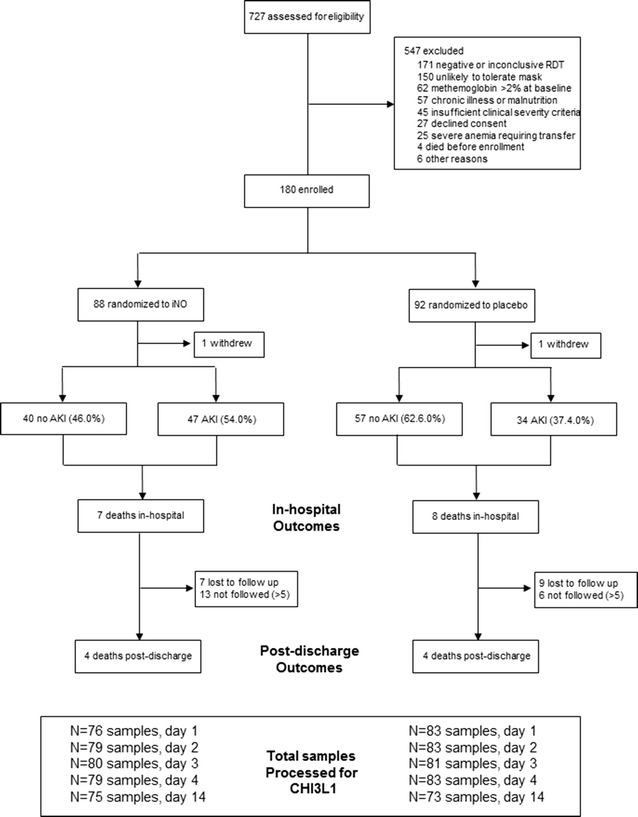
Plasma CHI3L1 levels were measured daily for 4 days in children admitted to hospital with severe malaria and at day 14 follow up. AKI was defined using the Kidney Disease: Improving Global Outcomes consensus criteria. This is a secondary analysis of a randomized double-blind placebo-controlled trial of iNO versus placebo as an adjunctive therapy for severe malaria. Inclusion criteria were: age 1-10 years, and selected criteria for severe malaria. Exclusion criteria included suspected bacterial meningitis, known chronic illness including renal disease, haemoglobinopathy, or severe malnutrition. iNO was administered by non-rebreather mask for up to 72 h at 80 ppm.
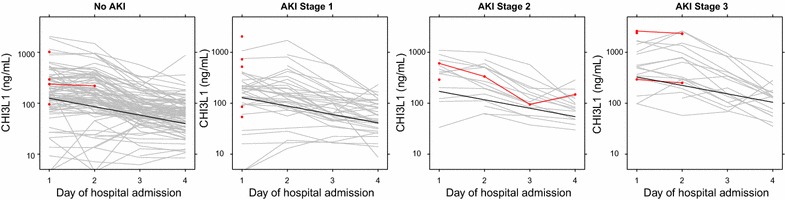
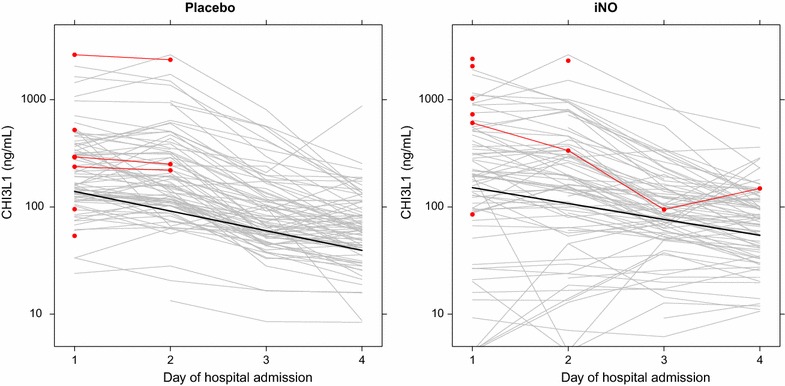
CHI3L1 was elevated in patients with AKI and remained higher over hospitalization (p < 0.0001). Admission CHI3L1 levels were elevated in children who died. By multivariable analysis logCHI3L1 levels were associated with increased risk of in-hospital death (relative risk, 95% CI 4.10, 1.32-12.75, p = 0.015) and all-cause 6 month mortality (3.21, 1.47-6.98, p = 0.003) following correction for iNO and AKI. Treatment with iNO was associated with delayed CHI3L1 recovery with a daily decline of 34% in the placebo group versus 29% in the iNO group (p = 0.012). CHI3L1 levels correlated with markers of inflammation (CRP, sTREM-1, CXCL10), endothelial activation (Ang-2, sICAM-1) and intravascular haemolysis (LDH, haem, haemopexin).
CHI3L1 is a novel biomarker of malaria-associated AKI and an independent risk factor for mortality that is associated with well-established pathways of severe malaria pathogenesis including inflammation, endothelial activation, and haemolysis. Trial registration Clinicaltrials.gov, NCT01255215. Registered December 7th 2010.
壳三糖酶样蛋白 1(CHI3L1)是一种在小儿严重疟疾中升高的糖蛋白,也是急性肾损伤(AKI)的新兴尿生物标志物。基于CHI3L1 水平在疟疾中升高与疾病严重程度相关的假设,本研究在乌干达接受吸入一氧化氮(iNO)作为严重疟疾辅助治疗的临床试验中,调查了血浆 CHI3L1 水平、AKI 和死亡率之间的关系。
在因严重疟疾入院的儿童中,每天测量 4 天的血浆 CHI3L1 水平,在第 14 天随访时测量。AKI 采用改善全球肾脏病预后组织共识标准定义。这是 iNO 与安慰剂作为严重疟疾辅助治疗的随机双盲安慰剂对照试验的二次分析。纳入标准为:年龄 1-10 岁,有严重疟疾的选择标准。排除标准包括疑似细菌性脑膜炎、已知慢性疾病(包括肾脏疾病、血红蛋白病或严重营养不良)。iNO 通过非再呼吸面罩给药,最高可达 80ppm,持续 72 小时。
AKI 患者的 CHI3L1 升高,住院期间持续升高(p<0.0001)。死亡患儿的入院 CHI3L1 水平升高。多变量分析显示,logCHI3L1 水平与住院期间死亡风险增加相关(相对风险,95%CI 4.10,1.32-12.75,p=0.015)和全因 6 个月死亡率(3.21,1.47-6.98,p=0.003),校正 iNO 和 AKI 后。与安慰剂组相比,iNO 治疗组 CHI3L1 恢复速度较慢,每日下降 34%,而 iNO 组下降 29%(p=0.012)。CHI3L1 水平与炎症标志物(CRP、sTREM-1、CXCL10)、内皮激活标志物(Ang-2、sICAM-1)和血管内溶血标志物(LDH、血红蛋白、血红素结合蛋白)相关。
CHI3L1 是疟疾相关 AKI 的新型生物标志物,也是死亡率的独立危险因素,与严重疟疾发病机制的既定途径相关,包括炎症、内皮激活和溶血。
Clinicaltrials.gov,NCT01255215。2010 年 12 月 7 日注册。