Division of Immunology, Transplantation and Infectious Diseases, IRCCS San Raffaele Scientific Institute, San Raffaele Via Olgettina 58, 20132, Milan, Italy.
Vita-Salute San Raffaele University, Milan, Italy.
Sci Rep. 2022 May 9;12(1):7606. doi: 10.1038/s41598-022-11532-x.
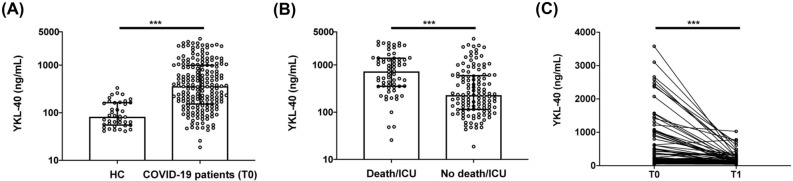
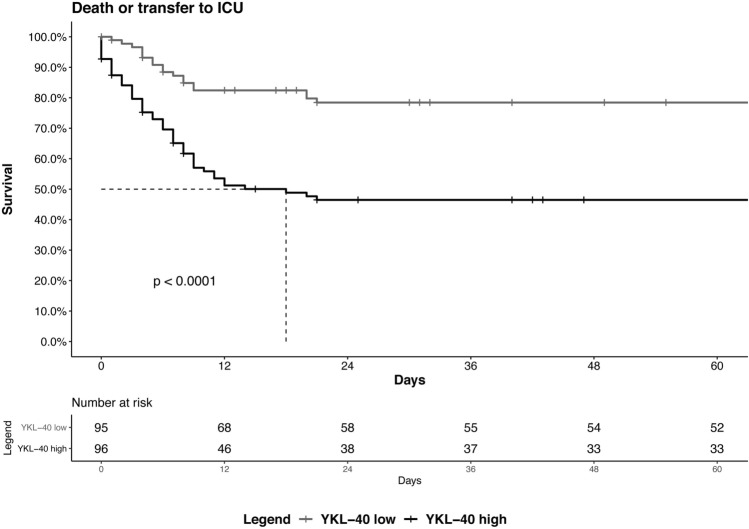
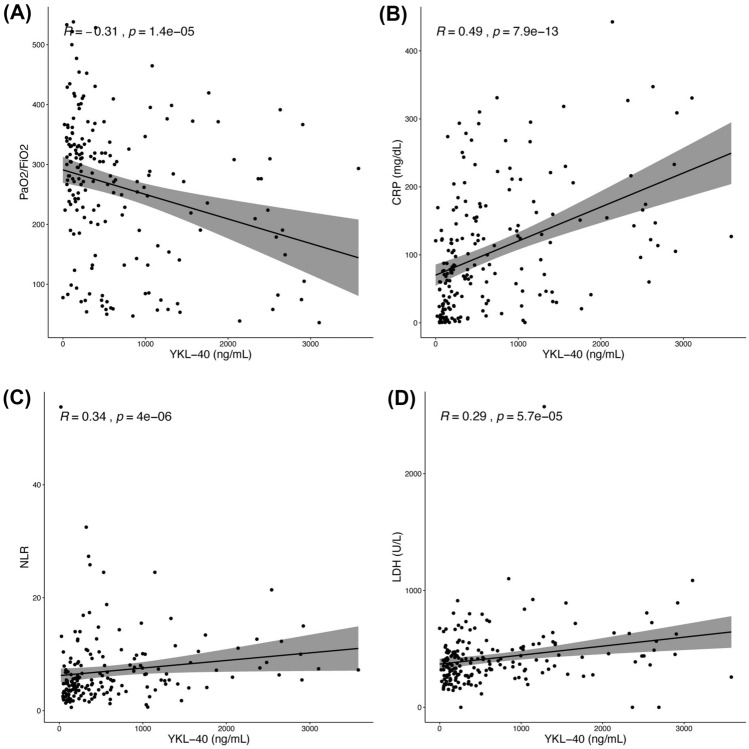
Infectious and inflammatory stimuli elicit the generation of chitinase-3-like protein-1 (CHI3L1), involved in tissue damage, repair and remodeling. We evaluated whether plasma CHI3L1 at disease onset predicts clinical outcome of patients with Coronavirus 2019 (COVID-19) disease. Blood from 191 prospectively followed COVID-19 patients were collected at hospital admission between March 18th and May 5th, 2020. Plasma from 80 survivors was collected one month post-discharge. Forty age- and sex-matched healthy volunteers served as controls. Primary outcome was transfer to intensive care unit (ICU) or death. CHI3L1 was higher in COVID-19 patients than controls (p < 0.0001). Patients with unfavorable outcome (41 patients admitted to ICU, 47 died) had significantly higher CHI3L1 levels than non-ICU survivors (p < 0.0001). CHI3L1 levels abated in survivors one month post-discharge, regardless of initial disease severity (p < 0.0001), although remaining higher than controls (p < 0.05). Cox regression analysis revealed that CHI3L1 levels predict primary outcome independently of age, sex, comorbidities, degree of respiratory insufficiency and systemic inflammation or time from symptom onset to sampling (p < 0.0001). Kaplan-Meier curve analysis confirmed that patients with CHI3L1 levels above the median (361 ng/mL) had a poorer prognosis (log rank test, p < 0.0001). Plasma CHI3L1 is increased in COVID-19 patients and predicts adverse outcome.
在感染和炎症刺激下,会产生几丁质酶 3 样蛋白 1(CHI3L1),它参与组织损伤、修复和重塑。我们评估了 COVID-19 患者发病时的血浆 CHI3L1 是否可以预测其临床结局。我们前瞻性地随访了 191 例 COVID-19 患者,于 2020 年 3 月 18 日至 5 月 5 日入院时采集其血液,其中 80 例存活患者在出院后 1 个月采集血浆,另外选择 40 名年龄和性别匹配的健康志愿者作为对照。主要结局是转入重症监护病房(ICU)或死亡。与对照组相比,COVID-19 患者的 CHI3L1 水平更高(p<0.0001)。预后不良的患者(41 例转入 ICU,47 例死亡)的 CHI3L1 水平显著高于非 ICU 存活者(p<0.0001)。无论初始疾病严重程度如何,存活患者在出院后 1 个月时 CHI3L1 水平下降(p<0.0001),尽管仍高于对照组(p<0.05)。Cox 回归分析显示,CHI3L1 水平可独立于年龄、性别、合并症、呼吸衰竭程度、全身炎症反应和从症状出现到采样的时间预测主要结局(p<0.0001)。Kaplan-Meier 曲线分析证实,CHI3L1 水平高于中位数(361ng/ml)的患者预后较差(对数秩检验,p<0.0001)。COVID-19 患者的血浆 CHI3L1 升高,并可预测不良结局。