Jessup Dana L, Glover Iv McKinley, Daye Dania, Banzi Lynda, Jones Philip, Choy Garry, Shepard Jo-Anne O, Flores Efrén J
Department of Radiology, Massachusetts General Hospital, Boston, MA, United States.
Massachusetts General Physicians Organization, Boston, MA, United States.
J Med Internet Res. 2018 Feb 15;20(2):e52. doi: 10.2196/jmir.8932.
Lung cancer is the leading cause of cancer-related deaths in the United States. Despite mandated insurance coverage for eligible patients, lung cancer screening rates remain low. Digital platforms, including social media, provide a potentially valuable tool to enhance health promotion and patient engagement related to lung cancer screening (LCS).
The aim was to assess the effectiveness of LCS digital awareness campaigns on utilization of low-dose computed tomography (LDCT) and visits to institutional online educational content.
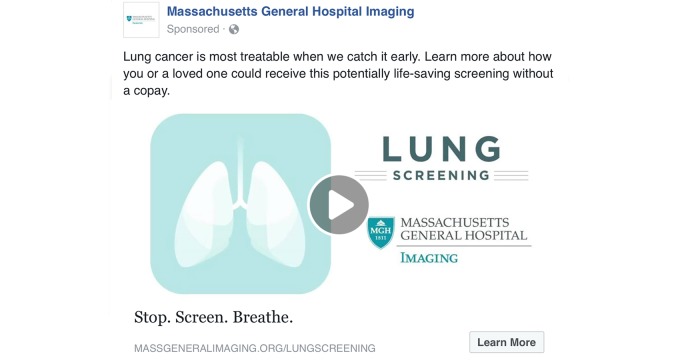
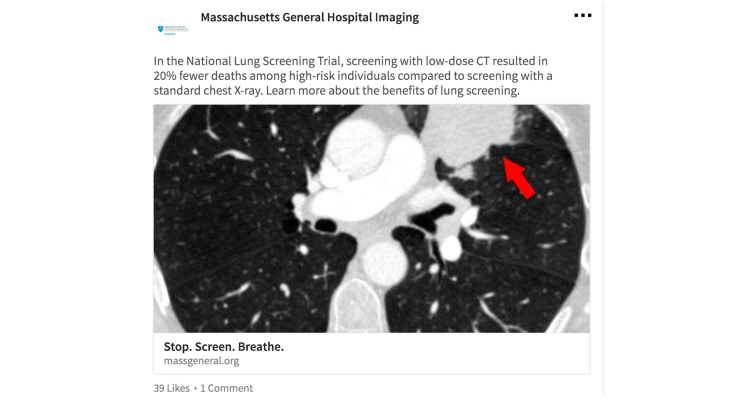
A pay-per-click campaign utilizing Google and Facebook targeted adults aged 55 years and older and caregivers aged 18 years and older (eg, spouses, adult children) with LCS content during a 20-week intervention period from May to September 2016. A concurrent pay-per-click campaign using LinkedIn and Twitter targeted health care providers with LCS content. Geographic target radius was within 60 miles of an academic medical center. Social media data included aggregate demographics and click-through rates (CTRs). Primary outcome measures were visits to institutional Web pages and scheduled LDCT exams. Study period was 20 weeks before, during, and after the digital awareness campaigns.
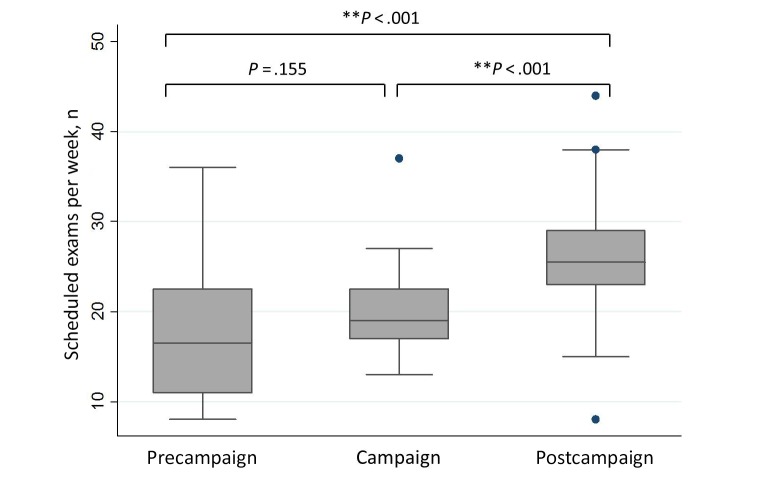
Weekly visits to the institutional LCS Web pages were significantly higher during the digital awareness campaigns compared to the 20-week period prior to implementation (mean 823.9, SD 905.8 vs mean 51, SD 22.3, P=.001). The patient digital awareness campaign surpassed industry standard CTRs on Google (5.85%, 1108/18,955 vs 1.8%) and Facebook (2.59%, 47,750/1,846,070 vs 0.8%). The provider digital awareness campaign surpassed industry standard CTR on LinkedIn (1.1%, 630/57,079 vs 0.3%) but not Twitter (0.19%, 1139/587,133 vs 0.25%). Mean scheduled LDCT exam volumes per week before, during, and after the digital awareness campaigns were 17.4 (SD 7.5), 20.4 (SD 5.4), and 26.2 (SD 6.4), respectively, with the difference between the mean number of scheduled exams after the digital awareness campaigns and the number of exams scheduled before and after the digital awareness campaigns being statistically significant (P<.001).
Implementation of the LCS digital awareness campaigns was associated with increased visits to institutional educational Web pages and scheduled LDCT exams. Digital platforms are an important tool to enhance health promotion activities and engagement with patients and providers.
肺癌是美国癌症相关死亡的主要原因。尽管符合条件的患者有强制保险覆盖,但肺癌筛查率仍然很低。包括社交媒体在内的数字平台提供了一个潜在有价值的工具,可用于加强与肺癌筛查(LCS)相关的健康促进和患者参与度。
旨在评估肺癌筛查数字宣传活动对低剂量计算机断层扫描(LDCT)的使用以及机构在线教育内容访问量的有效性。
在2016年5月至9月的20周干预期间,利用谷歌和脸书开展了一项按点击付费的活动,目标受众为55岁及以上的成年人以及18岁及以上的护理人员(如配偶、成年子女),宣传肺癌筛查内容。同时,利用领英和推特开展了一项针对医疗保健提供者的按点击付费活动,宣传肺癌筛查内容。地理目标半径在学术医疗中心60英里范围内。社交媒体数据包括总体人口统计信息和点击率(CTR)。主要结局指标是机构网页的访问量和预定的LDCT检查。研究期为数字宣传活动之前、期间和之后的20周。
与实施前的20周相比,数字宣传活动期间机构肺癌筛查网页的每周访问量显著更高(平均823.9,标准差905.8,对比平均51,标准差22.3,P = 0.001)。患者数字宣传活动在谷歌上的点击率超过了行业标准(5.85%,1108/18955对比1.8%),在脸书上也超过了行业标准(2.59%,4775 / 1846070对比0.8%)。提供者数字宣传活动在领英上的点击率超过了行业标准(1.1%,630/57079对比0.3%),但在推特上未超过(0.19%,1139/587133对比0.25%)。数字宣传活动之前、期间和之后每周预定的LDCT检查量平均分别为17.4(标准差7.5)、20.4(标准差5.4)和26.2(标准差6.4),数字宣传活动之后预定检查的平均数量与数字宣传活动之前和之后预定检查数量之间的差异具有统计学意义(P < 0.001)。
肺癌筛查数字宣传活动的实施与机构教育网页访问量增加以及预定的LDCT检查增加相关。数字平台是加强健康促进活动以及患者和提供者参与度的重要工具。