Section of Oncology and Immunology, Department of Surgery, Oncology and Gastroenterology, University of Padova, Via Gattamelata 64, Padova 35128, Italy.
Clinical Trials and Biostatistic Unit, Istituto Oncologico Veneto (IOV)-IRCCS, Via Gattamelata 64, Padova 35128, Italy.
Br J Cancer. 2018 Mar 20;118(6):878-886. doi: 10.1038/bjc.2017.492. Epub 2018 Feb 15.
Preoperative chemoradiotherapy (CRT) followed by surgery is the standard care for locally advanced rectal cancer, but tumour response to CRT and disease outcome are variable. The current study aimed to investigate the effectiveness of plasma telomerase reverse transcriptase (TERT) levels in predicting tumour response and clinical outcome.
176 rectal cancer patients were included. Plasma samples were collected at baseline (before CRT=T0), 2 weeks after CRT was initiated (T1), post-CRT and before surgery (T2), and 4-8 months after surgery (T3) time points. Plasma TERT mRNA levels and total cell-free RNA were determined using real-time PCR.
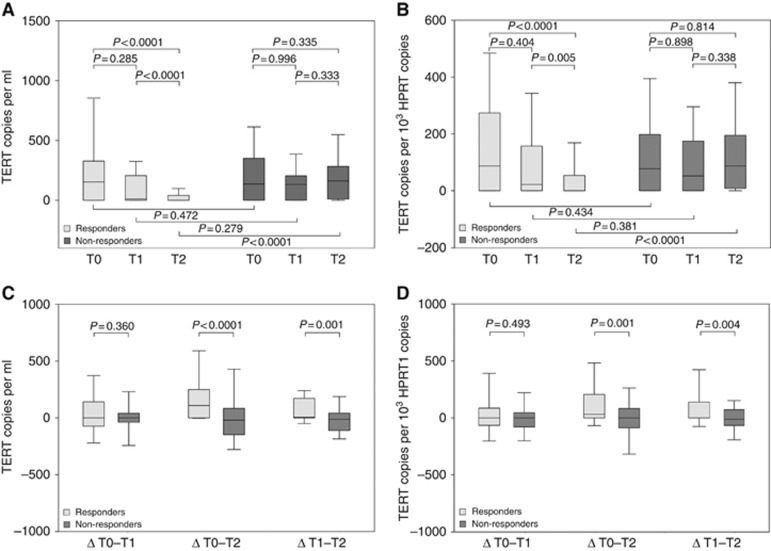
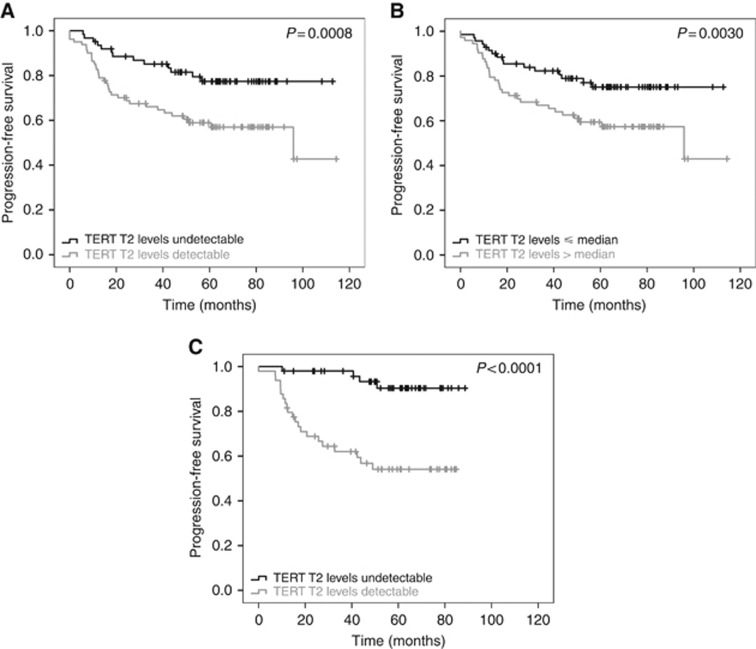
Plasma levels of TERT were significantly lower at T2 (P<0.0001) in responders than in non-responders. Post-CRT TERT levels and the differences between pre- and post-CRT TERT levels independently predicted tumour response, and the prediction model had an area under curve of 0.80 (95% confidence interval (CI) 0.73-0.87). Multiple analysis demonstrated that patients with detectable TERT levels at T2 and T3 time points had a risk of disease progression 2.13 (95% CI 1.10-4.11)-fold and 4.55 (95% CI 1.48-13.95)-fold higher, respectively, than those with undetectable plasma TERT levels.
Plasma TERT levels are independent markers of tumour response and are prognostic of disease progression in rectal cancer patients who undergo neoadjuvant therapy.
术前放化疗(CRT)加手术是局部晚期直肠癌的标准治疗方法,但肿瘤对 CRT 的反应和疾病转归存在差异。本研究旨在探讨血浆端粒酶逆转录酶(TERT)水平预测肿瘤反应和临床结局的有效性。
纳入 176 例直肠癌患者。采集基线(CRT 前=T0)、CRT 开始后 2 周(T1)、CRT 后及术前(T2)以及术后 4-8 个月(T3)的血浆样本。采用实时 PCR 法检测血浆 TERT mRNA 水平和总游离 RNA。
在有反应者中,T2 时 TERT 水平显著低于无反应者(P<0.0001)。CRT 后 TERT 水平和 CRT 前后 TERT 水平的差异可独立预测肿瘤反应,预测模型的曲线下面积为 0.80(95%置信区间(CI)0.73-0.87)。多因素分析表明,T2 和 T3 时间点可检测到 TERT 水平的患者疾病进展的风险分别为不可检测血浆 TERT 水平患者的 2.13 倍(95%CI 1.10-4.11)和 4.55 倍(95%CI 1.48-13.95)。
血浆 TERT 水平是肿瘤反应的独立标志物,可预测接受新辅助治疗的直肠癌患者疾病进展。