Petrikin Josh E, Cakici Julie A, Clark Michelle M, Willig Laurel K, Sweeney Nathaly M, Farrow Emily G, Saunders Carol J, Thiffault Isabelle, Miller Neil A, Zellmer Lee, Herd Suzanne M, Holmes Anne M, Batalov Serge, Veeraraghavan Narayanan, Smith Laurie D, Dimmock David P, Leeder J Steven, Kingsmore Stephen F
1Center for Pediatric Genomic Medicine, Children's Mercy, Kansas City, MO 64108 USA.
2Department of Pediatrics, Children's Mercy, Kansas City, MO 64108 USA.
NPJ Genom Med. 2018 Feb 9;3:6. doi: 10.1038/s41525-018-0045-8. eCollection 2018.
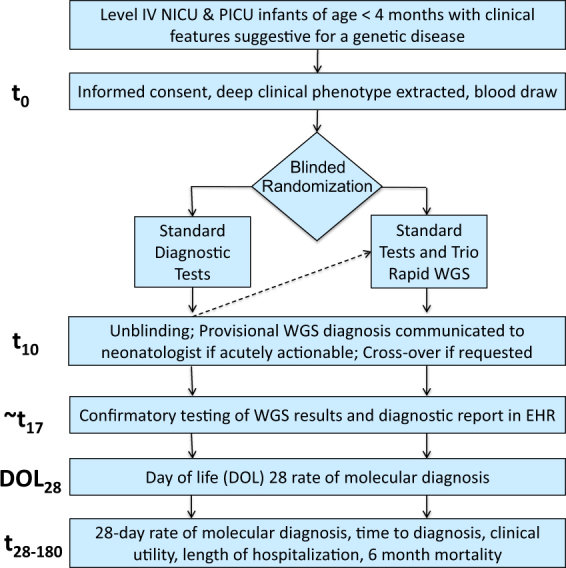
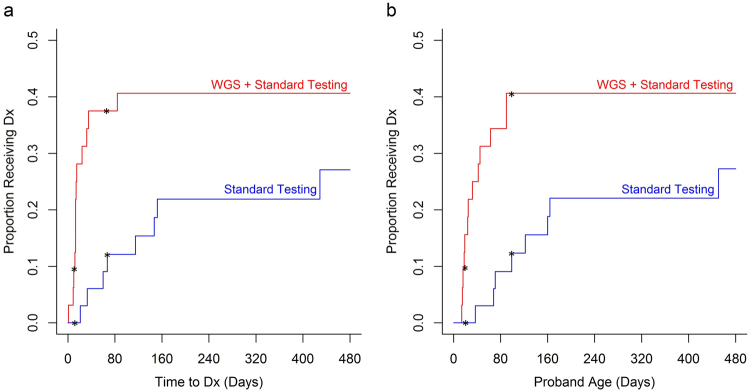
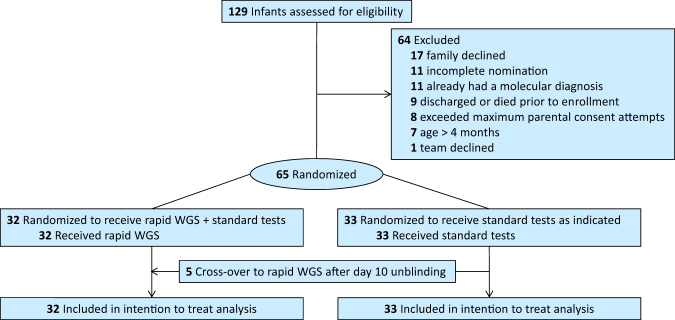
Genetic disorders are a leading cause of morbidity and mortality in infants in neonatal and pediatric intensive care units (NICU/PICU). While genomic sequencing is useful for genetic disease diagnosis, results are usually reported too late to guide inpatient management. We performed an investigator-initiated, partially blinded, pragmatic, randomized, controlled trial to test the hypothesis that rapid whole-genome sequencing (rWGS) increased the proportion of NICU/PICU infants receiving a genetic diagnosis within 28 days. The participants were families with infants aged <4 months in a regional NICU and PICU, with illnesses of unknown etiology. The intervention was trio rWGS. Enrollment from October 2014 to June 2016, and follow-up until November 2016. Of all, 26 female infants, 37 male infants, and 2 infants of undetermined sex were randomized to receive rWGS plus standard genetic tests ( = 32, cases) or standard genetic tests alone ( = 33, controls). The study was terminated early due to loss of equipoise: 73% (24) controls received genomic sequencing as standard tests, and 15% (five) controls underwent compassionate cross-over to receive rWGS. Nevertheless, intention to treat analysis showed the rate of genetic diagnosis within 28 days of enrollment (the primary end-point) to be higher in cases (31%, 10 of 32) than controls (3%, 1 of 33; difference, 28% [95% CI, 10-46%]; = 0.003). Among infants enrolled in the first 25 days of life, the rate of neonatal diagnosis was higher in cases (32%, 7 of 22) than controls (0%, 0 of 23; difference, 32% [95% CI, 11-53%]; = 0.004). Median age at diagnosis (25 days [range 14-90] in cases vs. 130 days [range 37-451] in controls) and median time to diagnosis (13 days [range 1-84] in cases, vs. 107 days [range 21-429] in controls) were significantly less in cases than controls ( = 0.04). In conclusion, rWGS increased the proportion of NICU/PICU infants who received timely diagnoses of genetic diseases.
遗传疾病是新生儿重症监护病房(NICU)和儿科重症监护病房(PICU)中婴儿发病和死亡的主要原因。虽然基因组测序有助于遗传疾病的诊断,但结果报告往往太晚,无法指导住院治疗管理。我们开展了一项由研究者发起的、部分设盲的、务实的、随机对照试验,以检验快速全基因组测序(rWGS)是否能提高NICU/PICU中在28天内获得遗传诊断的婴儿比例这一假设。参与者为地区NICU和PICU中年龄小于4个月、病因不明疾病的婴儿家庭。干预措施为三联体rWGS。于2014年10月至2016年6月进行入组,并随访至2016年11月。共有26名女婴、37名男婴和2名性别未确定的婴儿被随机分组,分别接受rWGS加标准遗传检测(n = 32,病例组)或仅接受标准遗传检测(n = 33,对照组)。由于失去均衡性,该研究提前终止:73%(24名)对照组接受了作为标准检测的基因组测序,15%(5名)对照组接受了同情性交叉治疗以接受rWGS。尽管如此,意向性分析显示,病例组(31%,32例中的10例)在入组后28天内(主要终点)获得遗传诊断的比例高于对照组(3%,33例中的1例;差异为28%[95%CI,10 - 46%];P = 0.003)。在出生后前25天入组的婴儿中,病例组(32%,22例中的7例)的新生儿诊断率高于对照组(0%,23例中的0例;差异为32%[95%CI,11 - 53%];P = 0.004)。病例组的诊断中位年龄(25天[范围14 - 90天])和诊断中位时间(13天[范围1 - 84天])显著低于对照组(分别为130天[范围37 - 451天]和107天[范围21 - 429天];P = 0.04)。总之,rWGS提高了NICU/PICU中及时获得遗传疾病诊断的婴儿比例。