Jongedijk Esmer, van der Klis Frits, de Zwart Rozemarijn, van Es Daan S, Beekwilder Jules
Laboratory of Plant Physiology Wageningen University 6708PB Wageningen The Netherlands.
Wageningen Food and Biobased Research 6708 WG Wageningen The Netherlands.
ChemistryOpen. 2018 Feb 8;7(2):201-203. doi: 10.1002/open.201700178. eCollection 2018 Feb.
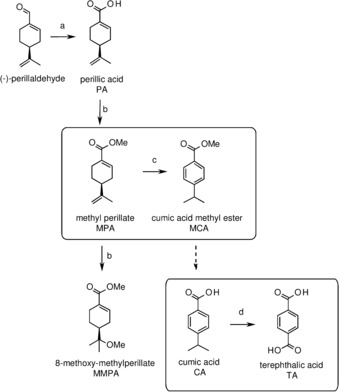
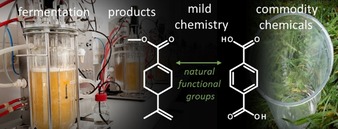
Renewable commodity chemicals can be generated from plant materials. Often abundant materials such as sugars are used for this purpose. However, these lack appropriate functionalities and, therefore, they require extensive chemical modifications before they can be used as commodity chemicals. The plant kingdom is capable of producing an almost endless variety of compounds, including compounds with highly appropriate functionalities, but these are often not available in high quantities. It has been demonstrated that it is possible to produce functionalized plant compounds on a large scale by fermentation in microorganisms. This opens up the potential to exploit plant compounds that are less abundant, but functionally resemble commodity chemicals more closely. To elaborate this concept, we demonstrate the suitability of a highly functionalized plant compound, methyl perillate, as a precursor for the commodity chemical terephthalic acid.
可再生的商品化学品可以从植物材料中生成。通常会使用诸如糖类等丰富的材料来实现这一目的。然而,这些材料缺乏合适的官能团,因此,在它们能够用作商品化学品之前,需要进行大量的化学修饰。植物界能够产生几乎无穷无尽的各种化合物,包括具有高度合适官能团的化合物,但这些化合物的产量往往不高。已经证明,通过微生物发酵大规模生产功能化的植物化合物是可行的。这为开发那些含量较少但在功能上更类似于商品化学品的植物化合物开辟了潜力。为了阐述这一概念,我们证明了一种高度功能化的植物化合物——紫苏酸甲酯,作为商品化学品对苯二甲酸的前体的适用性。