Thapa Dinesh, Cairns Elizabeth A, Szczesniak Anna-Maria, Toguri James T, Caldwell Meggie D, Kelly Melanie E M
Department of Pharmacology, Dalhousie University, Halifax, Nova Scotia, Canada.
Department of Anesthesia, Pain Management, and Perioperative Medicine, Dalhousie University, Halifax, Nova Scotia, Canada.
Cannabis Cannabinoid Res. 2018 Feb 1;3(1):11-20. doi: 10.1089/can.2017.0041. eCollection 2018.
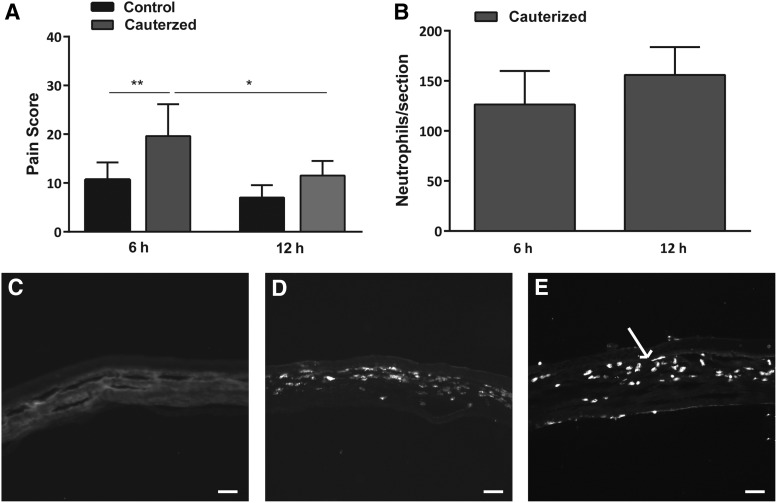
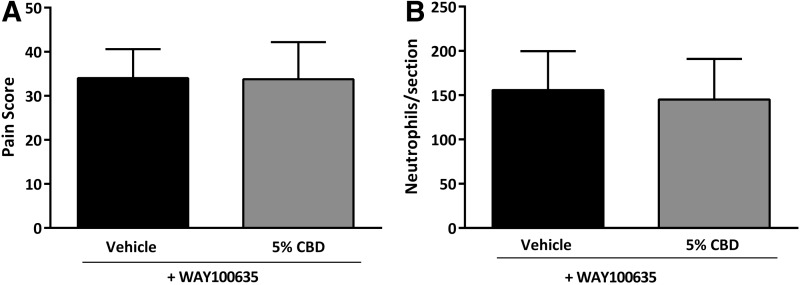
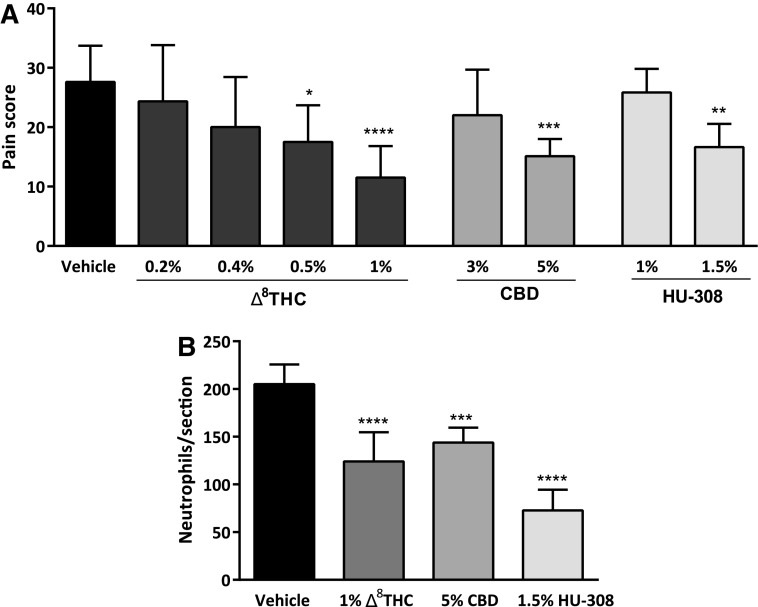
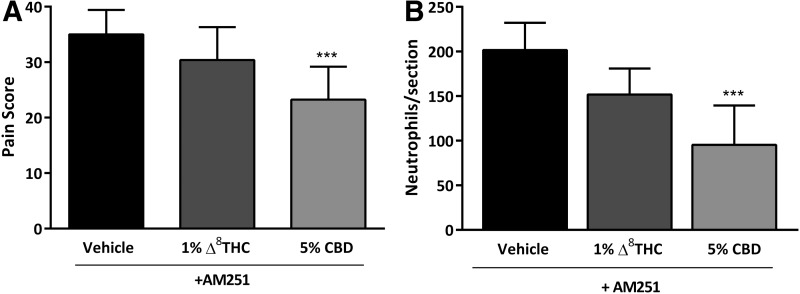
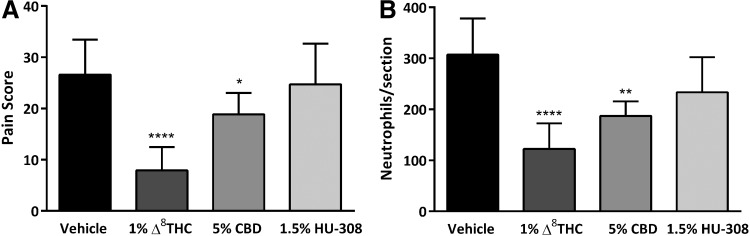
Corneal injury can result in dysfunction of corneal nociceptive signaling and corneal sensitization. Activation of the endocannabinoid system has been reported to be analgesic and anti-inflammatory. The purpose of this research was to investigate the antinociceptive and anti-inflammatory effects of cannabinoids with reported actions at cannabinoid 1 (CBR) and cannabinoid 2 (CBR) receptors and/or noncannabinoid receptors in an experimental model of corneal hyperalgesia. Corneal hyperalgesia (increased pain response) was generated using chemical cauterization of the corneal epithelium in wild-type (WT) and CBR knockout (CBR) mice. Cauterized eyes were treated topically with the phytocannabinoids Δ-tetrahydrocannabinol (ΔTHC) or cannabidiol (CBD), or the CBD derivative HU-308, in the presence or absence of the CBR antagonist AM251 (2.0 mg/kg i.p.), or the 5-HT receptor antagonist WAY100635 (1 mg/kg i.p.). Behavioral pain responses to a topical capsaicin challenge at 6 h postinjury were quantified from video recordings. Mice were euthanized at 6 and 12 h postcorneal injury for immunohistochemical analysis to quantify corneal neutrophil infiltration. Corneal cauterization resulted in hyperalgesia to capsaicin at 6 h postinjury compared to sham control eyes. Neutrophil infiltration, indicative of inflammation, was apparent at 6 and 12 h postinjury in WT mice. Application of ΔTHC, CBD, and HU-308 reduced the pain score and neutrophil infiltration in WT mice. The antinociceptive and anti-inflammatory actions of ΔTHC, but not CBD, were blocked by the CBR antagonist AM251, but were still apparent, for both cannabinoids, in CBR mice. However, the antinociceptive and anti-inflammatory actions of HU-308 were absent in the CBR mice. The antinociceptive and anti-inflammatory effects of CBD were blocked by the 5-HT antagonist WAY100635. Topical cannabinoids reduce corneal hyperalgesia and inflammation. The antinociceptive and anti-inflammatory effects of ΔTHC are mediated primarily via CBR, whereas that of the cannabinoids CBD and HU-308, involve activation of 5-HT receptors and CBRs, respectively. Cannabinoids could be a novel clinical therapy for corneal pain and inflammation resulting from ocular surface injury.
角膜损伤可导致角膜伤害性信号传导功能障碍和角膜致敏。据报道,内源性大麻素系统的激活具有镇痛和抗炎作用。本研究的目的是在角膜痛觉过敏的实验模型中,研究对大麻素1(CBR1)和大麻素2(CBR2)受体及/或非大麻素受体有作用的大麻素的抗伤害感受和抗炎作用。通过对野生型(WT)和CBR基因敲除(CBR-/-)小鼠的角膜上皮进行化学烧灼来产生角膜痛觉过敏(疼痛反应增强)。在有或没有CBR拮抗剂AM251(2.0mg/kg腹腔注射)或5-羟色胺受体拮抗剂WAY100635(1mg/kg腹腔注射)的情况下,对烧灼的眼睛局部应用植物大麻素Δ-四氢大麻酚(ΔTHC)或大麻二酚(CBD),或CBD衍生物HU-308。在损伤后6小时,根据视频记录对局部应用辣椒素刺激的行为性疼痛反应进行量化。在角膜损伤后6小时和12小时对小鼠实施安乐死,进行免疫组织化学分析以量化角膜中性粒细胞浸润。与假手术对照眼相比,角膜烧灼在损伤后6小时导致对辣椒素的痛觉过敏。在WT小鼠损伤后6小时和12小时,可见指示炎症的中性粒细胞浸润。应用ΔTHC、CBD和HU-308可降低WT小鼠的疼痛评分和中性粒细胞浸润。ΔTHC的抗伤害感受和抗炎作用被CBR拮抗剂AM251阻断,但对于两种大麻素来说,在CBR-/-小鼠中仍然明显。然而,HU-308的抗伤害感受和抗炎作用在CBR-/-小鼠中不存在。CBD的抗伤害感受和抗炎作用被5-羟色胺拮抗剂WAY100635阻断。局部应用大麻素可减轻角膜痛觉过敏和炎症。ΔTHC的抗伤害感受和抗炎作用主要通过CBR1介导,而大麻素CBD和HU-308的作用分别涉及5-羟色胺受体和CBR1的激活。大麻素可能是治疗眼表损伤引起的角膜疼痛和炎症的一种新型临床疗法。