Division of Systems Biomedicine and Pharmacology, Leiden Academic Centre for Drug Research, Leiden University, Einsteinweg 55, 2333 CC, Leiden, The Netherlands.
Pharm Res. 2018 Feb 15;35(3):64. doi: 10.1007/s11095-017-2333-x.
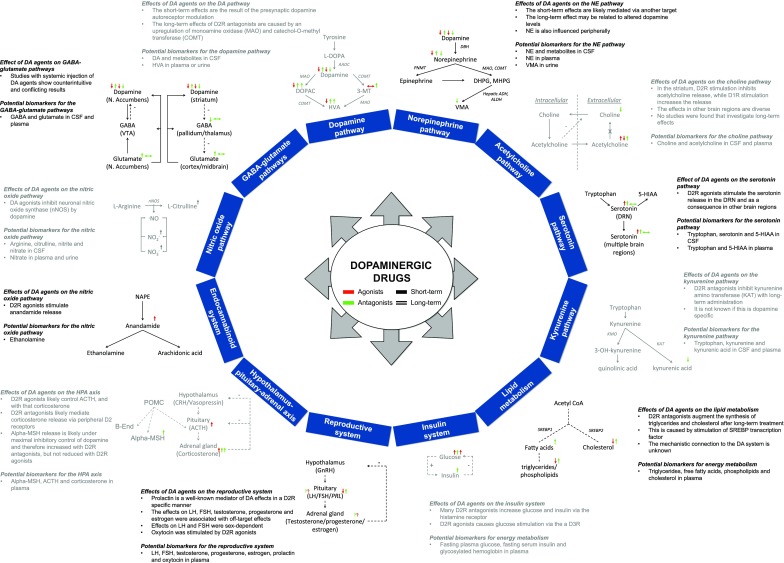
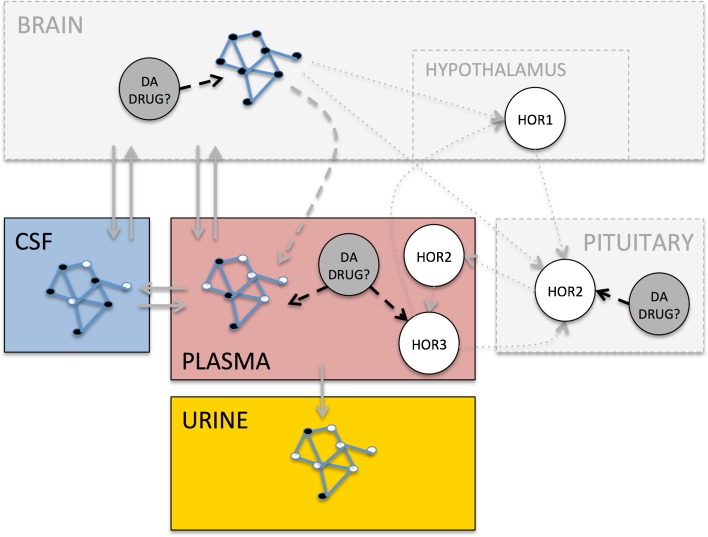
Despite substantial research carried out over the last decades, it remains difficult to understand the wide range of pharmacological effects of dopaminergic agents. The dopaminergic system is involved in several neurological disorders, such as Parkinson's disease and schizophrenia. This complex system features multiple pathways implicated in emotion and cognition, psychomotor functions and endocrine control through activation of G protein-coupled dopamine receptors. This review focuses on the system-wide effects of dopaminergic agents on the multiple biochemical and endocrine pathways, in particular the biomarkers (i.e., indicators of a pharmacological process) that reflect these effects. Dopaminergic treatments developed over the last decades were found to be associated with numerous biochemical pathways in the brain, including the norepinephrine and the kynurenine pathway. Additionally, they have shown to affect peripheral systems, for example the hypothalamus-pituitary-adrenal (HPA) axis. Dopaminergic agents thus have a complex and broad pharmacological profile, rendering drug development challenging. Considering the complex system-wide pharmacological profile of dopaminergic agents, this review underlines the needs for systems pharmacology studies that include: i) proteomics and metabolomics analysis; ii) longitudinal data evaluation and mathematical modeling; iii) pharmacokinetics-based interpretation of drug effects; iv) simultaneous biomarker evaluation in the brain, the cerebrospinal fluid (CSF) and plasma; and v) specific attention to condition-dependent (e.g., disease) pharmacology. Such approach is considered essential to increase our understanding of central nervous system (CNS) drug effects and substantially improve CNS drug development.
尽管在过去几十年中进行了大量研究,但仍然难以理解多巴胺能药物的广泛药理学效应。多巴胺能系统涉及多种神经疾病,如帕金森病和精神分裂症。这个复杂的系统通过激活 G 蛋白偶联多巴胺受体,涉及到情感和认知、精神运动功能和内分泌控制的多个途径。这篇综述重点介绍了多巴胺能药物对多种生化和内分泌途径的系统范围影响,特别是反映这些影响的生物标志物(即药理学过程的指标)。研究发现,过去几十年开发的多巴胺能治疗方法与大脑中的许多生化途径有关,包括去甲肾上腺素和犬尿氨酸途径。此外,它们还显示出对周围系统的影响,例如下丘脑-垂体-肾上腺 (HPA) 轴。因此,多巴胺能药物具有复杂而广泛的药理学特性,这使得药物开发具有挑战性。考虑到多巴胺能药物的复杂系统范围的药理学特性,本综述强调了系统药理学研究的必要性,包括:i)蛋白质组学和代谢组学分析;ii)纵向数据分析和数学建模;iii)基于药代动力学的药物效应解释;iv)同时在大脑、脑脊液 (CSF) 和血浆中评估生物标志物;v)特别关注条件依赖性(例如疾病)药理学。这种方法被认为对于增加我们对中枢神经系统 (CNS) 药物效应的理解并大大改善 CNS 药物开发至关重要。