El Sagheer Ghada, Soliman Elwy, Ahmad Asmaa, Hamdy Lamiaa
a Endocrinology Unit, Department of Internal Medicine, Minia School of Medicine , Minia University , Minia , Egypt.
b Hepatology Unit, Department of Internal Medicine, Minia School of Medicine , Minia University , Minia , Egypt.
Libyan J Med. 2018 Dec;13(1):1435124. doi: 10.1080/19932820.2018.1435124.
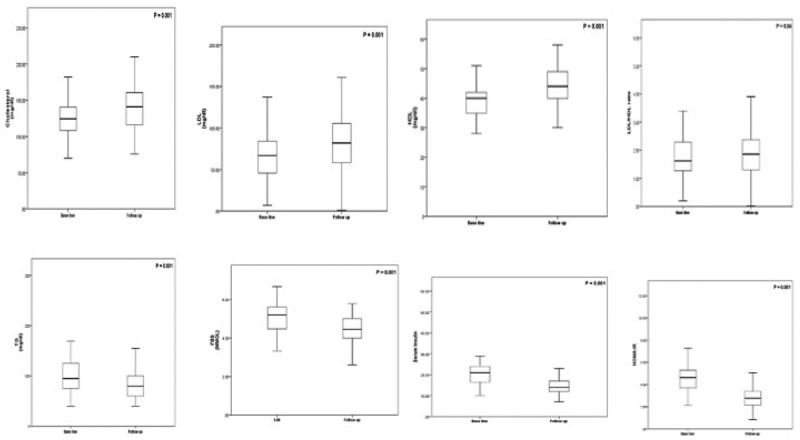
Chronic hepatitis C virus (HCV) infection is associated with altered metabolism, including dyslipidemia and insulin resistance. These contribute to disease progression and influences the response to therapy. To investigate the relationships of new direct-acting antiviral drugs, simeprevir/sofosbuvir, with lipid profile and insulin resistance (IR). Eighty chronic hepatitis C genotype 4 patients were included; they were divided into four groups according to the severity of fibrosis as detected by fibroscan. Forty healthy persons volunteered as a control group. Lipid profile changes and IR were analyzed at baseline and after the end of treatment, and any effect of these changes on the response to treatment was studied. Before treatment, the levels of serum triglycerides were significantly higher in patients than in the control, and the levels of fasting insulin showed a progressive increase with advancing stage of fibrosis. At the end of treatment, there were a significant reduction in serum triglycerides, FBS, fasting insulin, and homeostasis model for the assessment of IR (P < 0.001), and a significant elevation of serum cholesterol and low-density lipoprotein (LDL)-c, high-density lipoprotein (HDL)-c, and LDL/HDL ratio (P = 0.001). An end-of-treatment response (week 12) was achieved in (99%) of the treated cases with 99% sustained viral response for 12 weeks post-treatment (week 24). Significant lipid profile changes were detected at the end of treatment. Serum lipid levels and IR are no longer predictors of response to DAAs. Follow-up of the lipid profile is warranted to avoid any possible remote effect of atherosclerotic heart disease.
慢性丙型肝炎病毒(HCV)感染与代谢改变有关,包括血脂异常和胰岛素抵抗。这些因素会导致疾病进展并影响治疗反应。为了研究新型直接作用抗病毒药物simeprevir/sofosbuvir与血脂谱和胰岛素抵抗(IR)之间的关系。纳入了80例慢性丙型肝炎基因4型患者;根据FibroScan检测到的纤维化严重程度将他们分为四组。40名健康人自愿作为对照组。在基线和治疗结束后分析血脂谱变化和IR,并研究这些变化对治疗反应的任何影响。治疗前,患者血清甘油三酯水平显著高于对照组,空腹胰岛素水平随纤维化进展呈逐渐升高趋势。治疗结束时,血清甘油三酯、空腹血糖、空腹胰岛素以及评估IR的稳态模型均显著降低(P<0.001),血清胆固醇、低密度脂蛋白(LDL)-c、高密度脂蛋白(HDL)-c以及LDL/HDL比值显著升高(P = 0.001)。99%的治疗病例在治疗结束时(第12周)获得了治疗反应,治疗后12周(第24周)有99%的持续病毒学反应。治疗结束时检测到显著的血脂谱变化。血清脂质水平和IR不再是对直接作用抗病毒药物反应的预测指标。有必要对血脂谱进行随访,以避免动脉粥样硬化性心脏病的任何可能远期影响。