Hashimoto Satoru, Yatsuhashi Hiroshi, Abiru Seigo, Yamasaki Kazumi, Komori Atsumasa, Nagaoka Shinya, Saeki Akira, Uchida Shinjiro, Bekki Shigemune, Kugiyama Yuki, Nagata Kazuyoshi, Nakamura Minoru, Migita Kiyoshi, Nakao Kazuhiko
Clinical Research Center, National Hospital Organization (NHO) Nagasaki Medical Center, Nagasaki University Graduate School of Biomedical Sciences, Nagasaki, Japan.
Department of Gastroenterology and Hepatology, Graduate School of Biomedical Sciences, Nagasaki University, Nagasaki, Japan.
PLoS One. 2016 Sep 28;11(9):e0163644. doi: 10.1371/journal.pone.0163644. eCollection 2016.
BACKGROUND & AIM: We performed lipid analyses at the early period of therapy in patients with chronic hepatitis C who underwent interferon (IFN)-free direct-acting antiviral (DAA) treatment, and we attempted to identify the factors that contributed to a rapid increase in the patients' serum low-density lipoprotein cholesterol (LDL-C) concentration.
We retrospectively analyzed the cases of 100 consecutive patients with HCV infection treated at the National Hospital Organization Nagasaki Medical Center: 24 patients underwent daclatasvir (DCV) and asunaprevir (ASV) combination therapy (DCV/ASV) for 24 weeks, and the other 76 patients underwent ledipasvir and sofosbuvir combination therapy (LDV/SOF) for 12 weeks. ΔLDL-C was defined as the changed in LDL-C level at 28 days from the start of therapy. To determine whether ΔLDL-C was associated with several kinds of factors including viral kinetics, we performed a stepwise multiple linear regression analysis.
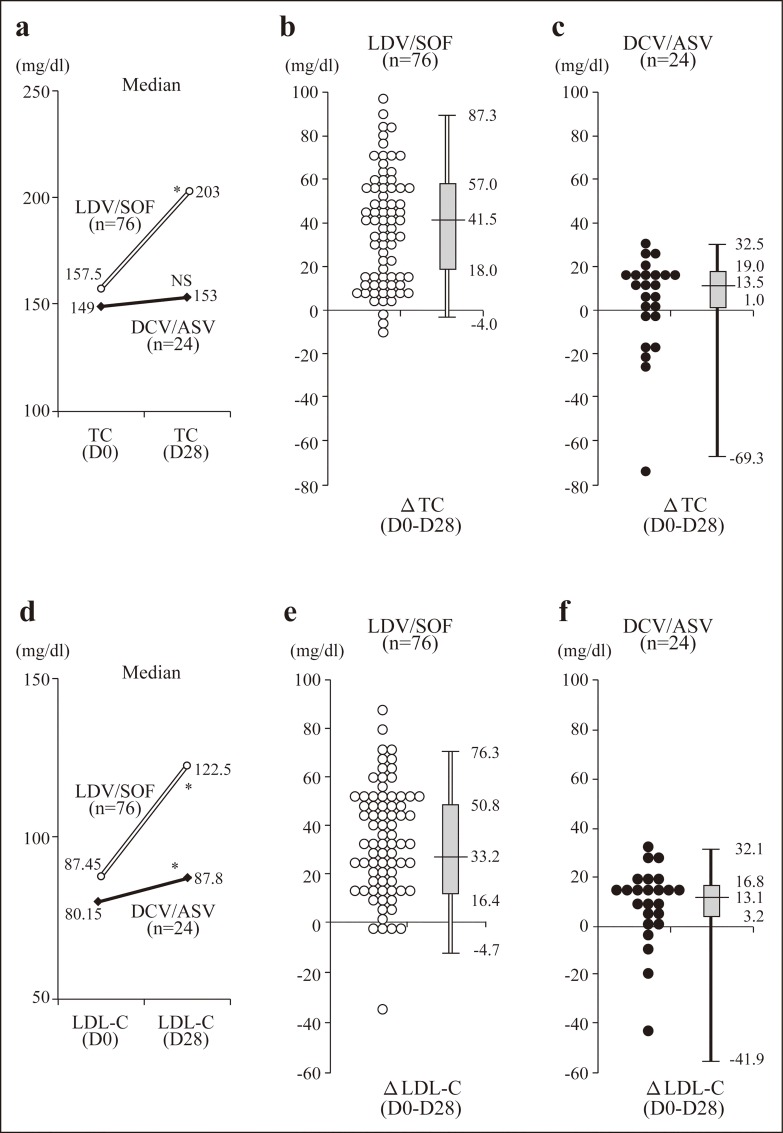
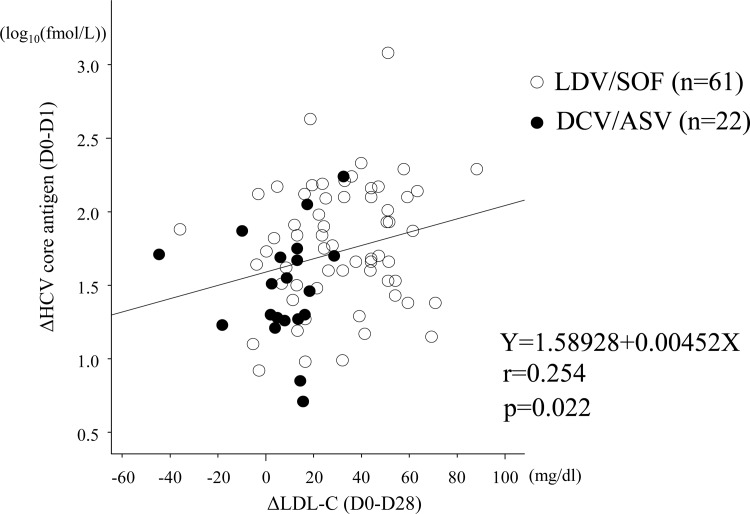
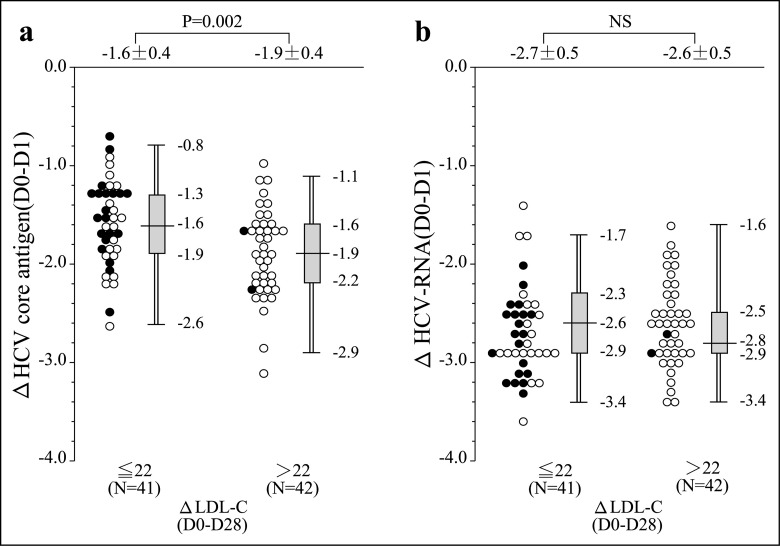
The LDL-C levels in patients treated with LDV/SOF were markedly and significantly elevated (87.45 to 122.5 mg/dl; p<10-10) compared to those in the DCV/ASV-treated patients (80.15 to 87.8 mg/dl; p = 0.0056). The median levels of ΔLDL-C in the LDV/SOF and DCV/ASV groups were 33.2 and 13.1, respectively. LDV/SOF combination therapy as an IFN-free regimen (p<0.001) and ΔHCV core antigen (0-1 day drop) (p<0.044) were identified as independent factors that were closely related to the ΔLDL-C.
A rapid increase in the serum LDL-C concentration during the IFN-free treatment of hepatitis C was associated with the type of HCV therapy and a decline of HCV core protein.
我们对接受无干扰素直接抗病毒(DAA)治疗的慢性丙型肝炎患者在治疗早期进行了血脂分析,并试图确定导致患者血清低密度脂蛋白胆固醇(LDL-C)浓度快速升高的因素。
我们回顾性分析了长崎医疗中心国立医院连续治疗的100例丙型肝炎病毒(HCV)感染患者的病例:24例患者接受了24周的达卡他韦(DCV)和阿舒瑞韦(ASV)联合治疗(DCV/ASV),另外76例患者接受了12周的来迪派韦和索磷布韦联合治疗(LDV/SOF)。ΔLDL-C定义为治疗开始后28天LDL-C水平的变化。为了确定ΔLDL-C是否与包括病毒动力学在内的多种因素相关,我们进行了逐步多元线性回归分析。
与接受DCV/ASV治疗的患者(80.15至87.8mg/dl;p = 0.0056)相比,接受LDV/SOF治疗的患者的LDL-C水平显著升高(87.45至122.5mg/dl;p<10-10)。LDV/SOF组和DCV/ASV组的ΔLDL-C中位数水平分别为33.2和13.1。LDV/SOF联合治疗作为一种无干扰素方案(p<0.001)和ΔHCV核心抗原(0 - 1天下降)(p<0.044)被确定为与ΔLDL-C密切相关的独立因素。
丙型肝炎无干扰素治疗期间血清LDL-C浓度的快速升高与HCV治疗类型和HCV核心蛋白的下降有关。